
How to Write a Lease Addendum That Holds Up
Marcus Vance / Payroll Operations Editor
Reviewed by: Reviewed by the Paystub Generator Editorial Team
Legal Reviewer
Last Updated: August 29, 2026
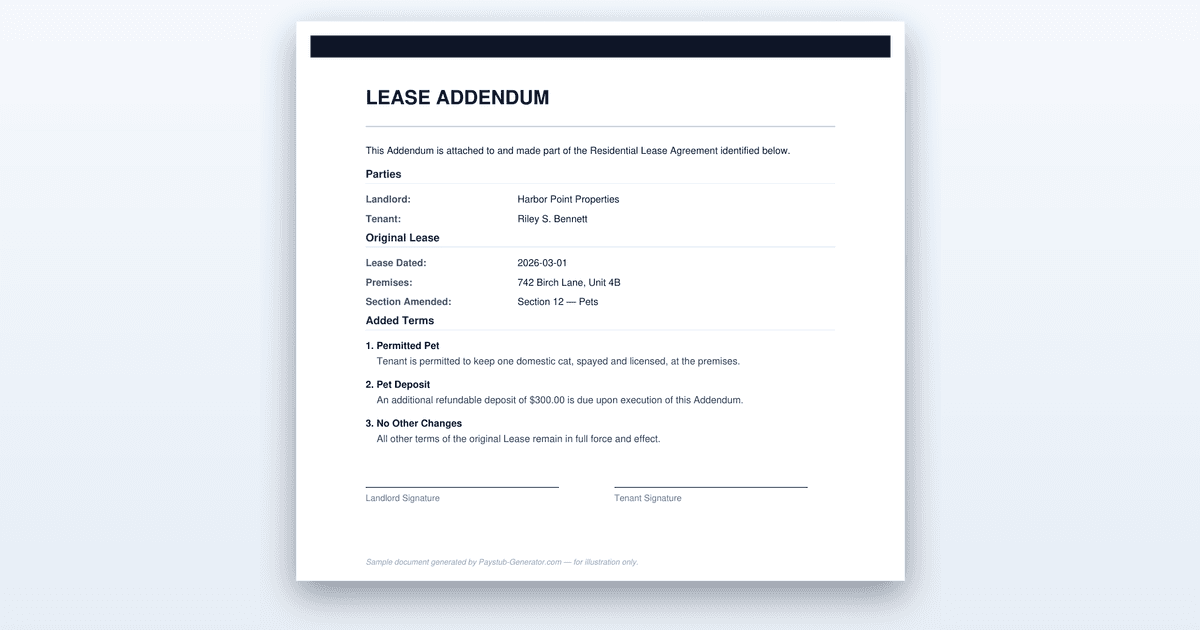
Six steps to a lease addendum that survives a dispute: addendum or amendment, referencing the lease, required disclosures, and signing it properly.
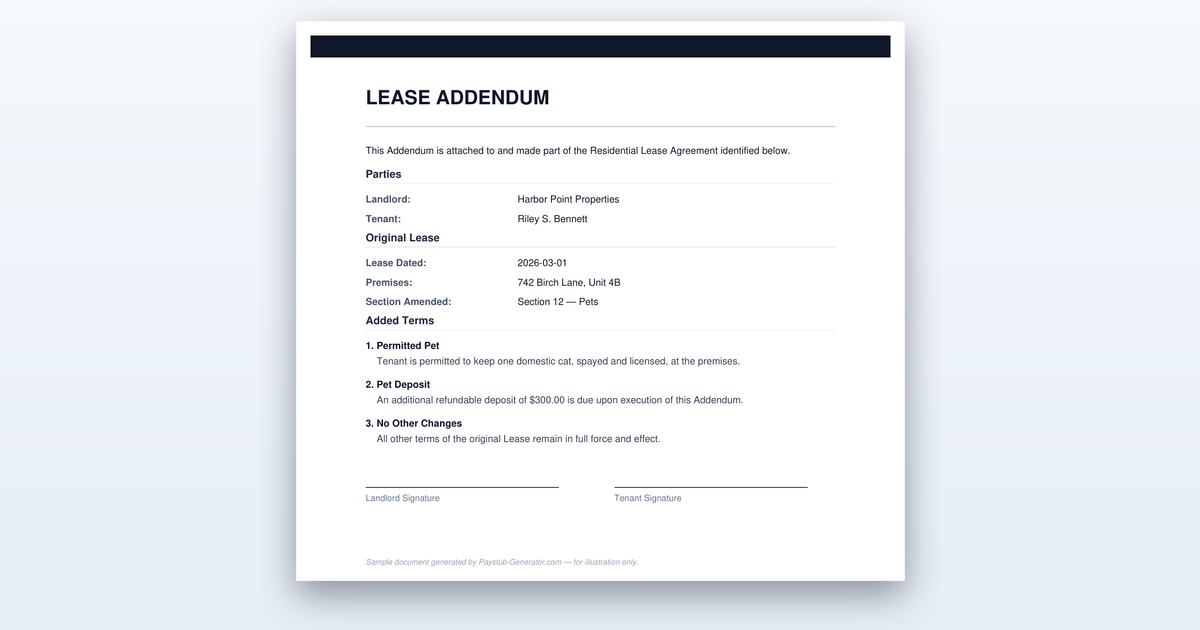
Short on time? You can also create the document you need in just a couple of minutes.
Key Takeaways
- •An addendum adds new terms; an amendment changes existing ones, and the distinction matters when a dispute reaches a judge.
- •Every addendum should name the original lease by date, address, and parties.
- •A clause confirming the rest of the lease is unchanged prevents an argument about scope.
- •Pet, smoking, and lead paint addenda often carry mandatory disclosures that the addendum itself is void without.
How to Write a Lease Addendum That Holds Up in Court
Drafting an enforceable lease addendum takes six steps: confirm an addendum is the right document, anchor it to a specific clause in the original lease, write the new term in plain language, state the rest of the lease remains unchanged, attach any required state disclosures, and collect every original party's signature. The drafting itself takes about thirty minutes, but the signing process can stretch across a few days when co-tenants or guarantors are involved. The job is finished when every signer holds a complete copy of the original lease plus the addendum.
Before You Start
You need three things in hand before you write a single word. First, the fully signed original lease, and you need to know which clause you are changing by its section number. Second, the exact legal names of every party who signed that original document, spelled precisely as they appear on the signature page. Third, a firm agreement on the change itself — if you and the other party are still negotiating the terms, you are not ready to draft, and any document you produce now will just be rewritten.
You also need to know whether your state imposes a disclosure requirement for the subject you are adding. Pet addenda, smoking bans, lead paint disclosures, and utility allocation agreements all carry state-specific rules in many jurisdictions. If you start drafting without checking your state's landlord-tenant code or your local housing authority's rules, you may produce a document that looks fine but is legally void on the specific term you added. This is general information, not legal advice, so verify the disclosure rules for your state before you commit anything to paper.
Step-by-Step: Drafting an Enforceable Lease Addendum
Step 1: Decide whether you need an addendum, an amendment, or a new lease
The first decision is the one most people get wrong. An addendum adds a new term the original lease never covered — a pet policy, a parking rule, a smoking prohibition. An amendment changes a term that already exists — raising the rent, extending the lease term, changing the notice address. The distinction matters because when a dispute reaches a judge, the court looks at what the document says it does, and a document that tries to do both invites an argument about which part controls.
You should consider a new lease instead of either document when the change is substantial enough to alter the fundamental deal. If you are changing the property itself, swapping one tenant for another, or rewriting the rent structure entirely, a new lease is cleaner. A patchwork of addenda on top of a heavily modified original lease becomes hard to read, and ambiguity is your enemy in enforcement.
You know the step worked when you can state in one sentence what the document does: "This adds a pet policy" or "This changes the rent amount." If you cannot say it that simply, you have the wrong instrument.
Step 2: Identify the exact clause and lease you are attaching to
Every enforceable addendum names its parent lease with precision. Open the document with a line identifying the original lease by its date, the full property address, and the names of the parties exactly as they appear on the signature page. Then cite the section number you are adding to or replacing. A floating addendum that says "attached to the lease between John and Mary" without a date or address is difficult to enforce because a court cannot be certain which lease it modifies.
This step is where sloppy drafting creates real risk. If you have multiple leases with the same tenant — say, one for a house and one for a storage unit — and your addendum does not specify which property it covers, the tenant can plausibly argue it applies to neither or to the wrong one. Write the property address into the first sentence of the addendum, and reference the specific clause number you are changing.
You know the step worked when someone reading only the addendum, with no other documents, can identify the exact lease and the exact section it touches.
Step 3: Write the new term in plain, specific language
State exactly what changes, when it takes effect, and what happens if the term is breached. Use numbers and dates, not adjectives. "Tenant may keep one cat under fifteen pounds" is enforceable. "Tenant may keep a small pet" invites a dispute over what "small" means. If the addendum adds a fee, state the dollar amount, the due date, and the method of payment. If it changes a deadline, give the exact date the new rule takes effect.
The judgment call here is how much detail to include. Overly vague language is unenforceable, but a document so dense with conditions that it reads like a regulation is also a problem — it becomes hard for a tenant to understand their obligation, and a court may read ambiguities against the drafter, who is usually the landlord. Write the term the way you would explain it to a reasonable person over the phone, then put that explanation in writing.
You know the step worked when you can read the addendum aloud to someone who has never seen the lease, and they can tell you what the new rule is without asking a clarifying question.
Step 4: State that the rest of the lease is unchanged
Include a line confirming that all other terms of the original lease remain in full force and effect. This single sentence prevents a common and costly argument. Without it, a tenant can claim the addendum superseded or replaced more than it was meant to, and you will spend time and money litigating the scope of a one-page document.
The standard language is simple: "Except as modified by this Addendum, all other terms and conditions of the Lease dated [date] remain in full force and effect." Put this sentence near the end of the addendum, just above the signature block. It costs you nothing to include and protects the entire original agreement from being dragged into a dispute about what the addendum changed.
You know the step worked when the addendum, read as a whole, clearly modifies one section and leaves the rest untouched.
Step 5: Add any disclosure the subject requires
Pet, smoking, mold, lead paint, and utility allocation addenda frequently carry state or federal disclosure requirements. The federal Lead-Based Paint Disclosure applies to housing built before 1978, and many states have their own pet deposit rules, smoking restrictions, and mold disclosure forms. Adding the term without the required disclosure can void the term itself, which means you could have a pet policy that looks signed and official but is legally unenforceable.
This is the step where you must check your state's rules rather than guess. Your state's labor department, housing authority, or attorney general's website will have the specific disclosure language required for the subject you are adding. Some disclosures must be a separate document; others can be incorporated into the addendum itself. The cost of checking is ten minutes online. The cost of skipping it is a void term and a tenant who knows their rights.
You know the step worked when you have confirmed that your addendum either includes the required disclosure language or is accompanied by the required separate disclosure form.
Step 6: Get every original party to sign and date it
Every person who signed the original lease signs the addendum — including co-tenants and guarantors. A guarantor who signed the original lease is still on the hook for the tenant's obligations, and if the addendum changes the tenant's obligations, the guarantor needs to acknowledge the change. If a co-tenant does not sign, they can argue the new term does not apply to them, which creates a mess when you try to enforce it against one tenant but not the other.
Have each party sign and date the addendum, and make sure the signatures match the names on the original lease. Then attach the addendum to the original lease, keeping them physically together, and give each party a complete copy of the lease with the addendum included. Do not rely on email attachments alone — provide a physical or clearly labeled digital copy that shows both documents together.
You know the step worked when every original signer has signed, and every party holds a copy of the lease with the addendum attached.
Where People Get This Wrong
The most common failure is using an addendum when an amendment was needed. A landlord who writes "Addendum to Lease" at the top of a document that raises the rent has created a document that contradicts the original lease's rent clause, and the tenant can argue the original rent still applies. The fix is to label the document accurately and state whether it adds a new term or modifies an existing one.
The second failure is forgetting the guarantor's signature. A landlord adds a pet policy, the tenant signs, and the guarantor never sees the document. When the pet causes damage and the tenant cannot pay, the guarantor argues they never agreed to the pet policy, and the landlord is left pursuing a tenant with no money. The fix is to treat the addendum like the original lease — every signer signs.
The third failure is skipping the state disclosure. A landlord in a state with a mandatory mold disclosure form adds a mold waiver clause to the addendum, the tenant signs, and the clause is void because the state requires a specific separate disclosure. The tenant's attorney finds the omission, and the entire addendum is challenged. The fix is to check your state's rules before you draft, not after.
The fourth failure is sloppy identification. An addendum that says "attached to the lease" without naming the date, address, and parties is nearly worthless in court. When the tenant has two leases with the same landlord, the ambiguity makes the addendum unenforceable against either. The fix is the one-sentence identification in Step 2, which takes thirty seconds to write.
Worked Example
Let me walk you through a realistic scenario. This is an example, not your numbers. Marcus rents a two-bedroom apartment at 412 Elm Street from Priya. The original lease was signed on January 15, 2024, for a one-year term, and the lease's Section 7 covers pets with a flat "no pets" clause. In June, Marcus asks Priya if he can adopt a cat. Priya agrees, but she wants a $300 non-refundable pet fee and a rule that the cat must be indoors at all times.
Priya starts with Step 1. She is adding a pet policy where none existed — the original lease says no pets, so there is no existing pet term to modify. She correctly decides this is an addendum, not an amendment. She opens the document with the Step 2 identification: "This Addendum is attached to and modifies the Lease Agreement dated January 15, 2024, between Priya Shah (Landlord) and Marcus Webb (Tenant), for the property at 412 Elm Street, regarding Section 7 of the Lease."
For Step 3, Priya writes: "Effective July 1, 2024, Tenant may keep one domestic cat, under fifteen pounds, indoors at all times. Tenant agrees to pay a non-refundable pet fee of $300, due with the July rent payment. Tenant is responsible for all damage caused by the cat beyond normal wear and tear." She includes the Step 4 clause: "Except as modified by this Addendum, all other terms and conditions of the Lease remain in full force and effect."
For Step 5, Priya checks her state's housing authority website and finds no separate pet disclosure form required in her state, but she confirms the lead paint disclosure is not needed because the building was built in 2005. She proceeds without an additional form. For Step 6, she sends the addendum to Marcus, who signs and dates it July 1, 2024. Priya signs the same day. There is no guarantor on the original lease, so no third signature is needed. Priya attaches the addendum to the original lease, scans both documents into one PDF, and emails the combined file to Marcus.
The result is an enforceable addendum that names the exact lease, specifies the new pet term, preserves the rest of the agreement, and carries both signatures. If Marcus later lets the cat roam outdoors, Priya has a clear, signed rule to enforce.
When to Get Professional Help
If the change involves a rent increase governed by rent control or rent stabilization, a transfer of the lease to a new tenant, a change that affects a guarantor's liability in a significant way, or any situation where the other party is represented by an attorney, get professional help. A landlord-tenant attorney in your state can review the addendum for a few hundred dollars, and that cost is trivial compared to the expense of litigating an unenforceable document. If you are a tenant and the landlord hands you an addendum mid-lease, have an attorney or a local tenant rights organization review it before you sign — you are agreeing to new obligations, and you should understand exactly what you are accepting.
The Bottom Line
A lease addendum holds up when it names the exact lease, states the new term in specific language, confirms the rest of the agreement stands, includes any required disclosures, and carries every original party's signature. The drafting takes half an hour, but the discipline of following all six steps is what makes the document enforceable when it matters.
Frequently Asked Questions
What is the difference between a lease addendum and an amendment?
An addendum adds a term the lease did not previously cover. An amendment modifies a term that is already in the lease. Both need every original party's signature.
Does a lease addendum need to be notarized?
Usually not. Leases and their addenda are generally valid on signature alone, though a few states require notarization for very long terms. Notarizing does no harm if there is any doubt.
Can a landlord add an addendum without the tenant agreeing?
No. An addendum is a contract change and requires the agreement and signature of every party to the original lease.
Authoritative References
The rules described here come from the agencies that set them. Check the current text before you rely on a deadline or a figure:
Related Guides
- Arizona 5-Day Notice to Pay or Quit: Rules and Timing
- California Residential Lease Agreement Template (2026 PDF)
- Eviction Notice for Nonpayment of Rent: State-by-State Guide
- How to Serve an Eviction Notice Correctly
- How to Screen a Tenant: A Landlord's Step-by-Step Process
Sources: Paystub-Generator.com editorial team. This guide is informational and not legal or tax advice.
This guide is part of our Rental Documents service — lease agreements, rent receipts and notices.
Explore Rental DocumentsRental Forms Knowledge Hub
Explore our suite of legally reviewed templates in the Rental category.
Citations & Legal Sources
- Paystub-Generator.com editorial team

