Payroll is far more than transferring wages on a fixed schedule. Every pay cycle produces a paper trail — wage statements, withholding elections, contractor intake forms, and year-end summaries — that federal and state agencies expect to be accurate, consistent, and retrievable on demand. Whether you manage a growing team or pay yourself as a business owner, mastering these core documents protects you from audits, penalty assessments, and disputes with workers over compensation.
This hub centralizes every payroll document our platform generates. Below, we walk through when each form applies, who is responsible for issuing it, and how the documents connect across the employment lifecycle — from the first day of onboarding to the final year-end filing.
1. Wage Statements: The Foundation of Every Pay Cycle
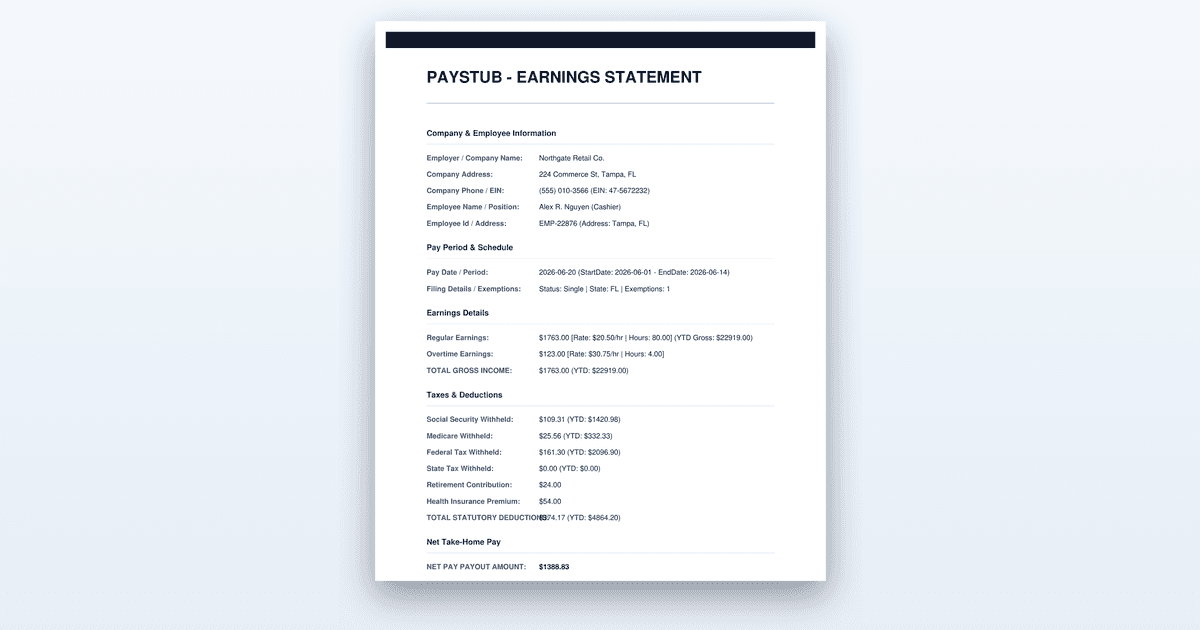
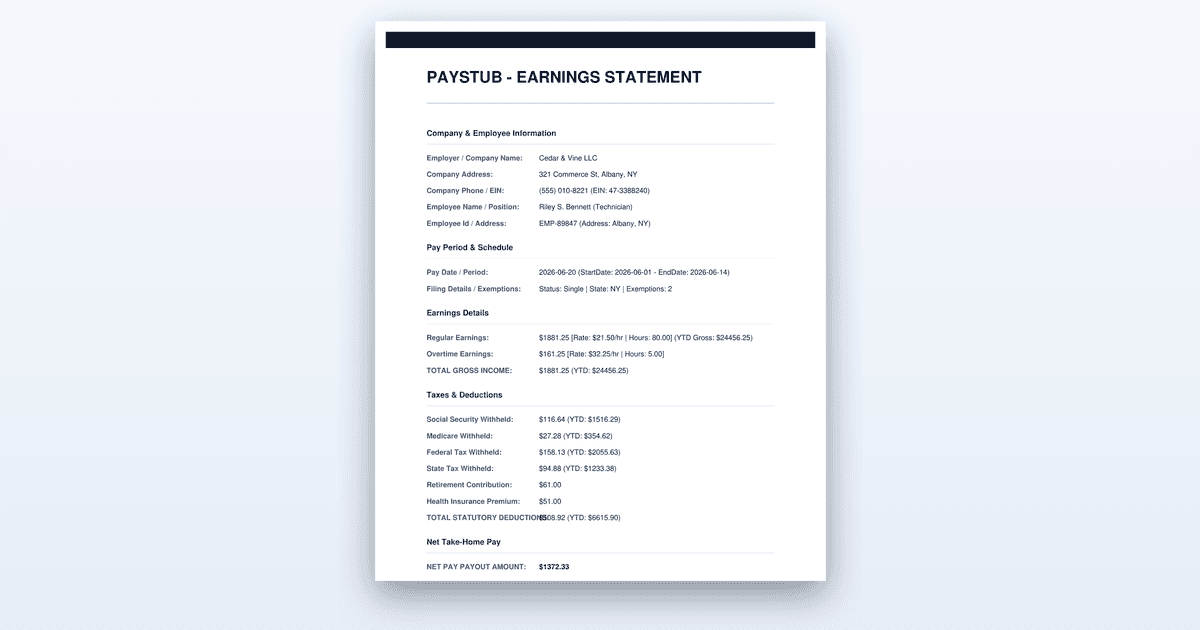
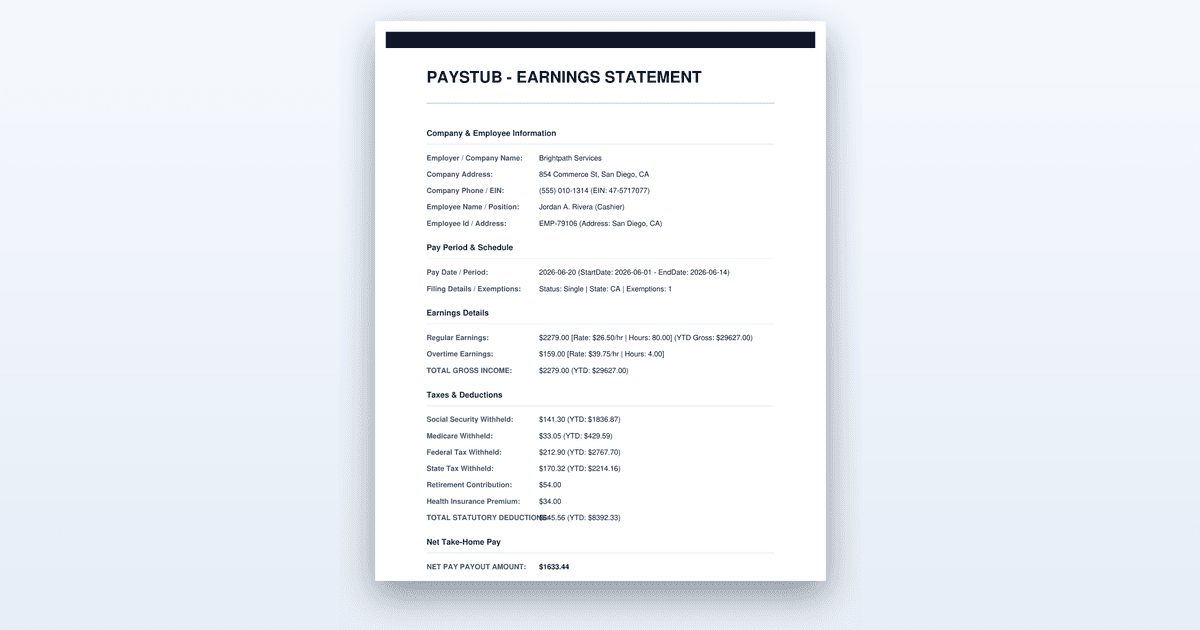
A pay stub documents exactly how a single paycheck was calculated: gross earnings, each tax withheld, voluntary deductions such as retirement or health premiums, and the resulting net pay. Most states require employers to furnish an itemized wage statement with every payment, and even where it is optional, lenders, landlords, and government programs routinely request recent stubs as proof of income.
Accurate stubs depend on accurate math. Federal FICA withholding combines Social Security (6.2%) and Medicare (1.45%), layered on top of federal and state income tax withholding that varies with each employee's elections. Our pay stub generator applies current-year rates automatically, so gross-to-net calculations reconcile to the penny on every document you issue.
2. Year-End Wage Reporting with Form W-2
Every employer must issue a Form W-2 to each employee by January 31, summarizing the full year's wages, federal and state withholding, and Social Security and Medicare contributions. The totals on the W-2 must reconcile with the cumulative figures on the employee's pay stubs — discrepancies between the two are a common trigger for amended filings and employee disputes.
Because the W-2 feeds directly into each worker's personal tax return, formatting and box-level accuracy matter. Review our W-2 template library to see how each box maps to payroll totals, then generate compliant statements with the W-2 creator.
3. Paying Independent Contractors: Form 1099-NEC and Form W-9
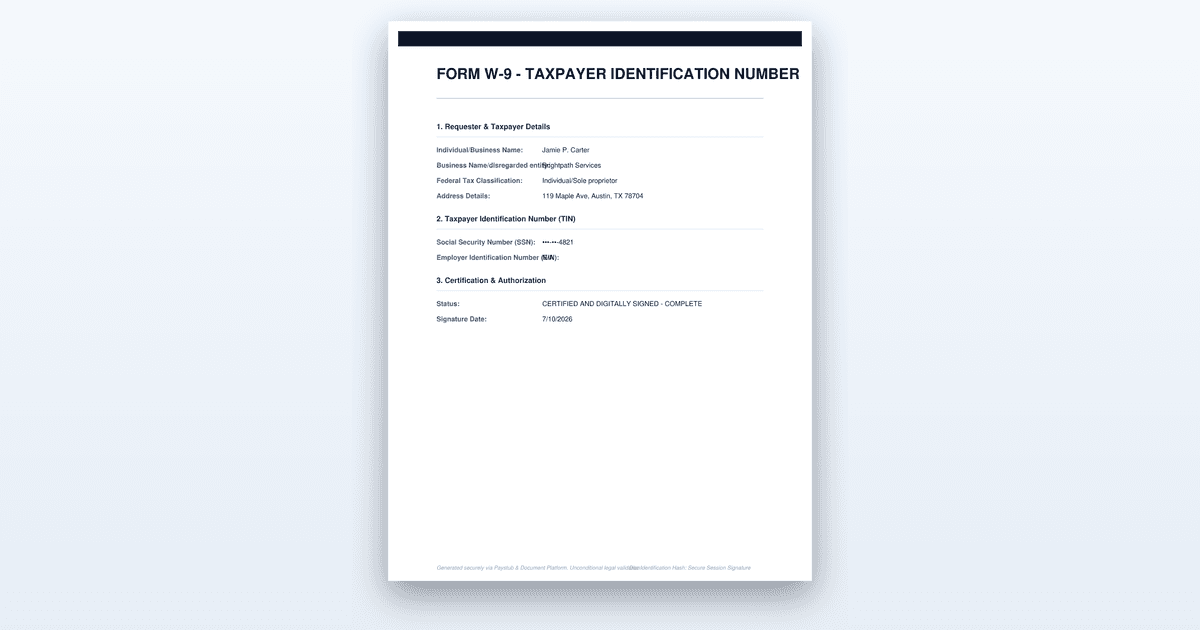
Contractors sit outside the payroll withholding system, but they generate documentation obligations of their own. Before issuing any payment, collect a completed Form W-9 recording the contractor's Taxpayer Identification Number — skipping this step can force you into automatic backup withholding. Then, when annual payments cross the IRS reporting threshold, report the total on Form 1099-NEC.
The IRS scrutinizes worker classification closely, weighing behavioral control, financial independence, and the permanency of the relationship. Maintaining clean W-9 and 1099-NEC records for every contractor demonstrates that your classifications are deliberate rather than accidental — the strongest defense in a misclassification review.
4. Onboarding and Withholding Elections: Form W-4
Every new employee must complete a Form W-4 before their first paycheck. The modern W-4 replaced allowance counts with direct dollar-amount adjustments for dependents, multiple jobs, and extra withholding — inputs your payroll process must translate into per-period tax figures.
Employees should revisit their W-4 after major life changes such as marriage, a new dependent, or a second income. As the employer, retaining the current signed W-4 on file for each worker is what justifies the withholding shown on every stub you issue. Prepare compliant elections with our W-4 form creator.
5. State Rules, Recordkeeping, and Staying Audit-Ready
Payroll compliance is layered: federal law sets the floor, but states impose their own wage statement contents, pay frequency minimums, and income tax withholding schedules. Requirements differ meaningfully between states — see our guide to pay stub requirements by state for a jurisdiction-by-jurisdiction breakdown.
Finally, retention matters as much as accuracy. The IRS expects employment tax records to be kept for at least four years, and several states require longer. A consistent document workflow — stubs each pay period, W-4s and W-9s at onboarding, W-2s and 1099s at year end — means an audit becomes a retrieval exercise instead of a reconstruction project. Browse the full payroll guides directory for deeper coverage of schedules, deductions, and state-specific rules.