
How to Serve an Eviction Notice Correctly
Marcus Vance / Payroll Operations Editor
Reviewed by: Reviewed by the Paystub Generator Editorial Team
Legal Reviewer
Last Updated: August 29, 2026
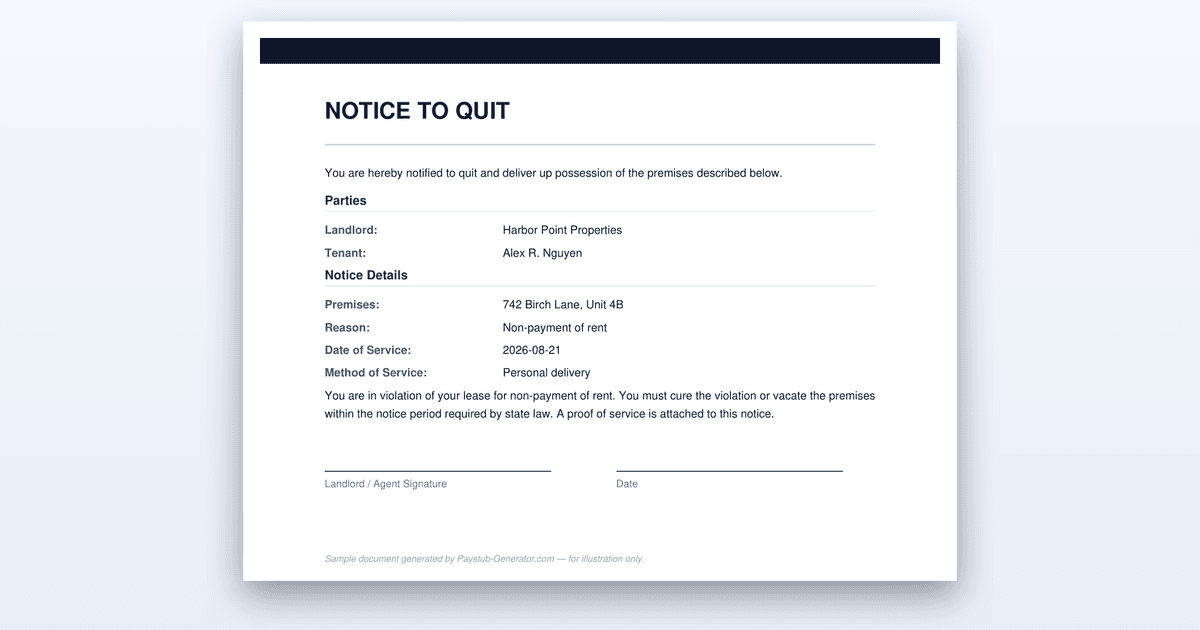
Serving an eviction notice the wrong way restarts the clock. Seven steps: the right notice type, lawful delivery, proof of service, and counting the days.
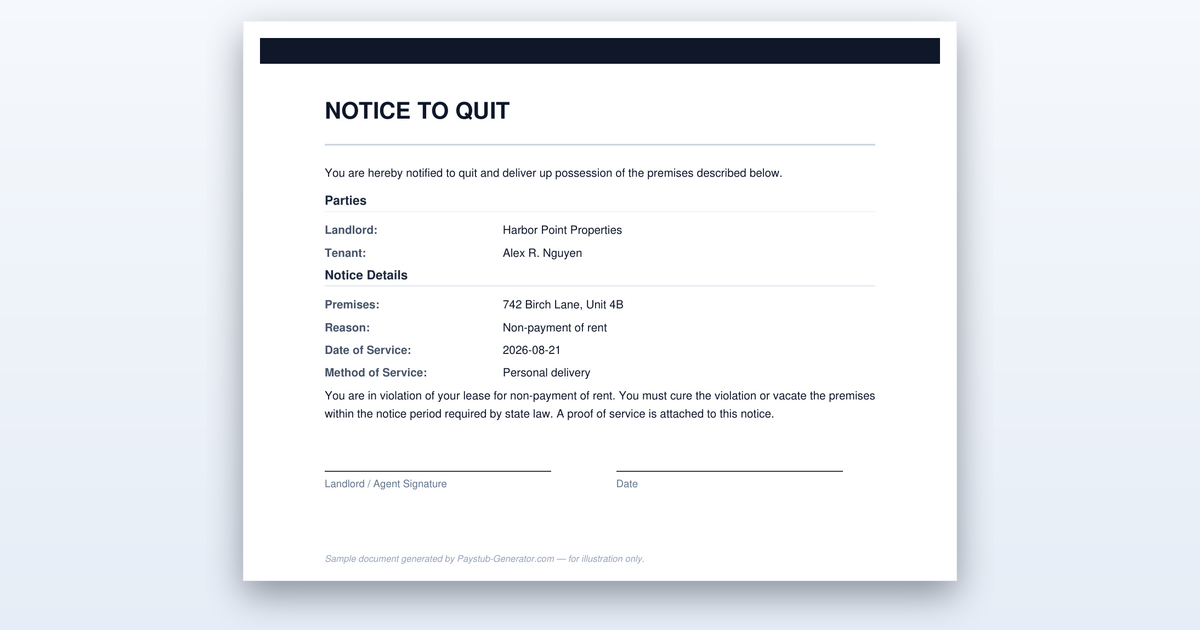
Short on time? You can also create the document you need in just a couple of minutes.
Key Takeaways
- •Serving the wrong notice type for the reason is the most common cause of a dismissed eviction filing.
- •Notice periods vary by state, by reason, and sometimes by city ordinance, and subsidized housing often adds federal requirements on top.
- •Personal service is accepted everywhere; posting and mailing is a fallback only where the statute expressly allows it.
- •A completed proof of service, signed and dated, is what turns delivery into evidence.
How to Serve an Eviction Notice Correctly
Serving an eviction notice correctly takes seven steps and roughly one to two hours of preparation plus the statutory waiting period, which ranges from three days to over a month depending on your state and the reason for the eviction. You must match the notice type to the legal reason, comply with your state's exact notice period, fill out every required field, deliver it by a method your state permits, and document that delivery with a signed proof of service. Getting any one of these wrong can get your case dismissed before a judge ever hears the merits.
Before You Start
Before you write a single word on the notice form, gather the documents that will tell you what the notice must say and prove. You need the signed lease to confirm the tenant's full legal name and the exact property address, including the unit number if there is one. You also need a rent ledger showing precisely what is owed, which dates the amounts cover, and any payments made — because the notice must state the exact dollar figure due, and a judge will compare that figure against your ledger. If the eviction is for a lease violation rather than non-payment, you need documentation of the specific behavior, such as a noise complaint or a pet policy breach.
You also need to know your state's notice requirements before you draft anything. Each state's landlord-tenant statute specifies which notice form applies to which reason, how many days the tenant gets, and which service methods are acceptable. Some cities add their own rules on top, and subsidized housing adds federal requirements. If you start drafting without this information, you risk serving the wrong notice type or the wrong number of days — the two most common reasons eviction filings get dismissed. Finally, decide in advance how you will prove delivery: a witness who can testify, certified mail with return receipt, or a licensed process server. You cannot document service after the fact, so the method must be chosen before the notice goes out.
Step-by-Step: How to Serve an Eviction Notice
Step 1: Confirm the legal reason and pick the matching notice
The first decision is not about the form — it is about the legal reason for the eviction. Non-payment of rent, a curable lease violation, an incurable violation, and a no-cause termination each require a different notice form, and each starts a different clock. Serving the wrong type is the single most common reason an eviction gets thrown out at the first hearing, because the judge will dismiss the case without considering whether the underlying complaint is valid.
For non-payment, most states require a notice to pay or quit, which gives the tenant a set number of days to pay the full amount owed or vacate. For a curable violation, such as keeping a pet in a no-pet building, the notice must state the violation and give the tenant time to fix it. For an incurable violation, such as serious property damage or illegal activity, the notice typically demands the tenant leave without offering a chance to cure. A no-cause termination, allowed only in certain states and only under month-to-month tenancies, requires a notice of termination that does not state a reason at all.
The judgement call here is classifying the violation correctly. If you are unsure whether a violation is curable, check your state statute — most states list examples of each category. When in doubt, err on the side of the curable notice, because a curable notice that the tenant fails to cure still supports an eviction, while an incurable notice used for a curable violation is fatal. You know you have the right notice when the form you selected matches the reason you will state in the court filing, and the cure period aligns with what your statute requires for that reason.
Step 2: Look up your state's notice period before you write anything
Notice periods for the same reason range from three days to a month or more depending on the state and sometimes the city. A three-day notice to pay or quit is common in states like California and Texas for non-payment, while other states require seven, fourteen, or even thirty days. Curable violations often carry longer periods — frequently fourteen or thirty days — because the tenant needs reasonable time to remedy the problem. No-cause terminations typically require thirty days for month-to-month tenants and sixty days in a few states.
You must also check whether your city has its own ordinance that overrides or extends the state default. Rent-controlled cities such as San Francisco, New York, and Los Angeles frequently require longer notice periods and additional disclosures. Subsidized housing, including Section 8 and project-based rental assistance, adds federal requirements on top of state law — the U.S. Department of Housing and Urban Development generally requires a fourteen-day notice for non-payment and a thirty-day notice for lease violations, regardless of what your state says.
The way to verify this is not to ask a friend or search a general website but to read your state's landlord-tenant statute directly, usually found under a section titled "Unlawful Detainer" or "Forcible Entry and Detainer." Your state's housing authority or a local tenant rights organization publishes plain-language summaries. You know you have the right period when the number of days on your notice matches the statute for your specific reason and your specific jurisdiction, and when you have checked whether any local ordinance or federal subsidy rule applies to your property.
Step 3: Draft the notice with everything the statute requires
Most states require the tenant's full legal name as it appears on the lease, the complete property address including unit number, the specific reason for the notice, and the exact amount due where money is involved. For non-payment notices, you must state the dollar figure owed and the period it covers. For lease violations, you must describe the behavior specifically enough that the tenant knows what to fix. The notice must also state what the tenant must do to cure the problem, the deadline for doing so, and the signature of the landlord or the landlord's agent. A missing element is usually fatal to the notice, meaning the court will dismiss the eviction even if the tenant genuinely owes rent.
The judgement call in drafting is how specific to be. Vague language like "you have violated your lease" will not survive a judge's review — you must name the behavior, such as "you have kept a dog in the unit in violation of paragraph 12 of the lease." For non-payment, some states require you to itemize late fees separately from rent, and a few require you to state that the tenant can pay by a specific method. Check your statute for any required language, because some states mandate a warning that eviction proceedings may be filed if the tenant does not comply.
You know the draft is complete when you can check every element against your statute's list and find each one present. Read the notice aloud as if you were the tenant — would you know exactly what you did wrong, what to do about it, and by when? If the answer to any of those questions is no, the notice is not ready. Have a second person read it if possible, because a judge will read it with the most critical eye in the room.
Step 4: Choose a service method your state actually allows
Personal delivery to the tenant is accepted everywhere — hand the notice directly to the tenant, and the service is valid in all fifty states. Substituted service on another adult at the property and posting on the door combined with mailing are permitted in some states and only in defined circumstances. For example, many states allow you to leave the notice with a person of suitable age and discretion who resides at the property, but only after you have made a reasonable attempt at personal service. Posting and mailing is a fallback that only works where the statute expressly allows it, and it almost always requires mailing a copy by first-class mail in addition to posting.
Email and text are rarely sufficient on their own. Even if your lease has an electronic communications clause, most state statutes still require physical delivery for eviction notices. A few states have begun to permit electronic service under narrow conditions, but you should never rely on it without confirming your statute explicitly authorizes it. The safest assumption is that electronic delivery is not service at all.
The judgement call here is whether to serve personally or hire a process server. Personal service is free and immediate, but it creates a credibility problem if the tenant claims they never received it — your word against theirs. A process server provides an independent witness and a professional proof of service, which is why most experienced landlords use one for the final notice. The cost typically runs twenty-five to seventy-five dollars, which is trivial compared to the cost of a dismissed case. You know the service worked when the person who delivered the notice can state under oath who received it, when, and where — and when that person is either you with a witness or a licensed professional.
Step 5: Document the service the day it happens
Complete a proof of service naming who served the notice, the date, the time, the address, and the method used. This document is what turns delivery into evidence — without it, you have only your word that the tenant was served. The proof of service should be signed by the person who actually performed the service, not by you if someone else delivered it. If you used certified mail, keep the receipt and the tracking record with the proof of service, because the return receipt showing the tenant's signature is your strongest evidence.
The judgement call is how much detail to include. A good proof of service describes the person served, such as "John Smith, an adult male, described as approximately 5'10" with brown hair, who stated he was the tenant." It also notes the time of day, because some jurisdictions require service during certain hours. If you posted the notice, describe exactly where you posted it and attach a photograph if you took one. If you used substituted service, describe your attempt at personal service first and why you resorted to the alternative.
You know the documentation is complete when someone who was not present could read the proof of service and understand exactly what happened. The proof of service should be notarized if your state requires it — check your statute — and you should make at least two copies before you file anything. Keep the original with your records and the copy for the court filing. Do not lose this document; it is the difference between a smooth eviction and a hearing where the tenant claims they never saw the notice.
Step 6: Count the notice period the way the statute counts it
States differ on whether the day of service counts, whether weekends and holidays count, and whether mailed service adds days. In some states, the day you serve the notice is day zero and the clock starts the next day. In others, the day of service counts as day one. Many states exclude weekends and court holidays from the counting, which can add several days to the effective period. If you used mailing as part of the service, some states add a fixed number of days — often three or five — for the mail to arrive, even if you also posted the notice.
Miscounting by one day gives the tenant a complete defense. If you file the eviction on day four of a three-day notice because you counted the day of service, the court will dismiss the case and you start over from the beginning, paying the filing fee again. The tenant's attorney will check the dates with a calendar, and a single day's error is enough to win a dismissal.
The judgement call is whether to count conservatively. The safe approach is to count the maximum possible number of days — exclude the day of service, exclude weekends, exclude holidays, and add mailing days if mailing was involved. This costs you a few extra days but eliminates the risk. You know the period has run when you have counted the days according to your state's method and the deadline has passed with no payment or cure from the tenant. Write the expiration date on your calendar and do not file before it.
Step 7: File only after the notice period has fully expired
If the tenant cures within the period, the notice is satisfied and you stop — the eviction process ends because the tenant has done what the notice required. If the period expires with nothing done, that expired notice and its proof of service become exhibits in your filing. You do not need a new notice; the expired one is the basis for the court action. File the eviction complaint with the court, attaching the notice and the proof of service as exhibits, and pay the filing fee, which typically runs one hundred to four hundred dollars depending on your county.
The judgement call is verifying that the cure did not happen. Check your ledger and your records on the final day of the notice period. Did the tenant pay the full amount, or only part? Did they fix the violation, or make only a partial attempt? In most states, a partial payment does not cure a pay-or-quit notice — the tenant must pay the full amount stated in the notice. A partial cure of a lease violation may or may not satisfy the requirement depending on your state's rules, so check the statute before you file.
You know you are ready to file when the notice period has fully expired, the tenant has not cured, and you have the original notice, the signed proof of service, and your rent ledger or violation documentation in hand. File promptly after the period expires, because delaying can complicate your case — some states require you to file within a certain window after the notice expires, and waiting too long can raise questions about whether you have waived the violation.
Worked Example
Let us walk through a realistic scenario so you can see the arithmetic and the decisions in action. This is an example only — your numbers, state, and deadlines will differ. Maria owns a duplex in Portland, Oregon, and rents unit B to a tenant named David Chen under a month-to-month lease. On the first of the month, David pays nothing. By the fifth, Maria checks her ledger and confirms he owes the full $1,400 for the month, with no partial payment and no prior balance.
Maria's first decision is the notice type. In Oregon, non-payment of rent requires a notice to pay or quit with a ten-day period, per state statute. She confirms this by reading the Oregon Residential Landlord and Tenant Act rather than trusting a website. She also checks whether Portland has a city ordinance that extends the period — it does not for standard market-rate units, so the ten-day state period applies. She confirms David's lease does not involve Section 8 or any subsidy, so no federal rules add on.
Maria drafts the notice on the fifth. She writes David's full legal name as it appears on the lease, the address as "1420 NE Flanders Street, Unit B, Portland, OR 97212," the amount due as exactly $1,400, and the period covered as the current month. She states that David must pay the full $1,400 within ten days or vacate. She signs and dates the notice. She checks her state statute and confirms every required element is present.
On the same day, she hires a process server for $60. The process server personally delivers the notice to David at the property at 6:15 PM, and David accepts it. The process server completes a proof of service naming himself as server, the date, the time, the address, the method as personal delivery, and a description of David. He signs it and gives Maria the original.
Now Maria counts the period. Oregon counts the day after service as day one, and the ten-day period includes weekends and holidays unless the final day falls on a court holiday. She serves on the fifth, so day one is the sixth, and the deadline is the fifteenth. The fifteenth is a Saturday, but Oregon does not extend the deadline for weekends in this context — the notice period is calendar days. The tenant has until the end of the day on the fifteenth to pay.
Maria checks her ledger on the sixteenth. David has paid nothing. The notice period has fully expired, and he has not cured. Maria files the eviction complaint on the seventeenth, attaching the notice and the proof of service as exhibits, and pays the filing fee of $244 at the Multnomah County courthouse. She is confident the service is valid because she used personal delivery, the method accepted in every state, and she has a signed proof of service from a licensed process server. If David challenges the service, the process server's testimony and the signed proof carry the day.
Where People Get This Wrong
The most common failure is serving the wrong notice type for the reason. A landlord who serves a no-cause termination when the real issue is non-payment, or a curable violation notice when the violation is incurable, will watch the case get dismissed at the first hearing. The consequence is starting over from scratch, losing the filing fee, and giving the tenant more time in the unit. The fix is to classify the reason first and match the notice form to the statute before anything else.
The second failure is miscounting the notice period. Landlords routinely count the day of service as day one when their state excludes it, or forget that mailed service adds days, or ignore that weekends do not count in their jurisdiction. Filing one day early gives the tenant a complete defense, and judges dismiss on that basis without considering the merits. The fix is to count conservatively — exclude the day of service, exclude weekends and holidays if your state does, and add mailing days — and to write the expiration date on a calendar before you file.
The third failure is sloppy proof of service. Landlords who serve personally without a witness, or who lose the certified mail receipt, find themselves in a he-said-she-said dispute at the hearing. The tenant claims they never received the notice, and the landlord has no evidence to contradict them. The consequence is a continuance at best and a dismissal at worst. The fix is to use a process server or a witness, complete the proof of service the same day, and keep it with the original notice.
The fourth failure is ignoring local and federal overlay rules. A landlord in a rent-controlled city who serves a three-day notice when the city requires thirty, or a landlord with a Section 8 tenant who serves a three-day notice when HUD requires fourteen, has served a defective notice. The consequence is the same dismissal, but the landlord often does not discover the error until the hearing. The fix is to check your city ordinance and confirm the subsidy status of the unit before you draft anything.
What a Tenant Should Check If They Have Been Served
If you are a tenant who has received an eviction notice, your first move is to check the date and the deadline. Count the days exactly as your state counts them — the day of service may or may not count, and weekends may or may not be excluded. If the deadline has passed and you received the notice late, or if the notice was posted and mailed rather than handed to you, the service may be defective. Check whether the notice states the exact amount owed, the specific violation, and the cure period — if any element is missing, the notice may not survive a judge's review. Keep the original notice and any envelopes, and take photographs of the property and your living conditions if the notice relates to a violation. If you believe the notice is defective, do not ignore it — respond in writing, and if you cannot pay or cure, consult a tenant rights organization or an attorney before the deadline passes. An expired notice with no response is what the landlord needs to file, so your window to act is the notice period itself.
When to Get Professional Help
You should get professional help when the stakes are high or the facts are complicated — if the tenant has an attorney, if the property is in a rent-controlled jurisdiction, if the tenant receives any form of housing subsidy, if the violation involves allegations of illegal activity, or if you have already made a mistake and need to know whether to start over. A landlord-tenant attorney typically charges two hundred to four hundred dollars per hour, and a consultation to review your notice and proof of service before you file is money well spent compared to a dismissed case. Tenants facing eviction should contact a legal aid organization or a tenant rights clinic immediately, because many provide free representation and because the deadlines are short — missing a deadline can mean losing the case by default. This article is general information, not legal advice, and your state's statute and local ordinances govern your specific situation.
The Bottom Line
Serving an eviction notice correctly is a matter of matching the notice type to the reason, using the right notice period, filling out every required field, serving by a permitted method, and documenting it with a signed proof of service. Count the days conservatively and file only after the period has fully expired. When in doubt, spend the money on a process server and an attorney review — the cost of a dismissed case is far higher.
Frequently Asked Questions
Can I email or text an eviction notice?
Rarely on its own. Most states specify personal delivery, substituted service, or posting combined with mailing. Electronic delivery is generally only valid where the statute or the lease expressly permits it, and even then a physical method alongside it is safer.
Does the day I serve the notice count as day one?
That varies by state. Many exclude the day of service and start counting the next day, and some also exclude weekends and legal holidays. Check the counting rule for your state before you set the deadline.
What happens if the tenant pays after the notice expires?
That depends on your state and on whether you have already filed. In many places accepting rent after expiration can waive the notice and force you to start over, so decide deliberately before taking the money.
Authoritative References
The rules described here come from the agencies that set them. Check the current text before you rely on a deadline or a figure:
Related Guides
- Arizona 5-Day Notice to Pay or Quit: Rules and Timing
- California Residential Lease Agreement Template (2026 PDF)
- Eviction Notice for Nonpayment of Rent: State-by-State Guide
- How to Screen a Tenant: A Landlord's Step-by-Step Process
- How to Raise Rent Legally: Notice, Limits, and the Letter
Sources: Paystub-Generator.com editorial team. This guide is informational and not legal or tax advice.
This guide is part of our Rental Documents service — lease agreements, rent receipts and notices.
Explore Rental DocumentsRental Forms Knowledge Hub
Explore our suite of legally reviewed templates in the Rental category.
Citations & Legal Sources
- Paystub-Generator.com editorial team

