
How to Screen a Tenant: A Landlord's Step-by-Step Process
Marcus Vance / Payroll Operations Editor
Reviewed by: Reviewed by the Paystub Generator Editorial Team
Legal Reviewer
Last Updated: August 29, 2026
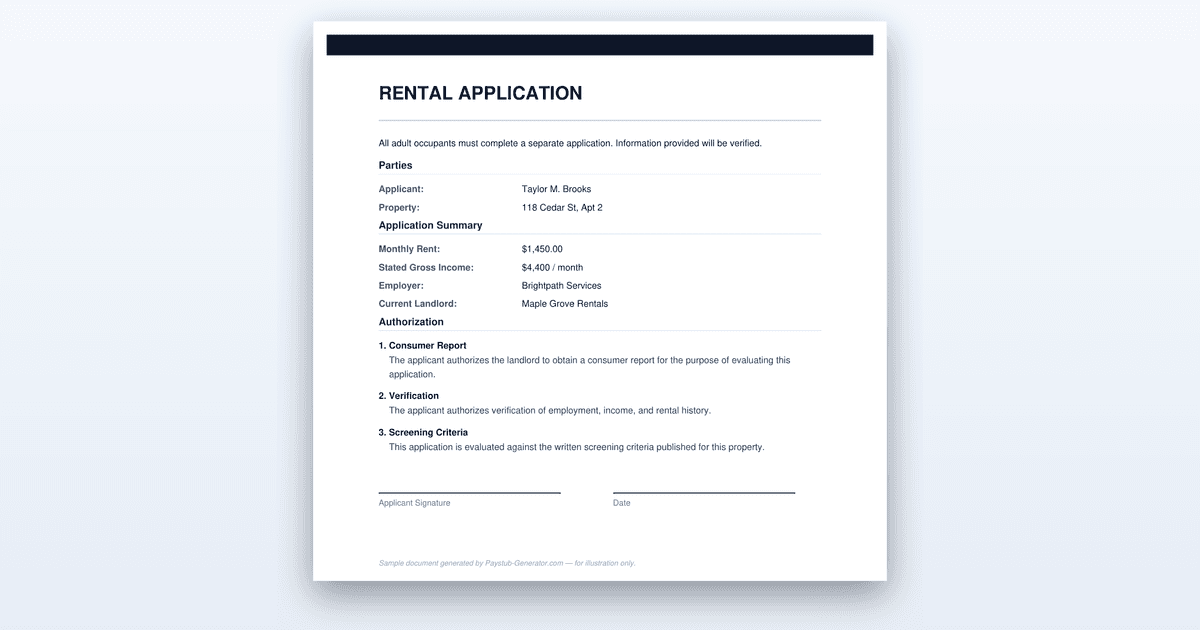
A repeatable seven-step tenant screening process: written criteria, a full application, income and landlord verification, FCRA consent, and adverse action.
Short on time? You can also create the document you need in just a couple of minutes.
Key Takeaways
- •Written screening criteria set before advertising are the strongest defence against a fair housing complaint.
- •The FCRA requires written authorization before a consumer report and an adverse action notice when a report contributes to a denial or worse terms.
- •The previous landlord is usually a more reliable reference than the current one.
- •Income verification means checking documents for internal consistency, not accepting a stated figure.
To screen a tenant properly, you need a seven-step process that starts before you ever advertise the unit: write your criteria down first, then verify income with documents, get written FCRA consent before running credit, call the previous landlord, and apply the same standard to every applicant. The whole process takes roughly 30 to 45 minutes per qualified applicant once you have the paperwork in hand, and it protects you from fair housing complaints and FCRA violations that cost far more than any month of rent.
Before You Start
You need four things in hand before you show the unit to a single person. First, your written screening criteria, finalized and dated. This is the document that says "gross monthly income must be 3x rent," "credit score must be 600 or above," and "no evictions in the past five years." Second, a rental application form that collects everything you intend to verify — employers, income, rental history for the past three to five years, and references. Third, a signed authorization from the applicant before you pull any consumer report; the Fair Credit Reporting Act makes this a hard legal requirement, not a courtesy. Fourth, a screening provider you trust and a clear decision about who pays the fee. If you start without the written criteria, you are making decisions in the moment, and that is precisely how fair housing claims get started — not from malice, but from inconsistency between one applicant and the next.
Step-by-Step: How to Screen a Tenant
Step 1: Write Your Criteria Down Before You Advertise
Sit down and decide, in writing, exactly what a qualified applicant looks like before you post the listing. Set the income multiple (commonly 2.5 to 3 times the monthly rent), the minimum credit score, the rental history requirement (typically two years of verifiable on-time payments), and your policy on pets, occupancy limits, and adverse records like evictions or criminal convictions. Write it as a checklist with specific numbers and timeframes. "Good credit" is not a criterion; "a credit score of 620 or higher from the primary applicant" is.
This document is your defence. If an applicant is denied and files a complaint, the first question you will face is whether your criteria were written before or after you met them. Criteria that exist on paper, dated before the advert ran, are nearly impossible to attack. Criteria that are "explained" after the fact look like rationalization, even when they are not. Keep a copy of the criteria with every application file. When you are done, read it once more and ask yourself whether you could apply this standard to your own mother without embarrassment — if not, rewrite it now, because you will be applying it to strangers.
Step 2: Require a Complete Application from Every Adult
Every adult who will live in the unit — every one of them, including a partner who does not work or a roommate who will not be on the lease — fills out the full application. This is non-negotiable, and it is the single most common shortcut that small landlords take. The reason is simple: an adult who is not screened is an adult you know nothing about, and they will have the same keys as the person you did screen. Collect full names, dates of birth, current and previous addresses, employers, income, and written authorization to verify all of it.
An application with gaps is not a reason to guess; it is a reason to go back and ask. A missing employer phone number is usually an oversight. Three missing employer phone numbers, a blank rental history section, and a "I'll explain later" note is information. A pattern of unexplained gaps tells you the applicant is avoiding verification, and that is as meaningful as anything they wrote down. When you receive the application, check it for completeness on the spot, hand it back if it is incomplete, and note the date and time it was returned complete. That timestamp matters if two applicants are competing for the same unit.
Step 3: Verify Income Against Documents, Not Statements
Ask for the documents that prove the numbers on the application. For a wage earner, that means the two or three most recent pay stubs and, ideally, an offer letter if they have just started a new job. For a self-employed applicant, ask for the most recent year's tax return and the last three months of bank statements. For someone living on Social Security or disability, ask for the current award letter. Do not accept a stated salary, a verbal assurance from an employer, or a screenshot of a banking app — those are not documents, they are claims.
The judgement call here is checking internal consistency. Look at the pay stub and check that the year-to-date gross income lines up with the pay dates. A stub dated June 15 with a YTD figure that suggests a salary half of what the applicant claims is either a new job or a problem — ask which. For the self-employed, compare the bank statements against the tax return; if the deposits do not match the claimed income, you have your answer. The step worked when you can state, in writing, the applicant's monthly gross income and the source document that proves it. If you cannot do that, you have not verified anything.
Step 4: Get Written Consent, Then Run Credit and Background
The Fair Credit Reporting Act requires you to get the applicant's written authorization before you obtain a consumer report — that includes credit reports, criminal background checks, and eviction history reports. The authorization can be a separate form or a clause in your application, but it must be signed and dated before you run anything. Keep that signed authorization with the application file for as long as you keep the file, which should be at least three years for compliance reasons.
When the report comes back, read it carefully rather than glancing at the score. Look at the credit utilization, the payment history on the accounts that matter (mortgage, car, credit cards), and any collections or judgments. A score of 620 with a clean history is different from a score of 620 with three recent collections. For the background check, look for evictions, criminal convictions, and any sex offender registry hits. Your written criteria from Step 1 should tell you what to do with what you find — if your criteria say "no evictions in five years" and the report shows one, the decision is already made. The step worked when you have the report, you understand it, and you have compared it against your written criteria.
Step 5: Call the Current Landlord and the One Before
Call the current landlord first, but understand their incentive: they may want a difficult tenant gone and will tell you what it takes to achieve that. Then call the previous landlord — the one before the current one — because they have no such incentive and will usually give you the more honest picture. Ask the same questions of both: Did the rent arrive on time every month? Were there late payments, and how late? How many written notices did you give them? What condition was the unit left in when they moved out? Did they give proper notice? Did you have any complaints from neighbours?
The judgement call is weighing what you hear. A current landlord who is effusive and a previous landlord who is vague is a red flag. A current landlord who is reluctant and a previous landlord who confirms on-time payment is a green one. Listen for the specifics — "always paid by the 3rd" is better than "no problems," because specifics are harder to fake. The step worked when you have spoken to both and can write down a two-sentence summary of each conversation. If you cannot reach either after three attempts, that is a finding, and your criteria should say how you treat unverifiable rental history.
Step 6: Apply the Criteria Identically to Everyone
Run every applicant against the same written standard, in the same order, every time. Start with the income check, then the credit check, then the rental history, then the background check, and stop at the first failed criterion. Record the result at each stage. This is not bureaucracy for its own sake; it is the structure that keeps you honest and gives you a defensible record if anyone ever questions a decision.
Fair housing problems are usually proved by inconsistency, not by anything anyone said out loud. If you waived the income requirement for one applicant and enforced it for another, the pattern speaks for itself, regardless of your intent. If you accepted a co-signer from one applicant and refused to consider one from another, that is the same problem. The step worked when you can look at any two applicants and show that the same criteria were applied in the same order, with the same documentation required. If you cannot do that, you have not screened — you have improvised, and improvisation is where the liability lives.
Step 7: Send an Adverse Action Notice When You Decline
If a consumer report contributed to a denial, a higher security deposit, a co-signer requirement, or any other negative decision, the FCRA requires you to tell the applicant. Send an adverse action notice that names the reporting agency that supplied the report, explains that the agency did not make the decision and cannot give the reasons for it, and tells the applicant they have the right to a free copy of the report within 60 days and the right to dispute its accuracy directly with the agency.
This notice must go out promptly — within a few days of the decision, not weeks later. You can use the model adverse action notice provided by the Consumer Financial Protection Bureau, which covers the required language. The step worked when the notice is in the mail or sent electronically, you have a copy in the file, and you can prove when it was sent. If you denied the applicant for reasons unrelated to the report — say, they failed the income check on the documents — no adverse action notice is required, but it is still good practice to send a simple written denial stating the reason, because a written record is cheaper than a lawsuit.
Worked Example
Let us walk through a real scenario so you can see the arithmetic and the decisions in action. These figures are an example only — your numbers will differ. Sarah owns a two-bedroom duplex in Columbus, Ohio, and advertises the unit at $1,200 per month. Her written criteria, dated before the ad ran, require gross monthly income of 3x rent ($3,600), a credit score of 620 or above, no evictions in five years, and verifiable on-time rent for the past two years.
Two applicants apply. The first, Marcus, earns $48,000 per year as a warehouse supervisor, which is $4,000 per month — comfortably above the $3,600 threshold. His pay stubs confirm the figure: the most recent stub shows YTD earnings of $24,100 on a June 15 pay date, which lines up with a $48,000 annual salary. His credit report shows a 641 score with one medical collection from three years ago, which his criteria allow. His current landlord confirms on-time payment for the past 14 months; the previous landlord confirms the same for the two years before that. Marcus passes every criterion in order.
The second applicant, Denise, earns $52,000 per year as a marketing coordinator, which is $4,333 per month — also above the threshold. Her pay stubs, however, show YTD earnings of $31,000 on a July 31 pay date, which implies an annual salary of roughly $54,000, not the $52,000 she claimed. Sarah flags the inconsistency and asks; Denise explains she received a raise in April and her stubs reflect the new rate. Sarah does the arithmetic: the raise explains the higher YTD figure, and the current stub confirms the $4,333 monthly rate. Denise's credit report shows a 598 score — below the 620 threshold in Sarah's written criteria. Sarah stops the screening at that point, per her process, and sends Denise an adverse action notice naming the credit reporting agency, because the credit report contributed to the denial. She files both application folders with the written criteria, the applications, the signed FCRA authorizations, the credit reports, the landlord reference notes, and copies of the adverse action notices. The whole process took Sarah about 40 minutes per applicant, and she can defend every decision she made with a paper trail.
Where People Get This Wrong
The most common failure is deciding the criteria after meeting the applicant. A landlord meets a friendly, well-dressed applicant, decides "this one feels right," and then discovers the credit is poor and "makes an exception." That exception is not kindness; it is the beginning of a fair housing pattern. When the next applicant is denied, the comparison is made, and the friendly applicant's exception becomes evidence of discrimination. The fix is the written criteria from Step 1, applied mechanically, with no exceptions for charm.
The second failure is treating the current landlord's reference as sufficient. The current landlord has a strong incentive to get rid of a problem tenant, and many will say almost anything to achieve that. A landlord who calls only the current reference and hears "great tenant, never a problem" is hearing exactly what a desperate landlord says about a tenant they want gone. The fix is the previous landlord call, which costs ten minutes and gives you the unvarnished version.
The third failure is skipping the adverse action notice for borderline decisions. A landlord who denies an applicant for a 610 credit score — ten points below the threshold — and says nothing is violating the FCRA, even though the decision was "close." The applicant has a right to know that the credit report contributed, to see the report, and to dispute it. The fix is to send the notice every single time a consumer report contributes to a negative decision, no matter how obvious the denial seems.
The fourth failure is inconsistent fee handling. A landlord who charges one applicant for the screening and waives the fee for another has created a record of disparate treatment, even if the fee waiver was an innocent gesture. The fix is a published fee, charged to every applicant, with the amount stated in the advertisement and the application.
When to Get Professional Help
If you own more than a handful of units, or if you have ever had a fair housing complaint filed against you, or if an applicant has a lawyer write to you about a denial, stop improvising and get professional help. A landlord-tenancy attorney can review your written criteria, your application form, and your adverse action notices for a few hundred dollars, and that review is cheap insurance against a claim that costs tens of thousands. Similarly, if you are in a jurisdiction with rent control or tenant protection ordinances — like Portland, Oregon, or New York City — the local rules can override your criteria, and you need a local attorney or your state landlord association to tell you what those rules are. This article is general information, not legal advice, and where state or local law differs from what is described here, the local law wins.
The Bottom Line
Screening a tenant is a seven-step process that takes under an hour per applicant and protects you from the two biggest risks a landlord faces: a tenant who cannot pay and a fair housing complaint you cannot defend. Write the criteria down first, verify everything with documents, call the previous landlord, and apply the same standard to everyone. The paperwork is not bureaucracy — it is the difference between a defensible decision and a guess.
Frequently Asked Questions
What income requirement is standard?
Many landlords use a gross monthly income of two and a half to three times the rent. Whatever multiple you choose, write it down in advance and apply it to every applicant the same way.
Do I need permission to run a credit check?
Yes. The Fair Credit Reporting Act requires the applicant's written authorization before you obtain a consumer report, and you have to keep that authorization on file.
Can I reject an applicant because of a criminal record?
Blanket bans invite fair housing scrutiny. Federal guidance points toward individualized assessment considering the nature of the offence, how long ago it was, and its relevance to tenancy. Some states and cities restrict this further.
Authoritative References
The rules described here come from the agencies that set them. Check the current text before you rely on a deadline or a figure:
Related Guides
- Arizona 5-Day Notice to Pay or Quit: Rules and Timing
- California Residential Lease Agreement Template (2026 PDF)
- Eviction Notice for Nonpayment of Rent: State-by-State Guide
- How to Serve an Eviction Notice Correctly
- How to Raise Rent Legally: Notice, Limits, and the Letter
Sources: Paystub-Generator.com editorial team. This guide is informational and not legal or tax advice.
This guide is part of our Rental Documents service — lease agreements, rent receipts and notices.
Explore Rental DocumentsRental Forms Knowledge Hub
Explore our suite of legally reviewed templates in the Rental category.
Citations & Legal Sources
- Paystub-Generator.com editorial team

