

Complete Guide to Professional Business Forms & Project Billing
Operating a commercial enterprise in today's rapid digital environment demands meticulous documentation and airtight accountability. Every transaction you complete, invoice you draft, quote you issue, and estimate you present represents your company’s institutional quality. Disorganized invoices or scribbled price lists lead to client friction, delayed clearances, and potential auditory problems under IRS regulatory benchmarks. By standardizing your billing workflows via optimized interactive structures, you protect receivables and present an unassailable professional image to clients.
1. Accelerating Accounts Receivable with Compliant Invoicing
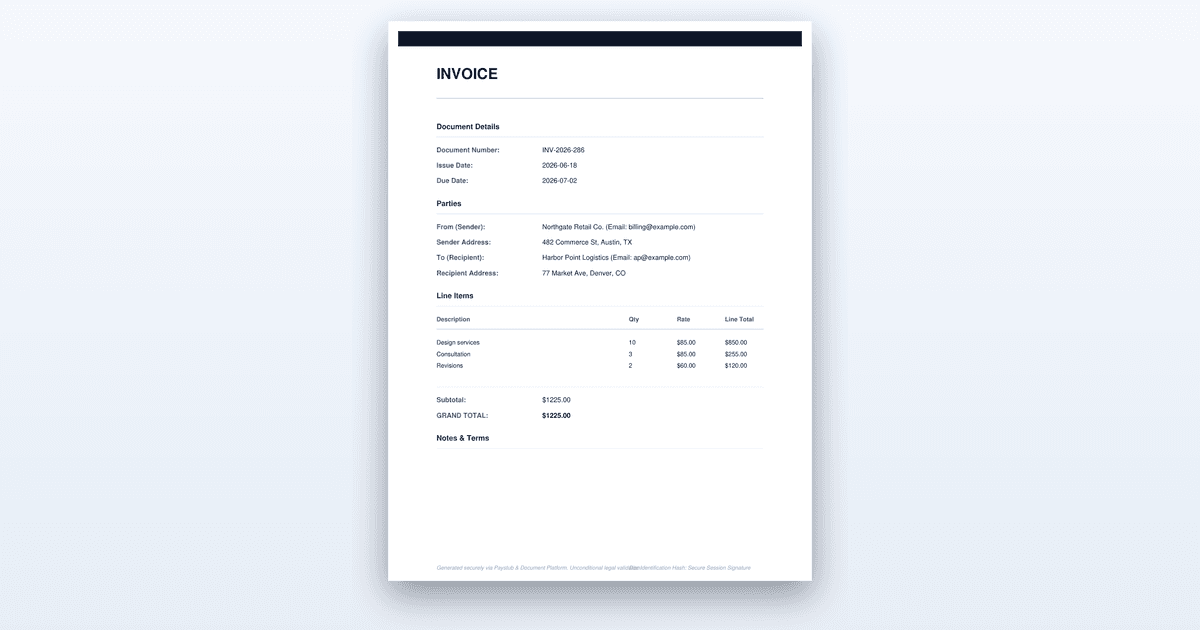
A formal commercial invoice is more than a simple request of funds; it is a legally supportive itemized record of values exchanged. A compliant statement includes precise company EIN identifiers, client corporate references, sequential billing codes, complete line item totals, applicable tax computations, and unambiguous Net-30 remittance conditions.
When contractors or freelancers manage multiple parallel projects, applying clean, pre-calculated layouts minimizes administrative bottlenecks. This protects working capital from unnecessary delays. Launch our Interactive Invoice Creator to build custom watermark-free PDF billing items instantly.
2. Quotation vs. Estimate: Mastering the Project Scoping Phase
A recurrent source of misunderstanding between independent contractors and commercial clients centers on the structural distinction between a Quote and an Estimate. Identifying when to implement which instrument is a baseline standard of service contract management.
- Pricing Quotes: A fixed, binding financial structure issued for well-defined parameters. Once a Price Quote is authorized, the pricing is locked in for the explicit timeline of the contract and cannot be adjusted unilaterally.
- Project Estimates: A flexible budget projection designed for variable scopes where labor requirements or material costs fluctuate. Utilizing a Project Estimate allows operators to outline an educated baseline while reserving the right to recalibrate values as the scope manifests.
3. Securing Immediate Proof of Transaction via Sales Receipts
Whenever transactions clear via physical cash, credit card processors, or digital banking routing, issuing an immediate, clean sales receipt is a tax-compliance necessity. These records function as direct physical proof of payment, letting corporate accounting units balance books cleanly.
For your commercial bookkeeping records, preserving structured transaction lists ensures your deductions remain completely defendable against audit audits. Create beautiful, itemized credit and debit payment proofs with our Professional Sales Receipt Maker.