
How to Verify a Tenant's Income Before You Sign a Lease
Marcus Vance / Payroll Operations Editor
Reviewed by: Reviewed by the Paystub Generator Editorial Team
Legal Reviewer
Last Updated: August 29, 2026
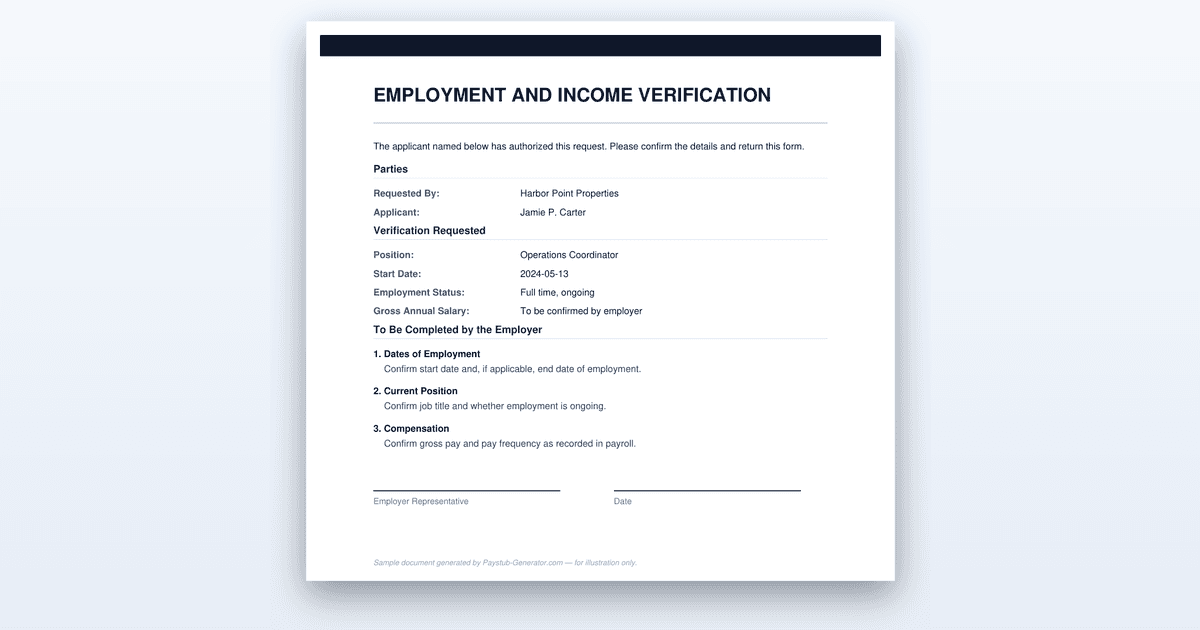
Verify tenant income properly: set a written standard, request the right documents, check pay stubs for consistency, and confirm employment at the source.
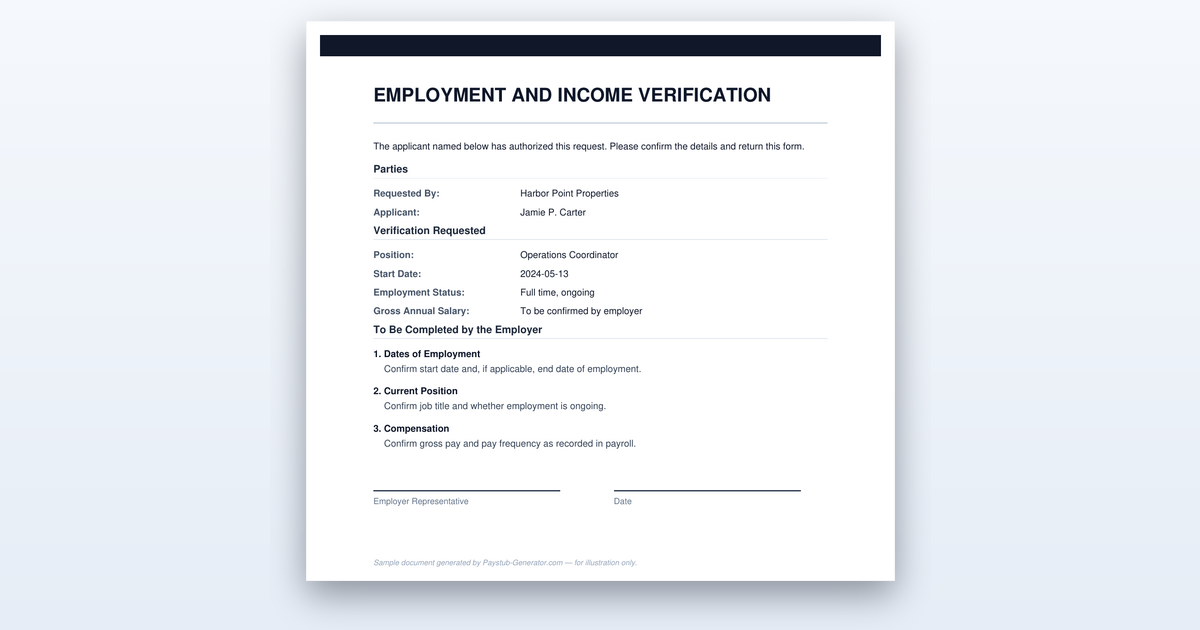
Short on time? You can also create the document you need in just a couple of minutes.
Key Takeaways
- •A written income standard applied identically to every applicant is the core fair housing protection.
- •Pay stub verification is a consistency check: year-to-date totals, gross minus deductions, and plausible withholding.
- •Employer phone numbers should be sourced independently of the application.
- •Self-employed income is averaged over a longer period and reconciled against bank deposits and tax returns.
To verify a tenant’s income before you sign a lease, you need a seven-step process that takes roughly 30 to 45 minutes per applicant once you have the documents in hand: set a written income standard, collect the right documents for the income type, check the pay stubs for internal consistency, confirm employment at the source, average out self-employed income, apply the identical test to every applicant, and follow FCRA rules if a credit report drives your decision. This guide walks you through exactly how to verify a tenant’s income so you can spot a forgery, a padded number, or a job that no longer exists before you commit to a lease.
Before You Start
You need four things in hand before you evaluate a single applicant. First, a written income standard expressed as a multiple of the rent — most landlords use 2.5 to 3 times the monthly rent — and a clear statement of whether you count a roommate’s income and how you treat bonuses, overtime, and commission. Second, a signed application that explicitly authorizes you to contact the applicant’s employer; without that signature, calling the employer is a privacy violation and could land you in legal trouble. Third, the applicant’s two most recent pay stubs, or the equivalent records for a self-employed applicant, which we will cover in detail. Fourth, a direct phone number or verification address for the employer that you sourced independently — from the company’s website, a business directory, or a prior tenant — not the number printed on the application, because a fraudulent application will have a fraudulent phone number on it.
If you start without the written standard, you are making decisions case by case, which is exactly the pattern that produces fair housing complaints. If you start without the signed authorization, you cannot legally confirm employment. If you start without the pay stubs, you are guessing. Gather these four items first, and the rest of the process is mechanical.
Step-by-Step: How to Verify a Tenant’s Income
Step 1: Set the standard in writing before you look at anyone
Decide the income multiple you require — commonly 2.5 to 3 times the monthly rent — and write it down before you receive a single application. Decide whether a roommate’s income counts toward that multiple and whether you combine incomes or require each leaseholder to meet the standard individually. Decide how you treat variable earnings like bonuses, overtime, and commission: many landlords count only the base salary, or average the variable portion over the last six months. Write all of this down in a single paragraph, and keep it in your files.
The reason this step comes first is that a standard invented after you have met the applicant is the shape a fair housing complaint takes. If you require 3x rent from one applicant and accept 2x from another who happens to share a protected characteristic, you have created a discrimination case even if that was never your intent. The standard also gives you a defensible answer when an applicant asks why they were denied: “Our written policy requires gross income of 2.5 times the rent, and your verified income was 1.8 times.” You know the step worked when you can articulate your standard in one sentence and you have it written down somewhere you can produce it.
Step 2: Ask for the documents that match the income type
For a salaried applicant, request the two most recent pay stubs and, if the job is new, the offer letter. For an applicant paid hourly, ask for the same two pay stubs plus a schedule or timesheet if you want to confirm the hours. For a self-employed applicant, request the two most recent years of tax returns, the last three to six months of bank statements, and a profit-and-loss statement if they have one. For a gig-economy applicant — rideshare drivers, delivery workers, freelance designers — request the platform’s earnings summary, which apps like Uber and DoorDash generate, plus the bank statements showing those deposits landing.
The judgement call here is matching the document request to the income type. Asking a contractor for pay stubs they cannot have just delays the file and signals that you do not understand their situation, which can drive away a perfectly good tenant. Asking a salaried applicant for two years of tax returns is overkill and invasive. Match the request to the income, and tell the applicant exactly what you need and why. You know this step worked when every applicant has provided a complete document set, and you have not asked anyone for a document that their income type cannot produce.
Step 3: Check the stubs for internal consistency
Pay stub verification is a consistency check, and inconsistency is far more revealing than appearance. Start with the year-to-date totals: if the stub says the applicant earns $4,000 per month and the year-to-date gross is $12,000 with three months elapsed, that reconciles. If the year-to-date gross is $12,000 but the pay period is biweekly and we are in week 20 of the year, the math is off — that would be roughly ten pay periods, not three. Next, check that gross minus the deductions equals the net pay on the stub; if the numbers do not add up, the document was likely edited in a PDF editor. Finally, check that tax withholding is plausible for the income level and the state. A single person earning $60,000 a year in California will have meaningful state and federal withholding; a stub showing zero deductions on that income is a red flag.
The specific figures matter. Federal withholding on a $60,000 annual income is roughly $400 to $500 per biweekly pay period for a single filer with no dependents, and state withholding varies. If the stub shows $50 in federal withholding on that income, the document has been altered or the applicant has filed an exotic W-4 that you should question. You know this step worked when every figure on the stub reconciles: year-to-date matches the pay periods, gross minus deductions equals net, and withholding is in the right ballpark. If any figure does not reconcile, that is your signal to ask for more documentation or to move on.
Step 4: Confirm employment at the source
Call the employer on a number you found yourself — from the company’s website, a business directory, or LinkedIn — not the number written on the application. Ask for the human resources department or the applicant’s manager, and verify three things: the applicant’s role, their start date, and whether their employment is ongoing. Many employers will confirm only dates of employment and job title, which is still worth having because it confirms the job exists and the applicant actually works there.
The judgement call here is what to do when the employer refuses to confirm salary. That is common — many companies have a policy of confirming only dates and title — and it is not a reason to deny the application. The pay stubs already gave you the salary figure; the call confirms the job is real. What you are really testing for is whether the applicant is employed at all and whether the start date matches what they told you. A start date of last week on an application that claims two years of employment at that company is a problem. You know this step worked when you have spoken to a human being at the company who confirmed the applicant is employed, and that confirmation matches what the application and the pay stubs told you.
Step 5: Handle self-employed and variable income properly
Self-employed and gig applicants need a longer averaging period than a salaried applicant. A rideshare driver might earn $3,000 one month and $1,200 the next, so a single strong month is not a reliable picture. Average the income across the last three to six months of bank statements, and reconcile that average against the most recent tax return. If the bank deposits average $4,000 per month but the tax return shows $30,000 for the year, that is a mismatch worth questioning — either the deposits include non-income transfers or the tax return understates the income.
For seasonal income — construction workers, landscapers, holiday retail staff — you need the whole season, not the peak. If an applicant earned $8,000 in December but nothing in January, their annual income is not $96,000; it is whatever the full year actually produced. Ask for the last twelve months of bank statements or the previous year’s tax return, and average across the full period. You know this step worked when you can state the applicant’s average monthly income with confidence, you have reconciled it against bank deposits and the tax return, and the average meets your written standard. If the average does not meet the standard, you deny based on the written policy, not on a gut feeling.
Step 6: Apply the same test to every applicant and record it
Run every applicant through the same steps in the same order: documents, consistency check, employment verification, income averaging. Record the outcome for each one — the verified monthly income, the multiple of rent, and the decision — in a simple spreadsheet or a notes field in your applicant tracking system. This record is what makes a denial defensible and what makes a fair housing complaint evaporate when you can show that every applicant was treated identically.
The judgement call here is the temptation to make exceptions for applicants you like. Resist it. The moment you accept a 2x income multiple for one applicant and enforce 3x for another, you have created the inconsistency that an attorney will exploit. The record also helps you when an applicant disputes a denial: you can show them the exact math and the exact policy. You know this step worked when you can produce a record for every applicant you have screened this year, and each record shows the same steps applied in the same order with the same standard.
Step 7: Follow FCRA rules if a report drives your decision
If a consumer report — a credit report, a background check, or an eviction history report — contributes to a denial, a higher security deposit, or a requirement for a co-signer, the Fair Credit Reporting Act requires you to send an adverse action notice. That notice must name the agency that supplied the report, give the agency’s contact information, state that the applicant has the right to dispute the report’s accuracy, and explain that the applicant can get a free copy of the report within 60 days. You must also tell the applicant which factor — income, credit, or background — drove the decision.
The judgement call here is what happens when the income verification passes but the credit report fails. You are allowed to deny on the credit report, but you must say so in the adverse action notice, and you must name the credit reporting agency. Many landlords skip this step and simply say “we went with another applicant,” which is legal only if you are not using the report as the basis for the decision. You know this step worked when you have sent the adverse action notice within the required timeframe — typically within 30 days of the decision — and you have kept a copy in the applicant’s file.
Worked Example
Let us walk through a realistic scenario so you can see the arithmetic. Maria applies for a $1,800-per-month one-bedroom in Austin, Texas. Your written standard requires gross income of 2.5 times the rent, which is $4,500 per month, and you count only the applicant’s income, not a roommate’s. Maria’s application lists her as a salaried project coordinator at a construction firm, earning $52,000 per year, which works out to $4,333 per month — just below your 2.5x threshold of $4,500. Her two pay stubs show a biweekly gross of $2,000, which reconciles to $52,000 annually, and year-to-date gross of $26,000 with 13 pay periods elapsed, which also reconciles. Federal withholding of $320 per pay period is plausible for that income in Texas, which has no state income tax. The stubs are internally consistent.
You call the construction firm on a number you found on their website, not the one on Maria’s application. HR confirms she has been a project coordinator there for fourteen months and is currently employed. The application said two years, which is a minor discrepancy — she may have counted a prior role — but the job is real and the income is verified at $4,333 per month. That is $4,333 against your $4,500 threshold: she does not meet your standard. You have a choice. Your written policy says 2.5x, and Maria is at 2.4x. If you make an exception for her, you have to make an exception for everyone, and you have to explain why a $167-per-month shortfall is acceptable. The defensible move is to deny based on the written standard, or to offer her the unit with a co-signer or a higher deposit — but if a credit report contributes to that decision, you must send an adverse action notice naming the credit agency. You decide to deny, send the notice, and record Maria’s file: verified income $4,333, 2.4x rent, denied per written policy. That record is your protection if she ever questions the decision. These figures are an example, not a guarantee — your numbers will differ, but the process should not.
Where People Get This Wrong
The most common failure is trusting the phone number on the application. A fraudulent applicant will list their friend’s number as the “employer,” and the friend will confirm anything you ask. If you call that number, you have verified nothing. Always source the employer’s number independently — from the company website, a directory, or a prior tenant — and if the number on the application does not match the number you found, that is a red flag, not a coincidence.
The second failure is accepting a single pay stub or a single bank statement. One stub tells you what the applicant earned in one pay period, which is meaningless if they worked overtime that week or were on leave the week before. Two stubs give you a pattern, and the year-to-date figure on the second stub gives you the cross-check. One statement from a self-employed applicant tells you what one month looked like, which is exactly how a bad month gets hidden. Require the full set.
The third failure is ignoring the year-to-date reconciliation. A forged stub often has a plausible gross and net but a year-to-date figure that does not match the number of pay periods elapsed. If the applicant earns $2,000 biweekly and the year-to-date shows $30,000 in week 12, that is impossible — 12 weeks is six pay periods, which is $12,000, not $30,000. Check the arithmetic every time.
The fourth failure is treating self-employed income as if it were salary. Averaging one strong month and calling it the annual income produces a tenant who cannot pay in the slow months. Use the longer average, reconcile against the tax return, and apply the same standard you apply to everyone else.
When to Get Professional Help
If an applicant disputes your denial and you suspect they may file a fair housing complaint, or if you are denying based on a consumer report and you are unsure whether your adverse action notice meets FCRA requirements, it is time to talk to a landlord-tenant attorney. The same goes for any situation involving a Section 8 voucher, where income verification interacts with public housing rules, or a situation where the applicant has a criminal history that you are weighing against fair housing guidance. An hour of an attorney’s time is cheaper than a discrimination lawsuit. This article is general information, not legal advice, and your state’s landlord-tenant laws may impose additional requirements beyond what is covered here.
The Bottom Line
Verifying a tenant’s income is a mechanical process: set the standard in writing, collect the right documents, check them for internal consistency, confirm the job at the source, average variable income properly, and apply the identical test to every applicant. The discipline of the process — not your intuition about an applicant — is what protects you from bad tenants and from fair housing complaints. Do the steps in order, record every decision, and you will sign leases with confidence.
Frequently Asked Questions
How much income should a tenant have?
A gross monthly income of two and a half to three times the rent is a common standard. Choose your multiple in advance and apply it to everyone the same way.
How can I tell if a pay stub is genuine?
Check that it reconciles: year-to-date figures should match the elapsed pay periods, gross minus deductions should equal net, and withholding should be plausible for the income and state. Then confirm employment with the employer directly.
What if the applicant is self-employed?
Ask for the most recent tax return, several months of bank statements, and a profit and loss statement, and average income over a longer period rather than relying on a single strong month.
Authoritative References
The rules described here come from the agencies that set them. Check the current text before you rely on a deadline or a figure:
Related Guides
- Arizona 5-Day Notice to Pay or Quit: Rules and Timing
- California Residential Lease Agreement Template (2026 PDF)
- Eviction Notice for Nonpayment of Rent: State-by-State Guide
- How to Serve an Eviction Notice Correctly
- How to Screen a Tenant: A Landlord's Step-by-Step Process
Sources: Paystub-Generator.com editorial team. This guide is informational and not legal or tax advice.
This guide is part of our Rental Documents service — lease agreements, rent receipts and notices.
Explore Rental DocumentsRental Forms Knowledge Hub
Explore our suite of legally reviewed templates in the Rental category.
Citations & Legal Sources
- Paystub-Generator.com editorial team

