
How to Sign and Witness a Will So It Is Legally Valid
Marcus Vance / Payroll Operations Editor
Reviewed by: Reviewed by the Paystub Generator Editorial Team
Legal Reviewer
Last Updated: August 29, 2026
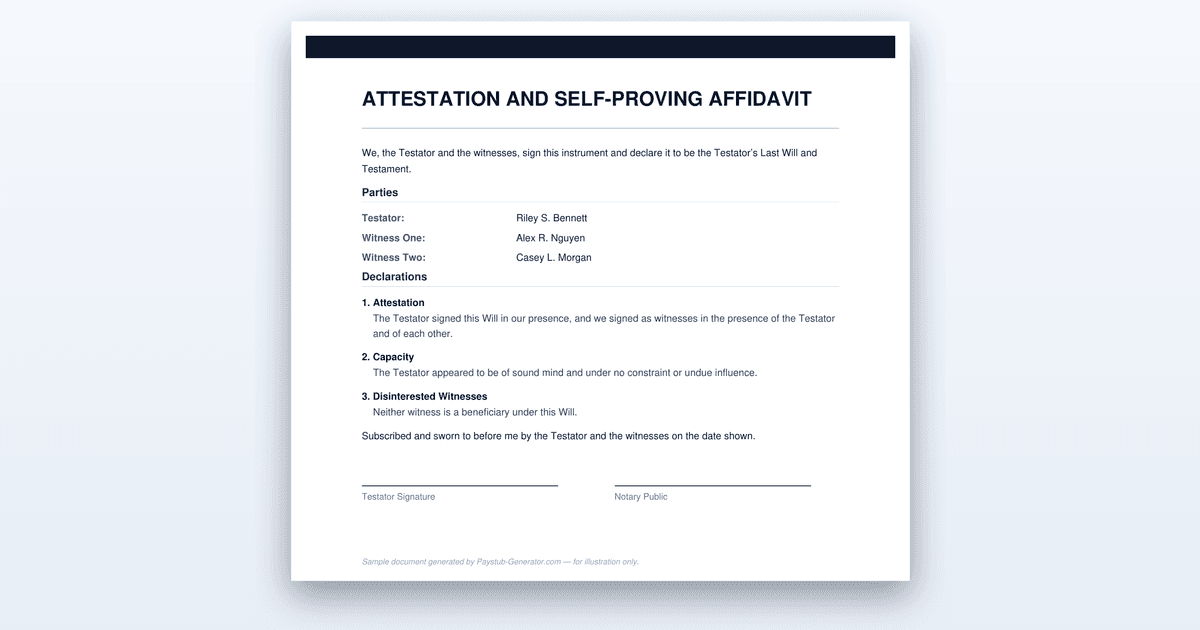
A will fails on execution more often than content. Seven steps: witness requirements, choosing disinterested witnesses, the signing itself, and self-proving.
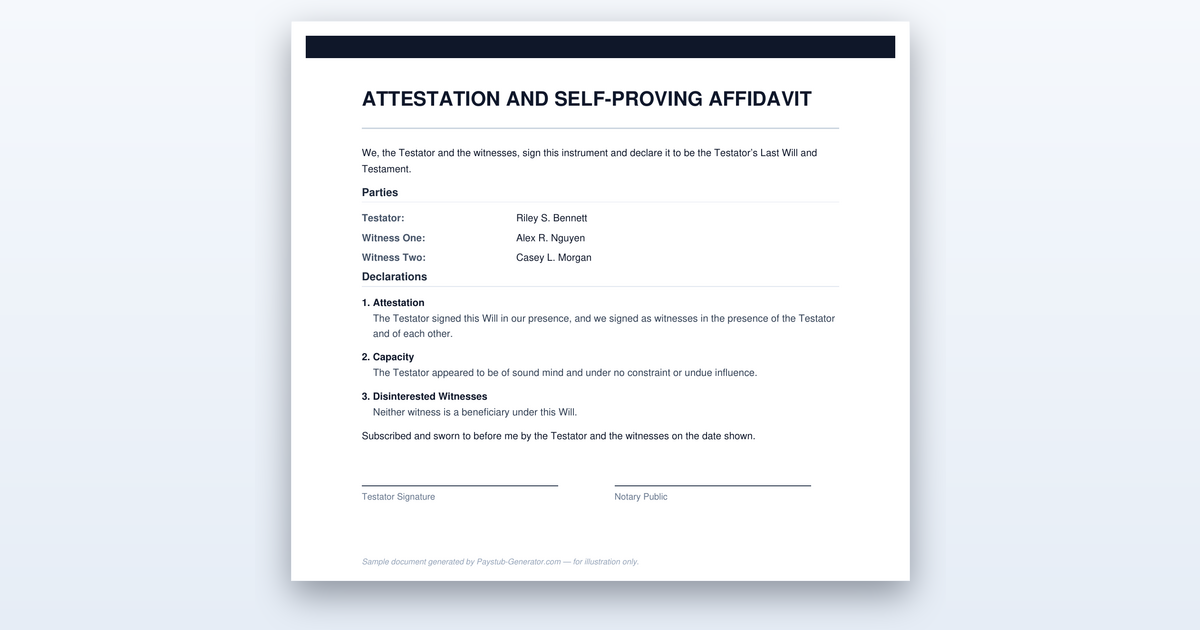
Short on time? You can also create the document you need in just a couple of minutes.
Key Takeaways
- •Most states require two adult witnesses, and the specific rule governs over any general guidance.
- •An interested witness can void their own gift under the will, so witnesses should be people who inherit nothing.
- •The testator and the witnesses should sign together in one sitting, in each other's presence.
- •A self-proving affidavit signed before a notary avoids having to locate the witnesses at probate.
How to Sign and Witness a Will: The 7-Step Execution Process
You can make your will legally valid by following a seven-step signing and witnessing procedure that takes about thirty minutes once everyone is in the room. The core of how to sign and witness a will is simple: the testator signs first, two disinterested adult witnesses watch and sign second, and ideally everyone adds a notarized self-proving affidavit on the spot. Get the order, the witnesses, and the original document storage right, and your will should sail through probate.
Before You Start
You need the finished will in your hands, printed in full on standard paper, with every blank filled in and no handwritten edits anywhere on the document. If you have a single typo or a crossed-out word, print a fresh copy before anyone gathers — a will with corrections on it invites a challenge that can cost your estate thousands in legal fees. You also need to know your state's exact witness rule, which is almost always two adults of sound mind but occasionally carries extra conditions. Finally, line up a notary if you want the self-proving affidavit done at the same sitting, and make sure your chosen witnesses are people who inherit nothing under the will and are not married to anyone who does. Starting without these pieces means you will either have to redo the entire signing or leave your estate vulnerable to a contest.
Step-by-Step: Executing Your Will
Step 1: Finish the Document Before Anyone Gathers
Print the final version of the will in full, from the first page to the last, and read every page aloud to yourself before scheduling the signing. Confirm that every name, every dollar amount, and every disposition is exactly as you intend, because once you sign, the document is fixed. Leaving a blank for a beneficiary's name or an asset description is a defect that can invalidate the entire will in some states or force a court to guess at your intent, which is precisely what you are trying to avoid. Handwritten changes made after signing are a frequent reason a will gets challenged, and initialing them does not reliably cure the problem — a court may treat the will as revoked or apply the change inconsistently.
The judgment call here is whether to have a lawyer review the final draft before you print it, and for most people with modest estates, a careful self-review is sufficient. Check that the will includes an attestation clause, which is the paragraph near the end where the witnesses confirm they watched you sign, and that it names an executor and at least one backup. You know the step worked when you hold a clean, complete document with no blank spaces, no strike-throughs, and no marginal notes. If you find yourself tempted to fix something with a pen at the signing table, stop and reprint instead.
Step 2: Check Your State's Witness Requirement
Most states require two witnesses who are adults and of sound mind, and that is the rule you should plan for regardless of where you live, because it is the safest default. A few states have additional conditions, such as requiring witnesses to be physically present in the same room or prohibiting witnesses who are related to the testator, and the rules for holographic wills, which are handwritten and unwitnessed, and electronic wills differ substantially from the ordinary case. You need to look up your state's statute on the execution of wills, which you can find through your state's legislature website or bar association, and write down the exact number of witnesses and any special qualifications before you invite anyone to your house.
The choice you face is whether to follow your state's bare minimum or exceed it, and exceeding it is almost always worth the small extra effort. If your state requires two witnesses, using three costs you nothing and protects you if one witness becomes unavailable or is later deemed incompetent. You also need to confirm whether your state permits a notary to serve as one of the witnesses, because some states allow it and others do not, and mixing those roles without checking can create a defect. You know the step worked when you can state your state's witness requirement from memory and you have identified at least two people who meet it.
Step 3: Choose Witnesses Who Inherit Nothing
Your witnesses should be people who receive nothing under the will and are not married to anyone who receives anything, because an interested witness, one who gets a gift, can invalidate their own gift and in some states cast doubt on more than just their share. The legal doctrine here is that a witness who benefits from a will is presumed to have an incentive to lie about its execution, so the law voids their gift to remove that incentive. Neighbours, colleagues, and friends who are not beneficiaries are the safe choice, and you should avoid using your executor, your lawyer, or anyone else who has a financial stake in the document being valid.
The practical judgement call is who to ask, because you need people who are reliable enough to show up, sober enough to testify years later if needed, and young enough or healthy enough to outlive you. Your adult children are the worst possible witnesses because they are almost certainly beneficiaries, and your spouse is equally problematic for the same reason. Ask people who live nearby, who you trust to keep the matter confidential, and who are not named anywhere in the will, including as a backup executor or trustee. You know the step worked when you have two or three people who have confirmed they can attend and who have no interest in the will's contents.
Step 4: Hold the Signing with Everyone in the Room Together
The testator and both witnesses should be present at the same time and able to see one another sign, and this single sitting is the heart of a valid execution. Collecting signatures separately over several days is one of the most common execution defects, because a witness who signs after the testator left the room cannot truthfully attest that they watched the testator sign, and a court may reject the will on that basis. Gather everyone around a table, put the will in front of the testator, and make sure each person can see the signing surface clearly. If a witness needs to step out for a phone call or a bathroom break, pause the procedure until they return.
The choice you face is whether to explain the document's contents to the witnesses, and the answer is no — they do not need to read the will, and in fact they should not know what you are leaving to whom. Their only job is to watch you sign and then sign themselves, and keeping them in the dark protects your privacy and prevents any appearance of undue influence. You should, however, explicitly state, in front of the witnesses, that this document is your last will and testament and that you are signing it freely. You know the step worked when all three of you are seated together, the will is on the table, and you have verbally declared your intent.
Step 5: Sign in the Correct Order and in the Right Places
The testator signs and dates the will first, at the bottom of the final page, and initials each page if the will provides for it, which most professionally drafted wills do to prevent page substitution. The witnesses then sign the attestation clause, which is the paragraph that states they watched you sign and believe you are of sound mind, and they add their addresses beneath their signatures. The order matters because a witness who signs before the testator cannot attest to having watched the testator sign, and a testator who signs after the witnesses have left has not signed in their presence.
The judgement call here is whether to use a pen that will not smudge and whether to sign your full legal name as it appears on the document, and both matter more than people expect. Use a black or blue ballpoint pen, never a pencil or a felt-tip that can bleed through the page, and sign exactly as you have spelled your name in the will, including any middle names. Each witness should print their name and address clearly beneath their signature, because the probate court will need to locate them if the self-proving affidavit is not completed. You know the step worked when the will is fully signed and dated by all three people, with no blank signature lines remaining.
Step 6: Add a Self-Proving Affidavit Before a Notary
A self-proving affidavit, signed by the testator and witnesses before a notary, lets the will be admitted to probate without tracking the witnesses down years later, and it is the single cheapest thing you can do to make probate easier. The affidavit is a separate page that accompanies the will, and it states that the testator signed voluntarily and the witnesses watched and signed in each other's presence. The notary verifies everyone's identity, watches all three people sign the affidavit, and then stamps and signs it themselves, and the whole process takes about five minutes.
The choice you face is whether to do the affidavit at the same sitting as the will signing or to skip it, and you should always do it at the same sitting because the witnesses are already present. If you skip it, the probate court will require the witnesses to appear in person or by deposition to verify the will's execution, which is a hassle that can delay probate by months and costs money for subpoenas and travel. You need to have the affidavit form ready before the signing, not after, because the notary must witness the signatures in person and cannot backdate the document. You know the step worked when the notary has stamped and signed the affidavit, and you have a single packet containing the will and the notarized affidavit.
Step 7: Store the Original and Tell the Executor Where It Is
Probate courts want the original will, not a copy, and if you store the original somewhere your executor cannot find it, the court may treat the will as revoked and distribute your estate according to state intestacy law. Keep the original in a fireproof and waterproof safe at home, in a bank safety deposit box, or with the attorney who drafted it, and make sure the executor knows the exact location and how to access it. A will that is locked in a safety deposit box with no one but you holding the key does no work at all, because your executor will need a court order to open the box after you die.
The judgement call is where to keep the document, and each option has trade-offs. A home safe is accessible but risks being overlooked or destroyed in a fire, while a safety deposit box is secure but requires the executor to obtain a court order to access it, which adds a step to probate. The best practice is to keep the original in a location your executor can reach without a court order, such as a fireproof safe with a spare key in the executor's possession, and to store a copy in a second location as backup. You know the step worked when you have told the executor where the original is, shown them how to access it, and confirmed they can retrieve it without your help.
Worked Example
Let us walk through a realistic scenario so you can see the procedure in action. Margaret, a 68-year-old widow in Ohio, has drafted a will leaving her house to her daughter Susan, her savings to her son David, and a small bequest to her church. She printed the will, reviewed every page, and confirmed that Ohio requires two witnesses who are adults and of sound mind. She asked her neighbour Tom, a retired teacher, and her former colleague Priya, a nurse, to serve as witnesses, and she confirmed that neither of them inherits anything under the will and neither is married to a beneficiary.
On a Saturday morning, Margaret gathered Tom and Priya at her kitchen table, placed the will in front of her, and said clearly that this was her last will and testament and she was signing it freely. She signed and dated the final page, initialed each of the four preceding pages, and then slid the will across the table. Tom signed the attestation clause, printed his name and address, and passed the document to Priya, who did the same. Margaret then brought out the self-proving affidavit, which she had prepared in advance, and the notary she had hired for the occasion verified all three identities, watched each of them sign the affidavit, and stamped it with her seal. The entire signing took twenty minutes.
Margaret placed the original will and the notarized affidavit in a fireproof safe in her home office, gave her daughter Susan the combination, and told David where the safe was as well. She also filed a copy in her desk drawer as a backup. When Margaret dies, Susan will retrieve the original, take it to the probate court in her county, and submit it along with the self-proving affidavit. Because the affidavit is notarized, the court will admit the will without requiring Tom or Priya to appear and testify, and probate will proceed smoothly. These are example figures and names only — your own will, witnesses, and state requirements will differ.
Where People Get This Wrong
The most common failure is collecting signatures separately, where the testator signs on Tuesday and the witnesses sign on Thursday because everyone could not find a common time. A witness who signs days after the testator cannot truthfully attest to watching the testator sign, and a probate judge who notices the date discrepancy may reject the will entirely, forcing your estate into intestacy. Fix this by insisting on one sitting, even if it means rescheduling several times to find a time that works for everyone.
Another frequent error is using a beneficiary as a witness, often a child or spouse who happens to be home at the time. The law voids that witness's gift, so your daughter who witnessed the will loses her inheritance, and in some states the entire will becomes suspect. Fix this by asking neighbours, friends, or colleagues who are not named anywhere in the document, and politely declining to explain why you are asking them rather than family.
A third mistake is skipping the self-proving affidavit because it seems like extra paperwork, and then discovering at probate that the witnesses have moved, died, or become incapacitated. Without the affidavit, the court requires the witnesses to appear and verify the execution, and if they cannot be found, your estate may have to litigate the will's validity for months. Fix this by having the notarized affidavit prepared in advance and signed at the same sitting, while everyone is still in the room.
Finally, people hide the original will in a safety deposit box and tell no one, or keep it in a drawer that the executor never thinks to check. The probate court requires the original, not a copy, and if the original cannot be found, the will is presumed revoked. Fix this by telling the executor exactly where the original is, giving them a way to access it, and storing a copy in a separate location as a backup.
When to Get Professional Help
If your estate is large enough to trigger federal estate tax, which applies to estates over roughly $13 million in 2025, or if you have a blended family, a disabled beneficiary, a business, or any situation where a relative might contest the will, you should have a lawyer draft and supervise the execution rather than using a template. A lawyer also becomes the right call if you are unsure about your state's witness requirements, if you have been diagnosed with a condition that could raise questions about your mental capacity, or if you need to disinherit a close relative, because those situations require careful documentation that a template cannot provide. This article is general information, not legal advice, and when in doubt, spending a few hundred dollars on a lawyer's review is far cheaper than the litigation your heirs will face if the execution is defective.
The Bottom Line
A valid will requires two disinterested adult witnesses, one sitting where everyone signs in each other's presence, and a notarized self-proving affidavit to make probate easy. Get the document printed clean, the witnesses chosen carefully, and the original stored where your executor can find it, and you have done everything you can to ensure your wishes are honoured.
Need This Document Done Right?
Create a clean, professional version in minutes with our generator.
Create a Legal DocumentFrequently Asked Questions
How many witnesses does a will need?
Two adult witnesses is the requirement in most states. A small number of states allow other arrangements, and rules for handwritten and electronic wills differ, so confirm your state's rule.
Can a beneficiary witness my will?
It is a bad idea. In many states an interested witness forfeits their gift under the will, and the challenge it invites can reach further than that gift. Use witnesses who inherit nothing.
Does a will have to be notarized?
The will itself usually does not. The self-proving affidavit attached to it does, and that affidavit is what spares your executor from tracking down witnesses at probate.
Authoritative References
The rules described here come from the agencies that set them. Check the current text before you rely on a deadline or a figure:
Related Guides
- Is a Free Legal Document Template Actually Legally Binding?
- The Comprehensive Guide to Cease and Desist Letters
- Comprehensive Guide to Creating a Durable Power of Attorney
- How to Notarize a Document: What to Bring and What Happens
- How to Revoke a Power of Attorney
Sources: Paystub-Generator.com editorial team. This guide is informational and not legal or tax advice.
This guide is part of our Legal Forms service — NDAs, bills of sale and demand letters.
Explore Legal FormsLegal Forms Knowledge Hub
Explore our suite of legally binding templates in the Legal Forms category.
Citations & Legal Sources
- Paystub-Generator.com editorial team

