
How to Notarize a Document: What to Bring and What Happens
Marcus Vance / Payroll Operations Editor
Reviewed by: Reviewed by the Paystub Generator Editorial Team
Legal Reviewer
Last Updated: August 29, 2026
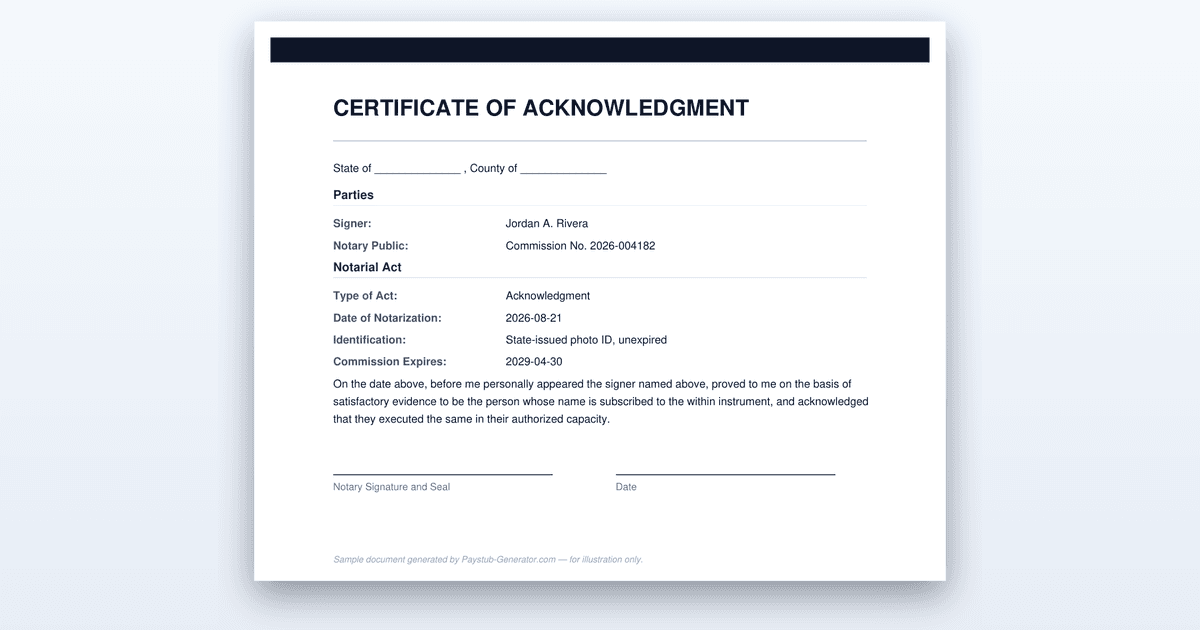
What actually happens at a notarization: leaving the document unsigned, the ID that works, finding a notary, witnesses, and checking the certificate afterwards.
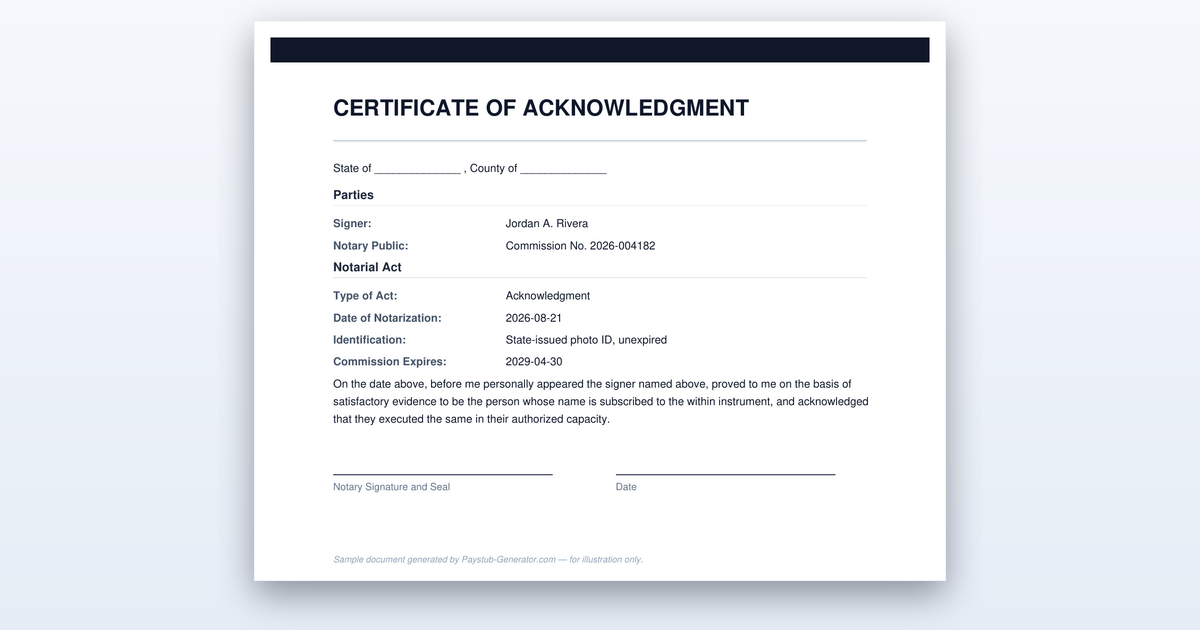
Short on time? You can also create the document you need in just a couple of minutes.
Key Takeaways
- •Do not sign the document before you arrive; the notary is witnessing the signature itself.
- •An acknowledgment confirms identity and willingness; a jurat is an oath that the contents are true, and the document specifies which it needs.
- •Notarization is not the same as witnessing, and a document can require both.
- •Remote online notarization is authorized in many states, though the receiving party may still prefer a physical seal.
How to Notarize a Document: The Complete Step-by-Step Guide
To notarize a document correctly, you bring your completed but unsigned paperwork, a current government-issued photo ID, and any required witnesses to a licensed notary, then sign in their presence and verify the certificate before you leave. The process takes about ten minutes once you are face-to-face with the notary, but the preparation beforehand is what separates a smooth appointment from a wasted trip. Seven steps cover the entire process, from confirming the document actually needs notarization to checking the final certificate for errors.
Before You Start
You need four things in hand before you even search for a notary, and each one is a hard requirement. First, the completed document itself with every blank filled in — a notary will refuse a document with empty fields because they cannot notarize something that could be altered later. Second, a current, unexpired government-issued photo ID with your signature on it, such as a driver's license, state ID card, or passport. Third, any witnesses the document itself names, each with their own valid photo ID. Fourth, the notary's fee in the form they accept, which is typically cash, though some accept cards or checks. If you show up without any of these, the notary will send you away and you will have to schedule a second appointment. The single most common mistake people make is signing the document at home before they arrive, which defeats the entire purpose of the notarial act.
Step-by-Step: Notarizing Your Document
Step 1: Confirm the Document Actually Needs Notarization
Not every piece of paper with a signature line requires a notary, and showing up with a document that does not need one wastes everyone's time. Real estate deeds, powers of attorney, living wills, and many affidavits are the classic documents that demand notarization because they transfer rights or make sworn statements that a court may rely on. Most ordinary contracts — a lease, a freelance agreement, a purchase order — do not require a notary at all; they are valid once both parties sign.
The document itself will tell you what it needs, so read the signature block carefully. If it contains language like "acknowledged before me" or "subscribed and sworn to before me," it is specifying the exact type of notarial act required. An acknowledgment means the notary verifies your identity and that you signed willingly. A jurat means you are swearing under oath that the contents of the document are true. The distinction matters because a notary who performs the wrong act has not validly notarized the document, and the receiving agency may reject it. If the signature block has no such language, the document likely does not need notarization at all — you can simply sign it and move on with your day.
Step 2: Fill It In Completely, But Do Not Sign It
This is the step where most people trip up, because signing a document feels like the natural final act. The notary's entire job is to witness you signing, so if you arrive with your signature already on the page, the notary cannot truthfully certify that they saw you sign it. Most notaries will refuse to proceed, and some states explicitly forbid notarizing a pre-signed document. Fill in every blank field before you arrive — names, dates, property descriptions, dollar amounts — because a notary will also refuse a document with empty spaces, since a blank could be filled in later with terms you never agreed to.
If you are unsure what belongs in a particular field, leave it blank and ask the notary whether they can proceed, but expect most to say no. The correct approach is to complete the document fully at home, leave the signature line empty, and bring it to the appointment ready to sign. You should also make sure you are signing in the correct color ink — blue or black — and that you are signing exactly as your name appears on your ID. A signature that does not match your ID's signature can raise questions, and the notary may ask you to sign again in their presence to confirm consistency.
Step 3: Bring Identification the Notary Can Accept
The standard for notary identification is an unexpired government-issued photo ID that includes your signature. A driver's license, state identification card, or passport satisfies this in every state. The name on that ID must match the name on the document exactly, which becomes a problem if you have recently changed your name through marriage, divorce, or court order. If your ID says one name and the document says another, the notary cannot verify that you are the person named in the document, and they will refuse to proceed.
The fix is to bring the supporting paperwork that connects the two names — a marriage certificate, divorce decree, or court order — so the notary can see the chain from your old name to your new one. Some notaries will also accept two forms of non-photo identification or rely on a credible witness who vouches for your identity, but these are exceptions, not the rule, and you should not count on them. If your ID expires within the next few weeks, check the expiration date before you drive anywhere, because an expired ID is the same as no ID to a notary.
Step 4: Find a Notary and Check What They Can Do
Your options for finding a notary are broader than most people realize. Banks and credit unions are the most common choice because they typically notarize for account holders at no charge, though you may need to be a customer. Shipping stores like UPS locations, law offices, title companies, and courthouses all employ notaries, and they charge a fee that varies by state — typically between $2 and $15 per notarization, though mobile notaries who travel to you can charge significantly more for the convenience.
Before you go, call ahead and confirm two things: that a notary is actually on site, and that they are willing to handle your specific document type. Some notaries refuse to notarize wills or powers of attorney because of the liability involved, so you want to know that before you drive across town. Also ask what forms of payment they accept, since many notaries only take cash. Remote online notarization is now authorized in many states, which allows you to complete the entire process over a video call using an approved platform, but the receiving party may still prefer a physical seal, so verify that a remote notarization will be accepted before you choose that route.
Step 5: Bring Any Witnesses the Document Requires
Notarization and witnessing are two separate legal requirements, and a document can demand both. The notary verifies your identity and witnesses your signature, but witnesses are individuals who attest to the fact that you signed the document, and they are often required for wills, deeds, and powers of attorney. If your document calls for witnesses, you must bring them to the appointment — the notary does not provide them.
The critical restriction is that witnesses cannot be beneficiaries or interested parties named in the document, because their testimony would be biased. A witness who inherits under a will has a direct financial interest in that will being valid, which defeats the purpose of their attestation. Each witness must bring their own valid photo ID, and they will sign the document in the notary's presence alongside you. If you arrive without witnesses for a document that requires them, the notary cannot proceed, and you will need to reschedule.
Step 6: Sign in Front of the Notary and Answer the Required Question
When you are ready, the notary will ask you to sign the document in their presence, and then they will ask you a question that determines the type of certificate they complete. For an acknowledgment, the notary asks whether the signature on the document is yours and whether you signed it willingly — you answer yes, and the notary completes a certificate stating that you acknowledged the signature. For a jurat, the notary administers an oath, asking you to swear or affirm that the contents of the document are true, and you answer yes under penalty of perjury.
The document itself told you which one it needs back in Step 1, and the notary will follow that requirement. After you answer, the notary fills out the notarial certificate — the section with the venue, date, your name, and the notary's commission details — signs it, and applies their official seal. The entire exchange takes less than two minutes, but it is the legal heart of the entire process. Do not rush this moment; answer clearly and make sure you understand the question before you respond.
Step 7: Check the Certificate Before You Leave
Before you walk out the door, examine the completed notarial certificate as if you were the agency that will receive it. The certificate must state the correct venue — the county and state where the notarization occurred — because a wrong county can invalidate the document. The date must be accurate, your name must be spelled correctly, and the notary's signature and seal must both be present. The seal should include the notary's name, commission number, and commission expiration date; if any of these elements are missing or incorrect, the document will be rejected when you submit it, and you will have to track down the notary again to fix it.
A notary who has already left the office or moved on to another appointment is not easy to track down, so do this check while they are still in front of you. If you spot an error, point it out immediately and ask them to correct it before you leave. A notary cannot legally alter a certificate after the fact without re-performing the notarial act, so the correction needs to happen right then, in their presence, with the document still in front of both of you.
Worked Example
Let us walk through a realistic scenario so you can see how this actually plays out. Maria, a homeowner in Austin, Texas, is selling her house and needs to sign a warranty deed transferring ownership to the buyer. The title company emailed her the deed and told her it must be notarized before she returns it. She reads the signature block, which says "ACKNOWLEDGED before me," telling her this is an acknowledgment, not a jurat. Maria fills in her name, the buyer's name, and the property's legal description at her kitchen table, but she leaves the signature line blank. She pulls out her Texas driver's license, checks that it expires in 2026, and confirms her name on the license — Maria Elena Rodriguez — matches the name on the deed. Her bank, Wells Fargo, notarizes for account holders free of charge, so she calls the branch and confirms a notary is on duty that afternoon. The deed does not require witnesses, so she does not bring any. At the bank, she shows her ID, signs the deed in front of the notary, and answers "Yes" when asked if she signed willingly. The notary completes the certificate, writes "Travis County, Texas" as the venue, stamps her seal with commission number and expiration date, and hands the deed back. Maria checks that the date, her name, and the seal are all correct before leaving. Total time: eleven minutes, cost: zero. She emails the signed deed back to the title company, and the sale closes on schedule. This example uses fictional figures for illustration — your own fees, time, and requirements will depend on your state and the documents you are signing.
Where People Get This Wrong
The most common failure is signing the document before arriving, and it happens constantly because people think the notary is checking their identity rather than witnessing their signature. The consequence is a refused notarization and a second trip, or worse, a notary who notarizes anyway and exposes themselves to liability. The fix is simple: leave the signature line blank until the notary tells you to sign.
The second common mistake is arriving with an expired ID. People assume their old license is fine because it has their photo and signature, but a notary cannot accept expired identification under any state's rules. The consequence is that you are turned away, and you have to find your current ID or reschedule. The third mistake is assuming a notarized document is the same as a witnessed document, so people show up alone to sign a will that requires two witnesses. The consequence is that the notary cannot proceed, and you have to bring witnesses to a second appointment. The fourth mistake is failing to check the certificate before leaving, assuming the notary got everything right. The consequence is a rejected document days later, when the notary is no longer easy to find, and you have to pay again for a new notarization. Read the certificate while the notary is still in the room.
When to Get Professional Help
If you are notarizing a document that involves significant money, real estate, or your estate plan, it is worth having a lawyer review the document before you notarize it, because notarization only verifies your signature — it does not make the document's terms legal or fair. A real estate attorney should review any deed you are signing, and an estate attorney should draft your will or power of attorney rather than using a downloaded template. If you are being asked to sign something you do not fully understand, or if the document involves a dispute, do not notarize it until a lawyer has explained the consequences. A notary is not allowed to give legal advice, so they cannot help you with this. If a document has already been rejected because of a certificate error, contact the notary's commissioning agency — usually your secretary of state — to understand your options for correction.
The Bottom Line
Notarization is a simple process that fails for predictable reasons: signing too early, bringing the wrong ID, forgetting witnesses, or leaving with an incomplete certificate. Prepare the document fully at home, leave it unsigned, bring valid identification and any required witnesses, and verify the completed certificate before you leave. Ten minutes of preparation saves you a second trip and a second fee.
Need This Document Done Right?
Create a clean, professional version in minutes with our generator.
Create a Legal DocumentFrequently Asked Questions
Can I sign the document before I get to the notary?
No, for most notarial acts. The notary is witnessing you sign. Bring it completed but unsigned.
What ID do I need?
An unexpired government-issued photo ID bearing your signature, with a name that matches the document. If your name has changed, bring the document connecting the two.
Where can I get something notarized for free?
Many banks and credit unions notarize at no charge for account holders. Public libraries and some employers also offer it.
Authoritative References
The rules described here come from the agencies that set them. Check the current text before you rely on a deadline or a figure:
Related Guides
- Is a Free Legal Document Template Actually Legally Binding?
- The Comprehensive Guide to Cease and Desist Letters
- Comprehensive Guide to Creating a Durable Power of Attorney
- How to Sign and Witness a Will So It Is Legally Valid
- How to Revoke a Power of Attorney
Sources: Paystub-Generator.com editorial team. This guide is informational and not legal or tax advice.
This guide is part of our Legal Forms service — NDAs, bills of sale and demand letters.
Explore Legal FormsLegal Forms Knowledge Hub
Explore our suite of legally binding templates in the Legal Forms category.
Citations & Legal Sources
- Paystub-Generator.com editorial team

