
How to Revoke a Power of Attorney
Marcus Vance / Payroll Operations Editor
Reviewed by: Reviewed by the Paystub Generator Editorial Team
Legal Reviewer
Last Updated: August 29, 2026
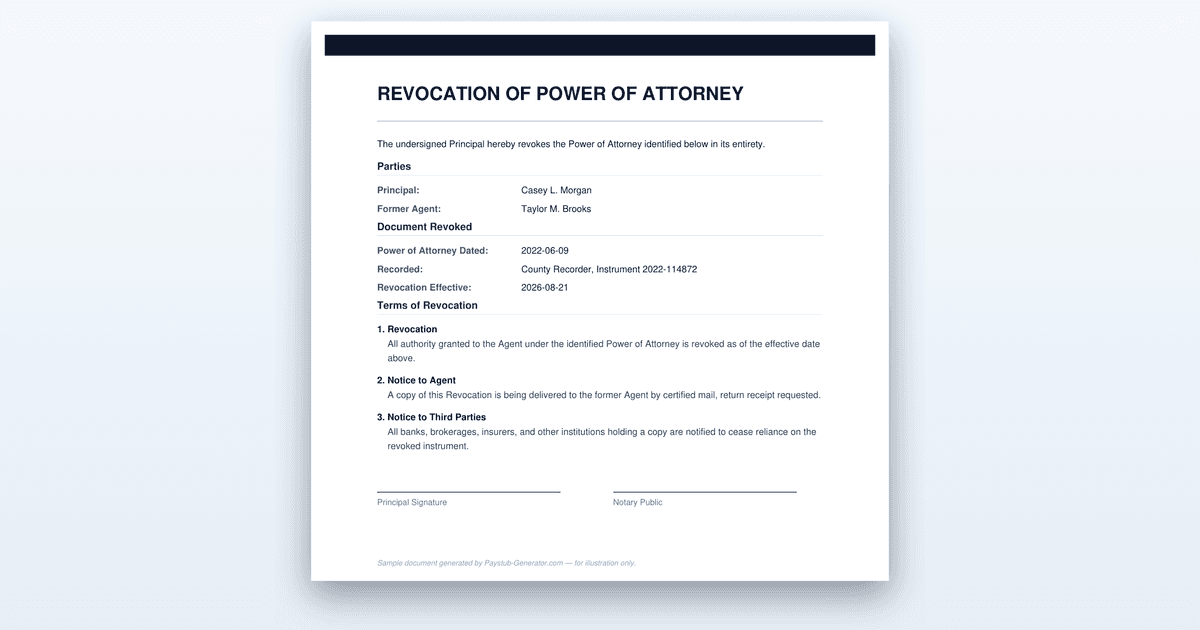
Revoking a power of attorney takes more than tearing it up. Seven steps: the written revocation, notarizing, notifying the agent, and telling every third party.
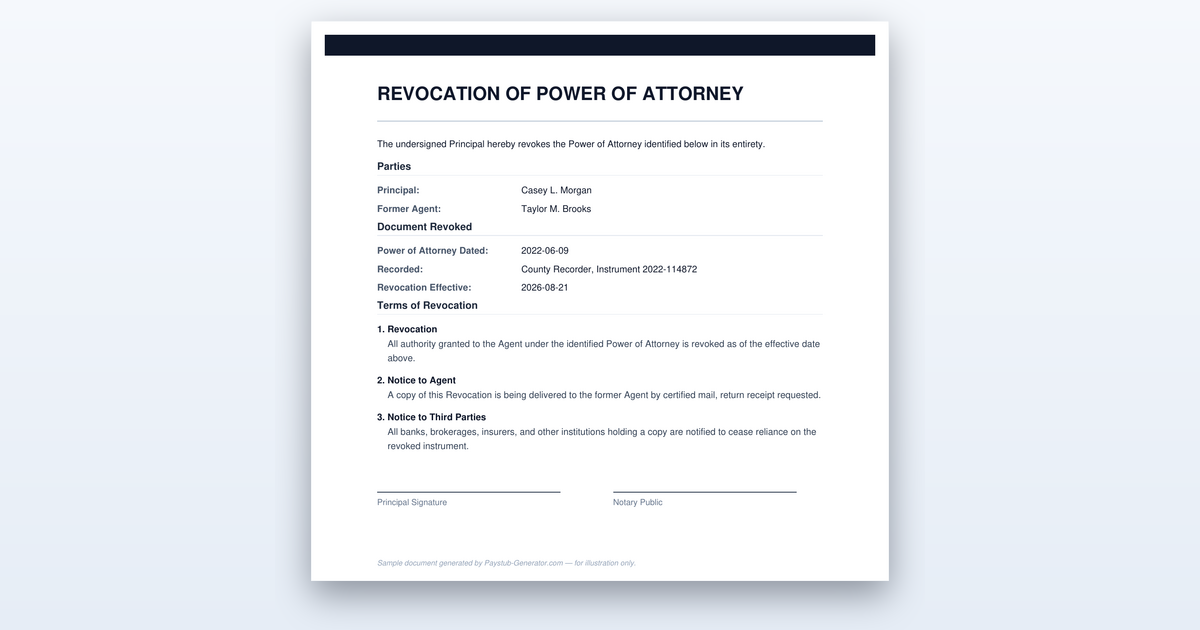
Short on time? You can also create the document you need in just a couple of minutes.
Key Takeaways
- •Revocation requires the same capacity that granting the authority required.
- •A written, notarized revocation naming the original document and its date is the standard instrument.
- •The agent's actions can still bind you until they have actual notice of the revocation.
- •Third parties holding a copy keep relying on it until each receives the revocation directly.
How to Revoke a Power of Attorney: The 7-Step Process That Actually Ends the Agent's Authority
To revoke a power of attorney, you must complete a seven-step process: confirm your mental capacity, review the original document for its own revocation terms, draft a precise written revocation, sign it before a notary, deliver it to the agent with proof of receipt, notify every third party that holds a copy, and record the revocation if the original was recorded with a county office. The entire process takes about one to two weeks if you have all your documents in order—the drafting and notarization take a single day, while the delivery and notification steps account for the rest. This guide walks you through each step so you can be certain the agent's authority is truly ended and no bank, broker, or other institution will honor the old document again.
Before You Start
Before you draft a single sentence of your revocation, you need to gather the original power of attorney document or a clear copy that shows its exact execution date. Without this, you cannot properly identify the document you are revoking, and a vague revocation that fails to name the specific instrument is almost guaranteed to be rejected by a bank or title company. You also need the agent's full legal name and current mailing address, because you must deliver the revocation to them in a way that produces proof of receipt—and you cannot do that if you are working with an outdated address.
You also need a list of every institution that has been given a copy of the power of attorney or has relied on it in any way. This includes banks, brokerages, insurers, retirement plan administrators, medical providers, and any title company involved in a real estate closing. Finally, you must determine whether the power of attorney was recorded with a county office—usually the county recorder or clerk where you own real property—because if it was, your revocation must be recorded in the same place to be effective against future title searches. If you start this process without this information, you will likely complete the revocation for the agent but leave third parties still holding the old document, which defeats the entire purpose.
Step-by-Step: How to Revoke a Power of Attorney
Step 1: Confirm you still have capacity to revoke
The law requires that you have the same mental capacity to revoke a power of attorney that you needed to grant it in the first place. This means you must understand what the power of attorney is, what authority it grants, and what the consequences of revoking it will be. If a doctor or a family member has raised genuine questions about your cognitive state, revocation is not the tool you should be reaching for—this becomes a matter for a lawyer or a guardianship court, and proceeding on your own could leave the revocation open to challenge later.
The practical test is straightforward: can you explain, in your own words, what the power of attorney authorizes the agent to do, and can you state why you want to end that authority? If you can, you have capacity. If you are unsure, or if the agent themselves is the one questioning your capacity, stop and consult an elder law attorney before you do anything else. A revocation signed under a cloud of capacity questions is a document that will be challenged in court precisely when you need it to work.
You will know this step is complete when you are confident—and can articulate—that you understand the document you are revoking and the effect of the revocation. If there is any doubt in your mind, resolve it before moving forward.
Step 2: Read the original document for its own revocation terms
Many powers of attorney contain their own provisions governing how they may be revoked. Some specify that revocation must be in writing and delivered to the agent by certified mail. Others name successor agents and state whether a revocation of the primary agent automatically activates the successor or whether the entire document is voided. Some documents, particularly those created for real estate transactions, state that revocation is effective only upon recording. You must follow these terms in addition to whatever your state law requires—a revocation that ignores the document's own instructions is procedurally defective.
The judgment call here is about how much weight to give the document's language versus your state's default rules. State law generally sets the floor: most states accept a written, signed, and notarized revocation as sufficient, regardless of what the document says. But if the document requires something more specific, like delivery by a particular method or notice to a successor agent, you should comply with it. The cost of ignoring the document's terms is that the revocation can be challenged, and in the meantime the agent's authority remains in question.
This step works when you have read the entire document, not just the grant of authority, and you have noted every clause that deals with revocation, amendment, successors, and termination. If the document is silent on revocation, proceed with the standard steps below.
Step 3: Draft a written revocation that identifies the document precisely
Your revocation must name you as the principal, identify the agent by full legal name, and reference the power of attorney by its exact execution date. It must state clearly that all authority granted under that specific document is revoked, effective as of a stated date. The single most common reason a revocation fails is vague wording—a statement like "I revoke the power of attorney I gave to my son" does not identify which document, from which date, you are revoking, and a bank will not act on it.
The document should also state that you are revoking the authority of any successor agents named in the original, unless you intend to keep them in place. If you are revoking only one agent but the document names successors, you must say so explicitly. You should also include a statement that you are notifying all third parties who may have received a copy of the original, and that they should no longer rely on it. This is the standard instrument that every institution will expect to see.
You will know this step is complete when you can hand the draft to a stranger and they can tell you exactly which document is being revoked, who the agent is, and when the revocation takes effect. If any of those facts require explanation, the draft is not precise enough.
Step 4: Sign it before a notary
Notarize the revocation even if your state does not strictly require it. A notarized revocation signals to banks, title companies, and other institutions that the signature is genuine and that you appeared in person to execute the document. An unnotarized revocation is easy for an institution to treat as insufficient—many will simply refuse to accept it because they cannot verify the signature, and they have no obligation to investigate further.
The notary will require you to present valid identification and will likely ask you to confirm that you are signing voluntarily and understand the document. This is the point where your capacity is informally tested, because the notary is required by law to refuse service if they believe you do not understand what you are signing. The notarization also creates a notarial record that can be used later to prove the date and circumstances of your signature.
This step is complete when you hold a signed, notarized revocation in your hands. Make at least three copies for your own records and for the notifications you will send in the next steps.
Step 5: Deliver it to the agent in a provable way
Until the agent has actual notice of the revocation, their actions can still bind you. This is a hard rule of agency law: an agent who acts in good faith without knowledge of revocation is generally protected, and you can be held to the consequences of their actions. This means you cannot simply tell the agent over the phone or in person that you are revoking their authority—you must deliver the written revocation in a way that produces proof of receipt.
Certified mail with return receipt requested is the standard method, and it costs roughly ten dollars. Send the revocation to the agent's current address, and keep the green return receipt card when it comes back. If the agent refuses to accept the mail, the returned envelope with the refusal notation still serves as evidence of your attempt. You can also use a process server if you expect the agent to be difficult, though this is more expensive and rarely necessary.
This step is complete when you have the return receipt or other proof of delivery in hand. Do not move on to notifying third parties until you have this proof, because the order matters—the agent should hear it from you, not from a bank.
Step 6: Notify every third party that holds a copy
This is the step that people skip, and it is the one that actually stops the old authority from being used. A power of attorney does not automatically become void in the eyes of a bank or insurer simply because you revoked it with the agent—each institution that holds a copy will keep relying on it until you directly notify them. You must send each one a copy of the notarized revocation along with a cover letter instructing them to remove the old document from their records and to refuse any future requests made under its authority.
The judgment call here is about who exactly needs to be notified. Start with every institution you listed in the "Before You Start" phase—banks, brokerages, insurers, retirement plan administrators, medical providers, and title companies. Then think about who else might have seen the document: an accountant who filed taxes, a property manager, a safe deposit box custodian, or a family member who was present at the original signing. When in doubt, send the notice. The cost of a missed institution is that the agent can still use the old document there, and you will not find out until after the damage is done.
This step is complete when you have sent a revocation notice to every institution on your list and you have a record of each mailing. Follow up by phone after a week to confirm each institution has actually processed the revocation and updated their records.
Step 7: Record the revocation if the original was recorded, then replace it
If the original power of attorney was recorded with a county office—which is almost always the case when it covered real estate—you must record the revocation with the same office. This is not optional: an unrecorded revocation leaves the old document in the public record, and a future title search will show the agent's authority as still active. Take your notarized revocation to the county recorder or clerk's office where the original was recorded, pay the recording fee (typically twenty to fifty dollars), and ask for a certified copy of the recorded revocation.
Once the revocation is recorded, you need to decide whether you still need a power of attorney at all. If you do—and most people do, because the original was created for a reason—execute a new power of attorney that names a different agent, and state in the new document that all prior powers of attorney are expressly revoked. This new document should be notarized and, if it covers real estate, recorded as well. The new document gives you the protection you need while ensuring there is no ambiguity about which document is currently in force.
This step is complete when the old power of attorney is revoked in the public record and, if you still need one, a new power of attorney is executed and distributed to the institutions that need it.
Worked Example
Let's walk through a realistic scenario. Margaret, a 68-year-old retiree in Ohio, granted a durable power of attorney to her daughter Claire in March 2019. The document was recorded with the Franklin County Recorder because it authorized Claire to sell Margaret's condo. In January 2025, Margaret discovers that Claire has been making unauthorized withdrawals from her brokerage account, and she decides to revoke the document and appoint her son David instead.
Margaret starts by confirming she understands what she is doing—she can explain that the document gives Claire authority over her finances and that she wants to end that authority immediately. She pulls out the original document and reads it, finding that it contains a clause requiring revocation to be in writing and delivered by certified mail. She drafts a one-page revocation that states: "I, Margaret Ellis, revoke the Durable Power of Attorney executed on March 15, 2019, naming Claire Ellis as my attorney-in-fact, effective immediately." She signs it before a notary on January 20, 2025.
Margaret sends the revocation to Claire by certified mail with return receipt, and the card comes back signed on January 24. She then sends copies of the notarized revocation to her bank, her brokerage, her insurance company, and the Franklin County Recorder. The county recorder accepts the revocation and issues a certified copy showing it recorded on January 28. Margaret then executes a new durable power of attorney naming David as her agent, stating that all prior powers are revoked, and she sends copies to the same institutions. By February 3, every institution has confirmed in writing that the old document has been removed from their records and Claire's authority is terminated. This example is illustrative only—your own figures and timeline will differ, but the sequence of steps is the same.
Where People Get This Wrong
The most common failure is skipping the third-party notifications entirely. People revoke the power of attorney with the agent, assume the job is done, and then discover months later that the agent wrote a check at a bank that never received notice of the revocation. The bank was within its rights to honor the check because it had no notice, and the principal is left trying to recover the funds. The fix is to treat the notification list as the core of the process, not an afterthought—if you have not personally delivered the revocation to an institution, you have not revoked the authority there.
Another frequent mistake is failing to record the revocation when the original was recorded. A principal revokes a power of attorney that covered real estate but never records the revocation with the county, and years later a title search reveals the old document. The title company flags it, the sale is delayed, and the principal has to scramble to record the revocation retroactively. The fix is simple: check the county recorder's records before you start, and if the original is there, your revocation goes there too.
A third error is relying on an oral revocation or a vague written statement. A principal tells the agent "you're fired" over the phone and assumes that ends it, but the agent later acts on the authority and the principal is bound because the agent had no written notice. Even worse, some people write a revocation that says "I revoke the power of attorney I gave to my daughter" without naming the date—and the bank rejects it because it cannot identify the document. The fix is to always put the revocation in writing, name the exact document and date, and deliver it with proof.
When to Get Professional Help
You should get professional help if you have any doubt about your mental capacity, if the agent is actively using the power of attorney and refusing to acknowledge the revocation, if the power of attorney covers significant real estate holdings, or if the original document contains unusual terms that are difficult to interpret. An elder law attorney or a general practitioner who handles estate planning can draft the revocation, ensure it complies with your state's specific requirements, and handle the recording and notification process. This is also the right call if you are revoking a power of attorney during a divorce or separation—the emotional dynamics make it easy to miss procedural steps, and a lawyer can ensure the revocation is airtight before your spouse or former spouse has a chance to use the old document. The cost of a lawyer is typically two to four hundred dollars for a straightforward revocation, which is cheap compared to the cost of an agent who continues to act with impunity.
The Bottom Line
Revoking a power of attorney is a simple process on paper, but it only works if you complete every step: confirm capacity, read the original, draft a precise revocation, notarize it, deliver it to the agent with proof, notify every third party, and record it if the original was recorded. The step that matters most is the one people skip—direct notification of every institution that holds a copy of the old document. Do that, and you can be confident the agent's authority is truly over.
Need This Document Done Right?
Create a clean, professional version in minutes with our generator.
Create a Legal DocumentFrequently Asked Questions
Is it enough to destroy the original document?
No. Third parties holding copies will keep honouring them. A written revocation, delivered to the agent and to every institution that has a copy, is what actually ends the authority.
Does the revocation have to be notarized?
Not everywhere, but do it anyway. Banks and title companies compare the revocation against a notarized original and often refuse to act on one that is not notarized.
Does a new power of attorney automatically cancel the old one?
Only if it says so, and even then third parties holding the old copy need notice. State the revocation of prior powers expressly in the new document and still send a revocation to everyone who has the old one.
Authoritative References
The rules described here come from the agencies that set them. Check the current text before you rely on a deadline or a figure:
Related Guides
- Is a Free Legal Document Template Actually Legally Binding?
- The Comprehensive Guide to Cease and Desist Letters
- Comprehensive Guide to Creating a Durable Power of Attorney
- How to Notarize a Document: What to Bring and What Happens
- How to Sign and Witness a Will So It Is Legally Valid
Sources: Paystub-Generator.com editorial team. This guide is informational and not legal or tax advice.
This guide is part of our Legal Forms service — NDAs, bills of sale and demand letters.
Explore Legal FormsLegal Forms Knowledge Hub
Explore our suite of legally binding templates in the Legal Forms category.
Citations & Legal Sources
- Paystub-Generator.com editorial team

