
How to Raise Rent Legally: Notice, Limits, and the Letter
Marcus Vance / Payroll Operations Editor
Reviewed by: Reviewed by the Paystub Generator Editorial Team
Legal Reviewer
Last Updated: August 29, 2026
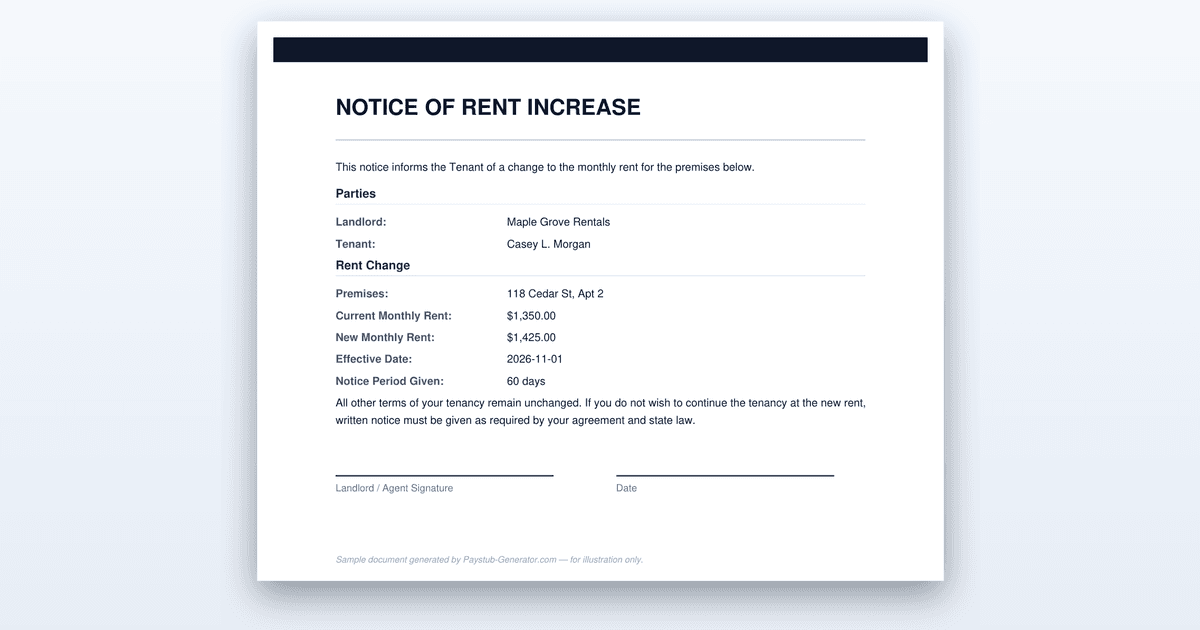
Raise rent without voiding the increase: check the lease and rent caps, price it against comps, calculate the notice period, and deliver a documented notice.
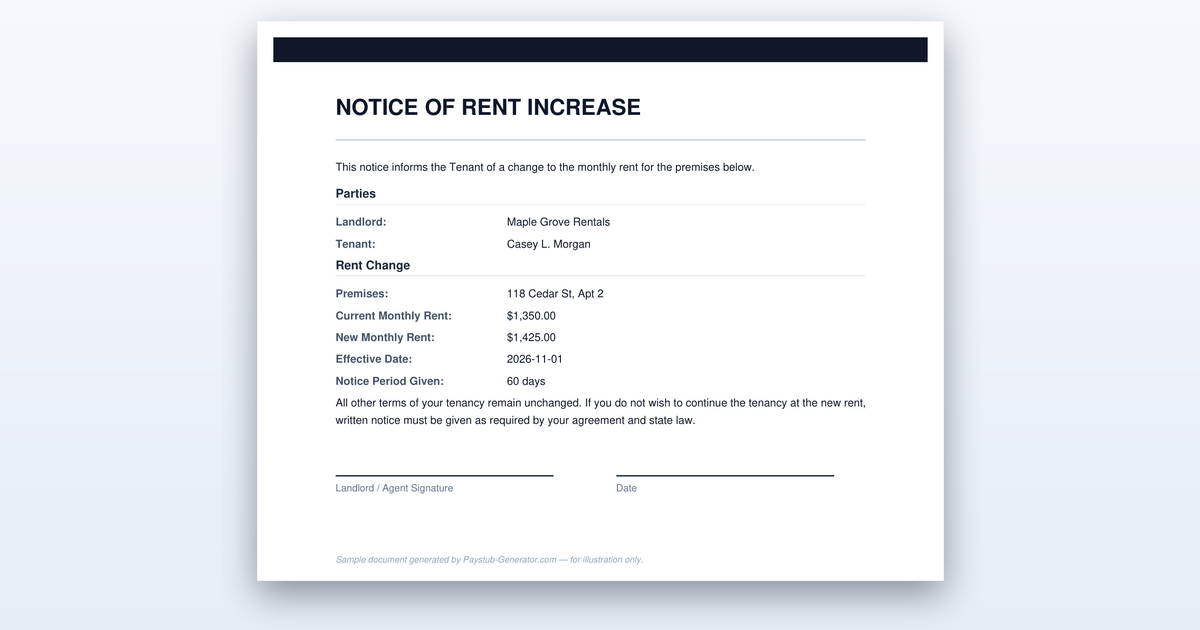
Short on time? You can also create the document you need in just a couple of minutes.
Key Takeaways
- •A fixed-term lease locks the rent for the term unless an escalation clause says otherwise.
- •Rent caps exist at both city and state level, and exemptions frequently turn on the building's age or whether the owner occupies it.
- •The required notice period often increases once the raise passes a percentage threshold.
- •A rent increase notice must state the current rent, the new rent, and the exact effective date to be enforceable.
To raise rent legally, you must first confirm your lease allows it, then verify whether a rent cap applies to the unit, set the new amount against market comparables, calculate the required notice period based on the increase's size, and deliver a written notice with the specific new rent and effective date. The process takes roughly 30 to 90 days from start to finish, depending on your state and the size of the increase. The entire legality of how to raise rent legally hinges on timing, notice, and whether a local cap overrides your plan.
Before You Start
Before you draft a single word, you need four things in hand: the current lease and its exact end date, confirmation of whether the unit falls under rent control, rent stabilization, or a state-wide cap, a list of comparable rents for the same unit type in your immediate area, and your state's required notice period for the specific increase size you have in mind. If you start without the lease, you risk attempting an increase mid-term on a fixed lease, which is unenforceable and will cost you the goodwill of a tenant who now knows you do not know the rules. If you skip the cap check, you may send a notice that is void on arrival, and a tenant who knows their rights will simply ignore it. Take the hour to gather these items before you commit to a number, because every step after this depends on the facts you establish here.
Step-by-Step: Raising Rent the Legal Way
Step 1: Check Whether the Lease Even Allows an Increase Now
A fixed-term lease locks the rent for its entire term unless the lease itself contains an escalation clause, a provision that permits a rent adjustment before the term ends. If your tenant signed a 12-month lease at $1,200 per month, you cannot raise the rent to $1,300 in month six simply because market rates have moved. The lease is a contract, and the rent is a fixed term of that contract. Attempting a mid-term increase without an escalation clause is not just bad practice; it is unenforceable, and a tenant who refuses to pay the extra amount will win if the dispute reaches a court or a rent board.
The real question in this step is often when rather than how much. If the lease is month-to-month, you can raise rent at any time, subject only to the notice period and any caps that apply. If the lease is fixed-term, your opportunity arrives at the natural end of the term, when you can propose a renewal at a new rate or let the tenancy convert to month-to-month. Read the lease's renewal clause carefully, because some leases automatically convert to month-to-month at the end of the term, while others require a new signed agreement. You know this step worked when you can state, without ambiguity, the earliest date on which a new rent can legally take effect, and you have identified the clause in the lease that permits it.
Step 2: Find Out Whether a Cap Applies to This Unit
Rent control and rent stabilization operate at the city level, and several states now cap annual increases outright, sometimes with exemptions for newer buildings or owner-occupied properties. In New York City, for example, rent-stabilized units have a maximum increase set annually by the Rent Guidelines Board, and that number applies regardless of what the market will bear. In Oregon, a state-wide cap limits annual increases to a percentage tied to inflation, but the cap does not apply to buildings less than 15 years old. California's Tenant Protection Act caps increases at 5 percent plus inflation, capped at 10 percent total, but exempts properties built within the last 15 years and units in buildings where the owner occupies one of the units.
You must confirm the status of your specific unit rather than the general rule. A building that is exempt from rent control because it was built after a certain year is still subject to a state cap, and a building that is subject to rent stabilization may have a lower ceiling than the state cap. The fastest way to check is to contact your state's department of housing or your city's rent board and ask whether your property is registered or covered. You know this step worked when you can state the exact maximum percentage you are permitted to raise the rent this year, and you have a source for that number that you can cite if the tenant challenges it.
Step 3: Set the Number Against Actual Comparables
Pull current listings for the same bedroom count, condition, and neighborhood, and be honest about how your unit compares. If three comparable one-bedrooms in your building's immediate area are listed at $1,400, $1,425, and $1,450, and your unit is in average condition with the same amenities, pricing it at $1,500 is a stretch that invites a vacancy. An increase priced above the market invites a vacancy, and turnover, lost rent, and make-ready costs usually exceed the extra you were chasing. A single month of vacancy on a $1,400 rent costs you more than the $100 per month increase you were hoping to secure, and that does not count the cleaning, painting, and advertising costs you will absorb to re-lease the unit.
The judgement call here is whether you are raising rent to match the market or raising it to push a tenant out. Both are legal in most jurisdictions, but they require different strategies. If you are matching the market, set the new rent at or slightly below the median of your comparables to retain a good tenant. If you are pricing to encourage a move-out, you are accepting vacancy risk, and you should price accordingly with the full cost of turnover in mind. You know this step worked when you can justify the new number with at least three active listings or recent lease records, and you would be comfortable presenting that justification to a tenant who asks how you arrived at the figure.
Step 4: Calculate the Required Notice Period
Thirty days is a common minimum for month-to-month tenancies, but many jurisdictions require sixty or ninety days once the increase passes a percentage threshold. In California, for example, a rent increase of 10 percent or less requires 30 days' notice, but an increase above 10 percent requires 90 days. In New Jersey, the notice period is one full rental period for month-to-month tenancies, which effectively means 30 days, but some municipalities have their own rules. The notice period is driven by the size of the increase as well as the tenancy type, so you cannot assume the same notice works for a 5 percent increase and a 15 percent increase.
Check your state's landlord-tenant statute and your city's municipal code, because the longer notice period often applies at thresholds you might not expect. A 9 percent increase might require 30 days in one state and 60 days in another, and the difference matters because serving the wrong notice means starting over from the beginning. Count the days carefully, and note that the notice period typically runs from the date of service, not the date the notice is written. You know this step worked when you have written down the exact date you must serve the notice and the exact date the new rent takes effect, and you have verified that the notice period is the longer one if your increase crosses the threshold.
Step 5: Write the Notice with the Required Contents
Name the tenant and the property, state the current rent, the new rent, and the exact date the new amount takes effect, and sign and date it. Vague language about a future adjustment is not a notice. A notice that says "rent will increase in the coming months" is worthless, because it does not give the tenant a specific amount or a specific date to respond to. The notice must be a clear, unambiguous statement of the new terms, and it must be in writing even if your state does not explicitly require it. A written notice creates a record, and that record is what you will rely on if the tenant disputes the increase later.
Include the address of the rental unit, the date the notice is served, the current rent amount, the new rent amount, and the effective date. Some states require additional language, such as a statement of the tenant's right to dispute the increase or a reference to the relevant statute, so check your local requirements before you finalize the document. You know this step worked when you can read the notice aloud and a reasonable person would understand exactly what is changing, by how much, and when, and when you have a signed and dated copy in your file.
Step 6: Deliver It in a Way You Can Prove
Use the delivery method your state accepts for a rent increase notice, and keep proof. Certified mail with return receipt requested is the standard in most jurisdictions, because it gives you a dated record of delivery. Personal delivery is acceptable in many states, but only if you can prove the date and the recipient, which usually means a signed acknowledgment from the tenant. Posting the notice on the door is a last resort and is only valid in a narrow set of circumstances, typically when the tenant is unreachable, so do not rely on it as your primary method.
If the increase is later disputed, the argument turns on when the tenant received it, and the notice period starts from that date. A tenant who claims they never received the notice can force you to prove delivery, and without a return receipt or a signed acknowledgment, you have no case. Keep the certified mail receipt, the green card, and a copy of the notice in your file, and do not discard them until well after the new rent has been collected without objection. You know this step worked when you hold a dated proof of delivery in your hand, and the date on that proof gives you enough time to meet the notice period before the effective date.
Step 7: Handle the Response and Update the Paperwork
If the tenant accepts, record the new amount in an addendum or a renewal so the file matches what is being collected. A verbal agreement to the new rent is not enough, because you need a written record that the tenant agreed to the new terms. If the tenancy is month-to-month, the tenant's continued payment of the new rent after the effective date can constitute acceptance, but a signed addendum is cleaner and eliminates any ambiguity. If the tenancy has a fixed end date, the new rent should be written into a renewal lease, not just tacked onto the old one.
If they give notice instead, you have your answer on the pricing. A tenant who leaves rather than pay the new amount is telling you the market did not support your number, and you should reconsider whether the increase was worth the vacancy. Process the move-out, deduct any legitimate charges from the security deposit, and re-list the unit at a price that reflects what the market will actually bear. You know this step worked when your lease file contains a signed document reflecting the new rent, or you have a signed notice to vacate and a plan for re-leasing the unit.
Worked Example
Let us walk through a realistic scenario so you can see the arithmetic in action. Marcus owns a two-bedroom apartment in Portland, Oregon, rented to a tenant named Dana on a month-to-month tenancy. The current rent is $1,500 per month, and Marcus wants to raise it to $1,650, which is a 10 percent increase. Dana has been a reliable tenant for three years, and Marcus wants to keep her, but he believes the market has moved.
First, Marcus checks the lease. It is month-to-month, so he is free to raise the rent subject to Oregon's statewide cap and its notice rule. The lease's 30-day termination clause governs ending the tenancy, not raising the rent, and it does not shorten the notice Oregon requires. Oregon's cap allows an increase of 7 percent plus the Consumer Price Index, with a hard ceiling of 10 percent, and the building is more than 15 years old, so the cap applies. A 10 percent increase is at the very edge of the cap, so Marcus checks the current CPI figure and confirms the cap is 9.9 percent this year. He sets the new rent at $1,635, which is 9 percent, to stay safely under the cap.
Next, Marcus pulls comparables. Three two-bedrooms in his neighborhood are listed at $1,600, $1,625, and $1,650. His unit is in good condition with updated appliances, so $1,635 is defensible against the comparables, and it keeps him below the highest listing. He calculates the notice period. Oregon requires at least 90 days' written notice before a rent increase takes effect in a month-to-month tenancy, and that 90 days applies no matter how small the increase is — there is no shorter notice for a modest raise, which is where landlords who assume the California-style percentage threshold get caught. He drafts the notice, naming Dana, the property address, the current rent of $1,500, the new rent of $1,635, and the effective date 90 days out. He signs and dates it, sends it by certified mail with return receipt requested, and files the receipt.
Dana receives the notice, and she has two options: accept the new rent or give 30 days' notice to vacate. She decides to stay, and Marcus prepares a month-to-month tenancy addendum reflecting the new rent of $1,635, which Dana signs. The file is updated, the new rent takes effect on the stated date, and Marcus has completed a legal rent increase that is defensible against any challenge. The example figures above are illustrative only; your actual numbers will depend on your lease, your state's cap, and your local market.
Where People Get This Wrong
The most common mistake is attempting a mid-term increase on a fixed lease without an escalation clause. A landlord who sends a notice in month four of a 12-month lease is asking the tenant to voluntarily pay more than the contract requires, and the tenant is within their rights to refuse. The consequence is a damaged relationship and a notice that is legally void, and the fix is to wait for the lease end and propose the increase at renewal.
The second failure is ignoring the cap because the landlord assumes the building is exempt. A building that is exempt from city-level rent control may still be subject to a state cap, and a landlord who raises rent above the cap is liable for the excess, which the tenant can recover. The consequence is a refund obligation plus potential penalties, and the fix is to confirm the unit's status with the state housing agency before setting the number.
The third mistake is serving the wrong notice period for the size of the increase. A landlord who serves 30 days' notice for a 12 percent increase in a state that requires 90 days has invalidated the notice, and the effective date is pushed back by the full 90 days from the date of service. The consequence is a two-month delay in the new rent, and the fix is to check the threshold before you decide on the percentage.
The fourth failure is delivering the notice without proof. A landlord who hands the notice to the tenant in person but does not get a signed acknowledgment has no evidence of the date of service, and a tenant who claims they never received it can force a restart. The consequence is a delayed increase and a credibility problem, and the fix is to use certified mail or obtain a signed receipt.
What Tenants Can Do When an Increase Looks Improper
If you receive a rent increase notice and believe it violates the lease, the cap, or the notice period, your first step is to check your state's landlord-tenant statute and your local rent board's rules. If the increase exceeds the cap or the notice is too short, the notice is void, and you can refuse to pay the new amount. If the increase is mid-term on a fixed lease, it is unenforceable, and you should continue paying the contract rent. Document everything, including the notice, the envelope, and any communication with the landlord, and consider contacting a tenant rights organization or a housing attorney if the landlord attempts to evict or retaliate. In most jurisdictions, retaliation for refusing an improper increase is itself illegal, and you have protections against it.
When to Get Professional Help
If your property is in a rent-controlled jurisdiction, if you are facing a tenant dispute over the increase, or if you are unsure whether your unit is exempt from a cap, consult a landlord-tenant attorney or your local rent board before you serve the notice. The cost of a consultation is typically a few hundred dollars, which is far less than the cost of a void notice, a refund obligation, or a tenant who withholds rent. Similarly, if you are a tenant facing an increase that appears to violate the cap or the notice period, a tenant rights organization or a housing attorney can tell you whether you have a case before you refuse to pay.
The Bottom Line
Raising rent legally is a matter of timing, notice, and compliance with caps, and the process is straightforward once you have the facts in hand. Check the lease, confirm the cap, set a defensible number, serve the correct notice with the required contents, and keep proof of delivery. A tenant who knows their rights will respect a landlord who follows the rules, and a clean, documented increase is the best protection you have against a dispute.
Frequently Asked Questions
How much notice do I have to give?
Thirty days is a common minimum for month-to-month tenancies, but many places require sixty or ninety days for larger increases. Check both your state rule and any city ordinance, because the stricter one applies.
Can I raise rent in the middle of a lease?
Generally no. A fixed-term lease holds the rent for its term unless it contains an escalation clause that the tenant agreed to when signing.
Is there a legal limit on how much I can raise rent?
In most of the country there is no cap, but a growing number of states and many cities limit annual increases. Confirm the status of your specific unit rather than relying on the general rule.
Authoritative References
The rules described here come from the agencies that set them. Check the current text before you rely on a deadline or a figure:
Related Guides
- Arizona 5-Day Notice to Pay or Quit: Rules and Timing
- California Residential Lease Agreement Template (2026 PDF)
- Eviction Notice for Nonpayment of Rent: State-by-State Guide
- How to Serve an Eviction Notice Correctly
- How to Screen a Tenant: A Landlord's Step-by-Step Process
Sources: Paystub-Generator.com editorial team. This guide is informational and not legal or tax advice.
This guide is part of our Rental Documents service — lease agreements, rent receipts and notices.
Explore Rental DocumentsRental Forms Knowledge Hub
Explore our suite of legally reviewed templates in the Rental category.
Citations & Legal Sources
- Paystub-Generator.com editorial team

