How to Fix a Payroll Error: A Step-by-Step Correction Guide
Marcus Vance / Payroll Operations Editor
Reviewed by: Reviewed by the Paystub Generator Editorial Team
Legal Reviewer
Last Updated: August 29, 2026
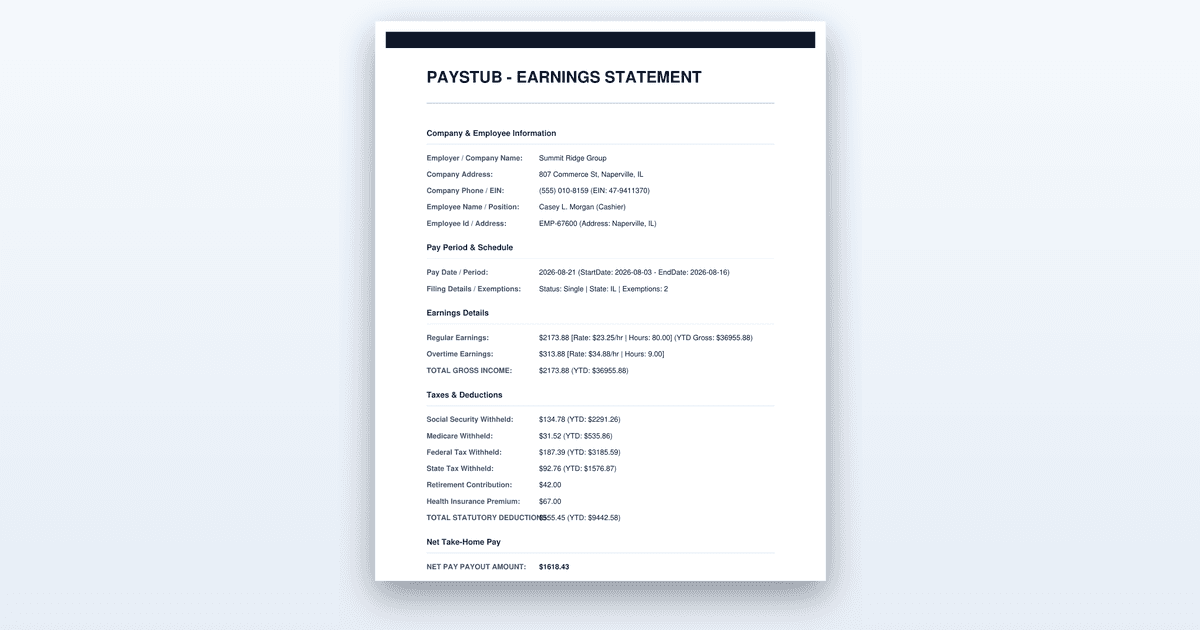
Underpaid, overpaid, or wrong withholding? Six steps to correct a payroll error properly, including the tax filings and the paperwork that has to follow.
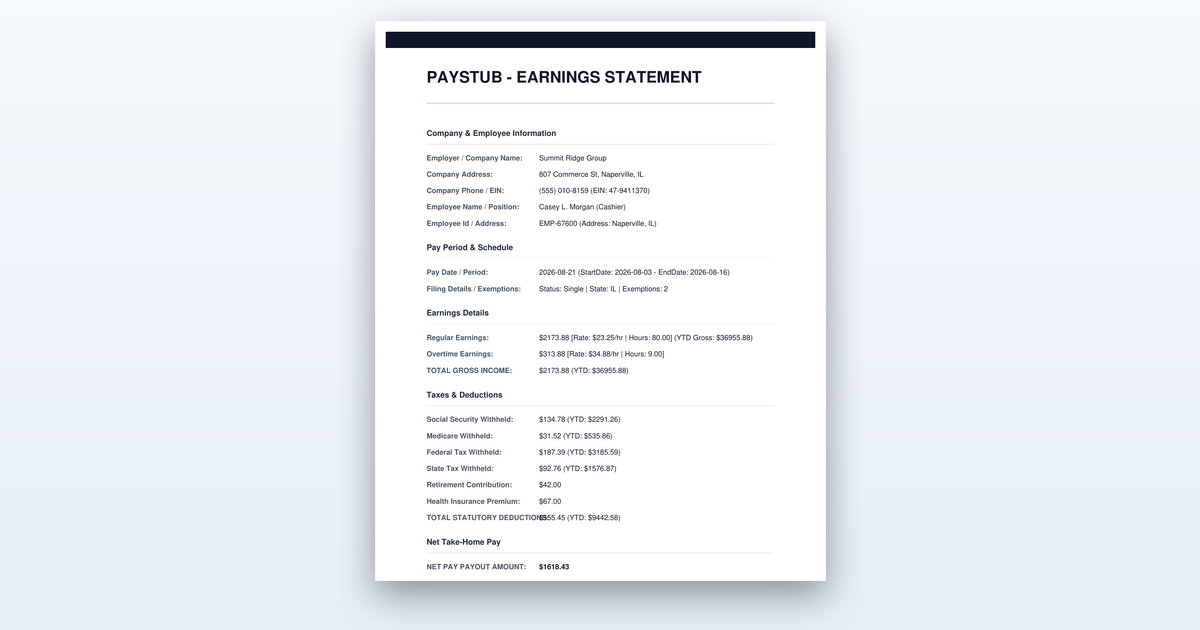
Short on time? You can also create the document you need in just a couple of minutes.
Key Takeaways
- •Underpayment and overpayment are governed by different rules, and overpayment recovery through payroll deduction usually requires the employee's written authorization.
- •Corrections that cross a quarter or a tax year require amended payroll tax filings and a corrected W-2, not just an adjusted paycheck.
- •Several states set a deadline for paying out wages that were underpaid, separate from the federal rule.
- •A corrected pay stub should show the adjustment as its own line rather than quietly absorbing it into a later period.
How to Correct a Payroll Error on a Pay Stub
You correct a payroll error by identifying the mistake type, documenting it in writing, notifying the other party, deciding between an off-cycle payment or next-cycle adjustment, correcting any affected tax filings, and updating your records to prevent a repeat. This is a six-step process that takes one to two business days of active work, plus waiting time for the payment or deduction to post. Straightforward cases complete in under a week, though errors crossing a tax quarter take longer.
Before You Start
Before you contact anyone about the mistake, you need the affected pay stub and the time records or timesheets that sit behind it. You also need the correct figures already worked out and written down — not just a vague sense that the number looks wrong. Pull the pay date from the stub and identify which quarter and tax year it falls in, because that determines whether you will need to amend tax filings later. Finally, check your state labor department's website for the rule on how quickly underpaid wages must be made up; several states impose deadlines far shorter than the federal standard. If you start the correction process without these four things in hand, you will make a second error while fixing the first one, and you will have no documentation to defend either decision if a wage claim or an audit follows.
Step-by-Step: Correcting the Payroll Error
Step 1: Identify Exactly Which Kind of Error It Is
Underpayment, overpayment, wrong tax withholding, and misclassification are four different problems with four different fixes, and the correction path diverges immediately. An underpayment means the employee received less than they earned, and the employer generally must make up the difference quickly — several states set a deadline, and federal law treats unpaid wages as a serious violation. An overpayment means the employee received more than they earned, and recovery is constrained: many states require the employee's written consent before the employer can deduct the excess from a future paycheck. Wrong withholding is a tax problem, not a wage problem, and it is fixed by adjusting the W-4 and the payroll system, not by writing a manual check. Misclassification means the employee was paid under the wrong exemption status or worker category, which changes their overtime eligibility and their tax treatment simultaneously.
Look at the pay stub and the time records side by side and ask what actually went wrong. Did the system pay the wrong rate per hour? Did the timesheet get approved with missing hours? Did the payroll software apply the wrong tax table? Did someone mark a non-exempt employee as exempt? Write down the answer in one sentence before you proceed. If you cannot name the error type, you are not ready to fix anything. This step is complete when you can state, in writing, whether you are dealing with an underpayment, an overpayment, a withholding mistake, or a classification error — and you know which of those categories the law treats differently.
Step 2: Document the Error in Writing
Put the pay stub, the time record, and the correct calculation side by side in one document, with the date you discovered the error written at the top. This document is what makes the correction defensible if it is ever questioned by the employee, an auditor, or a state wage board. For an underpayment, show the hours worked, the correct rate, the correct gross pay, and the difference between that and what was actually paid. For an overpayment, show the same arithmetic in reverse. For a withholding error, show the W-4 on file, the withholding that should have occurred, and what was actually taken out. For a classification error, show the job duties, the exemption test, and the classification that should have applied.
This documentation does not need to be fancy — a spreadsheet or even a handwritten sheet with the three documents taped to it works — but it must exist before you contact anyone. The reason is practical: verbal reports of payroll errors have a habit of evaporating, and payroll departments rotate staff. If you call on Monday and the person who took your call is gone by Friday, your correction starts over from zero. A written document with a date on it anchors the request and gives the payroll processor something to attach to their own records. You will know this step worked when you can hand the document to a third party and they can understand the error and the correct figure without you explaining it.
Step 3: Notify Payroll or the Employee in Writing
Whoever found the error tells the other side in writing, naming the pay date, the amount of the error, and the proposed fix. If you are the employee, send an email to payroll with the documentation from Step 2 attached, and keep the sent copy. If you are the employer, send the employee a written notice of the correction you intend to make, especially for an overpayment — many states require the employee's written consent before you deduct anything from a future check, and that consent must be obtained after you disclose the error, not before. The notice should state the pay date, the gross and net amounts paid, the correct amounts, and the difference.
Do not rely on a conversation. The written notice creates a timestamp that matters if a wage claim is filed later, and it forces both sides to agree on the numbers before any money moves. For an underpayment, the notice should propose a specific payment date. For an overpayment, the notice should propose a specific repayment schedule or a lump-sum deduction and explicitly ask for written authorization. This step is complete when the other party has acknowledged the notice in writing, or when a reasonable waiting period has passed — typically three to five business days — and you have a record that you sent it.
Step 4: Decide Between an Off-Cycle Payment and the Next Regular Cycle
Underpayments of wages usually need to move fast, and several states set a deadline for making up underpaid wages that is separate from the federal rule. Some states require payment by the next scheduled payday; others give a set number of days from discovery. Check your state labor department's website for the specific number before you choose. If the deadline is tight, run an off-cycle payment — a manual check or a special payroll run outside the normal schedule. This costs a little more in processing time but gets the money into the employee's hands within days. If the deadline allows, you can add the difference to the next regular check, but the corrected pay stub must show the adjustment as its own line rather than quietly absorbing it into the later period.
Overpayment recovery is more constrained than underpayment correction. Many states require the employee's written consent before anything is deducted from a future check, and some states prohibit deductions entirely if they would bring the employee's pay below minimum wage. If the employee refuses to consent, your only options are to negotiate a repayment agreement or, for larger amounts, pursue legal action — which is rarely worth it for small sums. The judgment call here is whether the speed of an off-cycle payment justifies the extra processing cost, and whether the amount is large enough to warrant the administrative overhead of a special run. You will know this step worked when the corrected money has been paid or recovered, and the employee has a pay stub or written notice showing the adjustment as a separate line item.
Step 5: Correct the Tax Filings, Not Just the Paycheck
If the error crossed a quarter or a tax year, the payroll tax return and the W-2 need correcting too. Fixing the net pay while leaving the filings wrong just moves the problem to January, when the employee receives a W-2 that disagrees with their actual earnings. For federal payroll taxes, if the correction is made in the same quarter, you can usually adjust the current quarter's Form 941 rather than filing an amended one. If the original pay date falls in a previous quarter, you must file Form 941-X to amend that quarter's return. For state payroll taxes, the process varies — check your state's revenue department for the equivalent form, which is often a variation on the state withholding return.
For a correction that crosses a calendar year, the employee needs a corrected W-2, issued on Form W-2c, and the employer typically files W-2c with the Social Security Administration as well. The corrected W-2 must show the correct wages and withholding, and it must be issued to the employee even if the original W-2 was already filed. This step is where most people stop short — they fix the paycheck and assume the tax records will sort themselves out, then discover the mismatch at tax time. You will know this step worked when the payroll register reflects the corrected figures, the relevant quarter's tax return has been amended or adjusted, and any affected W-2 has been issued or corrected.
Step 6: Update the Records and Close the Gap That Caused It
Amend the payroll register to reflect the corrected amounts, reissue the corrected pay stub to the employee, and fix whatever produced the error in the first place. Most repeat payroll errors trace back to a wrong rate or classification in the system rather than a one-off mistake, so the correction is incomplete until you have checked the employee's profile in the payroll software. Is the hourly rate correct? Is the exemption status correct? Is the W-4 on file the one the employee actually submitted? Is the worker classified as exempt or non-exempt correctly? If the error came from an unapproved timesheet, change the approval workflow so a manager must sign off before payroll runs.
This step is the difference between fixing one paycheck and fixing the problem. A payroll error that is corrected without a root-cause fix will recur, and the second occurrence is harder to explain to an employee who has already been burned once. Update the payroll register with a note referencing the correction, file the documentation from Step 2 with the payroll records, and make the system change. You will know this step worked when you can run a test payroll for the affected employee and the correct amounts come out without manual intervention.
Worked Example
Let us walk through a realistic scenario. Maria works as a non-exempt administrative assistant in Oregon, paid biweekly at $22.00 per hour. On the pay date of Friday, March 14, 2025, she received a check for 70 hours instead of the 80 hours she actually worked — the timesheet for her last two shifts was never approved by her manager, so the payroll system skipped those 10 hours. Her gross pay was $1,540.00 instead of $1,760.00, a $220.00 underpayment. She noticed the error on Monday, March 17, when she compared her stub to her time records.
Maria documents the error in a spreadsheet: the stub showing 70 hours, the time records showing 80 hours, and the correct calculation of $22.00 × 80 = $1,760.00. She emails payroll on March 17 with the spreadsheet attached, naming the pay date, the $220.00 gross difference, and the proposed fix. Oregon law requires that wages due on a regular payday be paid no later than the next scheduled payday, which in Maria's case is Friday, March 28. The payroll manager confirms the error and decides to run an off-cycle payment rather than wait for the next regular cycle, because the next regular payday falls on the deadline and they want a buffer.
Payroll runs a manual check for the 10 hours at $22.00 per hour, grossing $220.00, with the same federal and Oregon withholding rates applied as on the original check. The net payment is approximately $176.00, and the off-cycle stub shows the adjustment as its own line item: "Correction — 10 hours, pay period ending 2/28/2025." Because the error occurred and was corrected within the same quarter (Q1 2025), payroll adjusts the current quarter's Form 941 rather than filing an amended one — no 941-X is needed. The payroll register is amended with a note referencing Maria's original email, and the manager who failed to approve the timesheet is reminded to approve all timesheets before the payroll cutoff. Maria receives her off-cycle check on March 20, five business days after she reported the error, and because the correction landed in the same tax year as the error, no corrected W-2 is needed — her year-end W-2 will simply show the full $1,760.00 gross for that period. Had the error not surfaced until the following January, that is when the employer would have had to issue a W-2c. These figures are an example, not your numbers — your rates, state, and deadlines will differ.
Where People Get This Wrong
The most common failure is treating an overpayment like an underpayment in reverse. An employer who discovers an overpayment and simply deducts the excess from the next check without the employee's written consent has likely violated state wage laws, even though the employee was overpaid. The employee can file a wage claim for the deduction, and the employer ends up owing the money back plus penalties. The fix is to obtain written authorization before any deduction, and to check whether your state allows the deduction at all.
The second failure is correcting the paycheck but ignoring the tax filings when the error crossed a quarter or a year. An employer who fixes a December underpayment in January but does not issue a W-2c creates a tax-time disaster for the employee, who files a return with the wrong wage figure and faces a notice from the IRS. The fix is to check the pay date against the quarter and the calendar year before you do anything else, and to file the amended return or corrected W-2 as part of the correction, not as an afterthought.
The third failure is absorbing the adjustment into a later pay period instead of showing it as a separate line. An employee who sees a larger-than-normal net pay with no explanation will ask questions, and the employer who cannot show the correction on the stub has created a documentation gap. The fix is to always issue a corrected stub or an off-cycle stub that shows the adjustment as its own line item, dated and referenced.
The fourth failure is fixing the symptom and not the cause. An employer who corrects a wrong hourly rate for one pay period but does not update the rate in the payroll system will repeat the error every pay period until someone catches it. The fix is to treat the correction as a two-part job: fix the current check and fix the system that produced the wrong check.
When to Get Professional Help
If the error involves a misclassification that could affect overtime eligibility, a dispute over the amount of an overpayment, or a correction that crosses multiple tax years, get professional help. A payroll service provider, an accountant, or an employment lawyer is the right call when the amount is large, the employee disputes the correction, or a state wage claim has already been filed. This article is general information, not legal or tax advice, and the rules vary by state — when in doubt, consult someone who is licensed in your jurisdiction.
The Bottom Line
Correcting a payroll error is a six-step process that starts with naming the error type and ends with fixing the system that caused it. The two things that separate a clean correction from a legal problem are documentation and timing: write everything down, and check whether your state imposes a deadline on underpaid wages. Fix the paycheck, fix the tax filings, and fix the root cause, and you will not have to do this twice.
Need a Pay Stub Right Now?
Generate a clean, professional pay stub in minutes with our calculator.
Create a Pay StubFrequently Asked Questions
Can my employer just take an overpayment back out of my next check?
Not everywhere. Many states require your written authorization before wages are deducted to recover an overpayment, and some cap how much can come out of a single check. Check your state rule before agreeing.
How long does an employer have to fix an underpayment?
Federal law expects prompt payment, and several states set an explicit deadline tied to the next regular payday. Your state labor department publishes the applicable rule.
Authoritative References
The rules described here come from the agencies that set them. Check the current text before you rely on a deadline or a figure:
Related Guides
- Amazon Pay Stub Portal: Step-by-Step Access Guide (2026)
- How to Get a Pay Stub from DoorDash (Proof of Income Guide)
- H-E-B Pay Stub Portal Guide: PartnerNet Access (2026)
- How to Calculate Overtime Pay: A Step-by-Step Guide for 2026
- How to Get Pay Stubs From a Previous Employer
Sources: Paystub-Generator.com editorial team. This guide is informational and not legal or tax advice.
This guide is part of our Payroll & Tax service — pay stubs, W-2s and payroll compliance tools.
Explore Payroll & TaxPayroll Knowledge Hub
Explore related essential payroll terminology, tax definitions, and documentation guides.
Part of our interconnected SEO topic cluster network.
Citations & Legal Sources
- Paystub-Generator.com editorial team