How to Calculate Overtime Pay: A Step-by-Step Guide for 2026
Marcus Vance / Payroll Operations Editor
Reviewed by: Reviewed by the Paystub Generator Editorial Team
Legal Reviewer
Last Updated: August 29, 2026
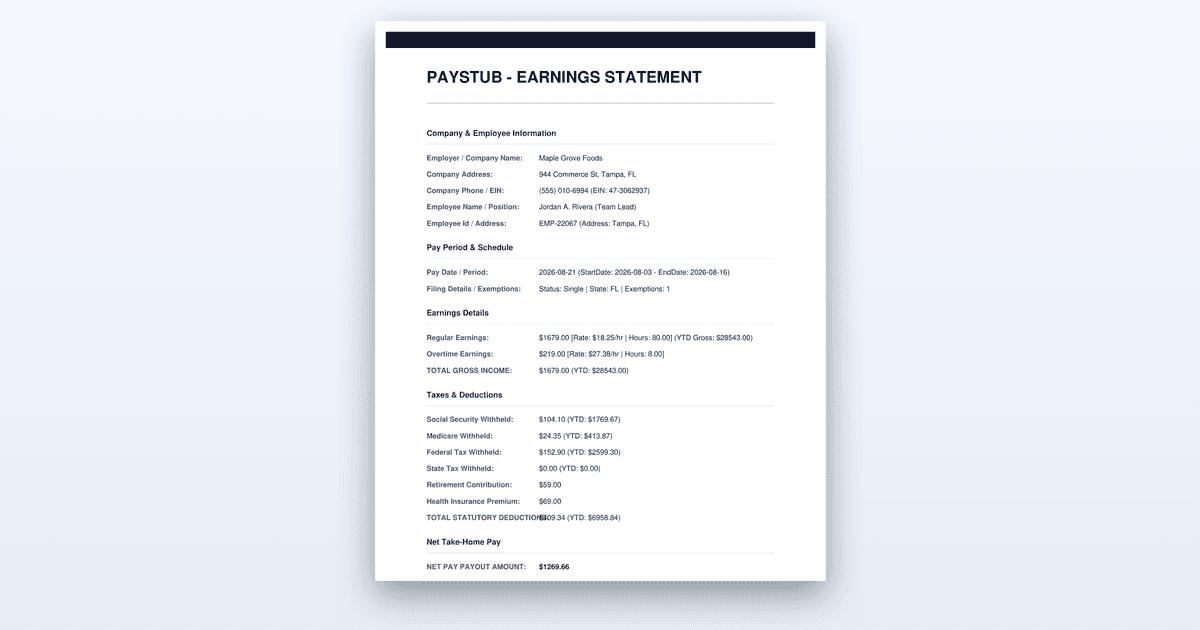
Calculate overtime pay correctly in six steps: exempt status, the workweek, the regular rate, OT hours, the 1.5x multiplier, and the pay stub line.
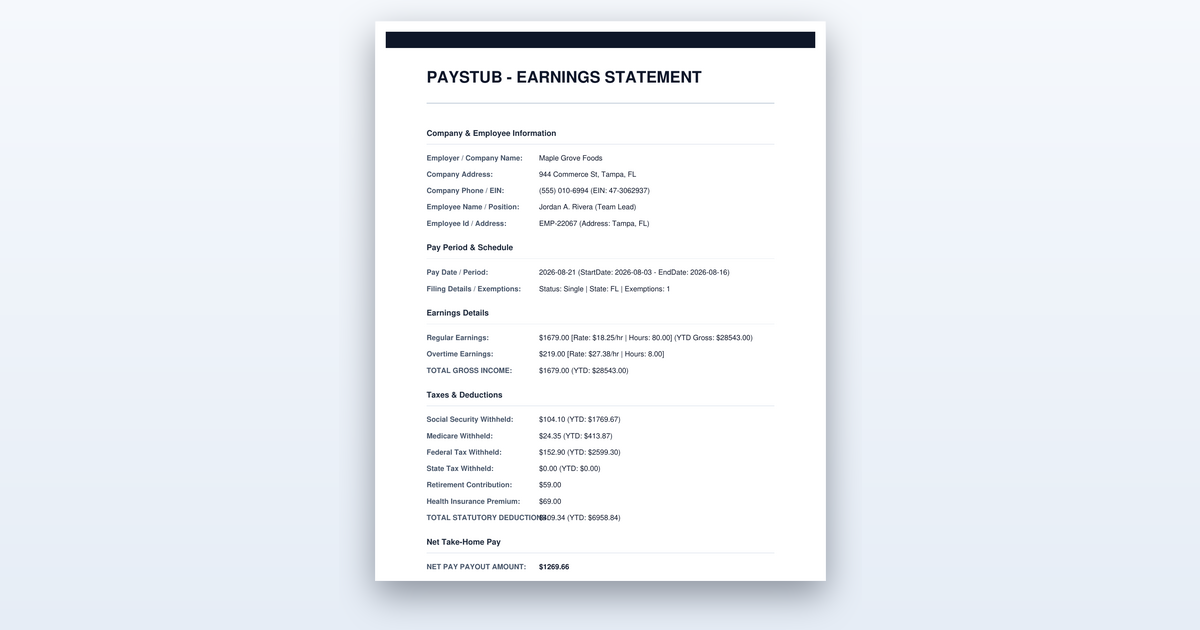
Short on time? You can also create the document you need in just a couple of minutes.
Key Takeaways
- •The FLSA overtime threshold is 40 hours in a fixed seven-day workweek, and the workweek must be established in advance.
- •The regular rate is not the same as the hourly rate once a nondiscretionary bonus or shift differential is in play.
- •California and a handful of other states require daily overtime after eight hours and double time after twelve, and the more generous rule wins.
- •Private employers generally cannot swap overtime pay for compensatory time off.
How to Calculate Overtime Pay: A Step-by-Step Guide
To calculate overtime pay, you confirm the employee is non-exempt, fix the workweek, total the actual hours worked, compute the regular rate of pay (which includes bonuses and commissions), identify the overtime hours past 40 (or the state threshold), and multiply those hours by 1.5 times the regular rate. This takes about 15 minutes per employee once you have the time records and pay data in front of you. The whole process is six steps, and getting the regular rate wrong is where most calculations fail.
Before You Start
You need four things in hand before you touch a calculator. First, the exact start and end dates of the fixed workweek you are calculating — not the pay period, not the month, but the recurring seven-day window your business established in advance. Second, the total hours actually worked in that single week, including any time worked off the clock like answering emails after shift or staying late to close the register. Third, the base hourly rate plus any nondiscretionary bonuses, commissions, or shift differentials paid for that same week. Fourth, a clear determination of whether the employee is exempt or non-exempt, and on what basis that classification rests.
If you start without the workweek defined, you will almost certainly miscalculate, because a pay period that runs from the 1st to the 15th spans parts of two different workweeks and the overtime threshold applies per week, not per check. If you start without the bonus figure, you will underpay the regular rate and owe back wages later. If you guess at the exemption status based on a job title, you are gambling with treble damages in a wage claim. Take the ten minutes to gather these items first; the arithmetic is the easy part.
Step-by-Step: Calculating Overtime Pay
Step 1: Confirm the Employee Is Non-Exempt
Overtime is owed only to non-exempt employees under the Fair Labor Standards Act (FLSA), so your first move is to verify the classification rather than assume it. Being salaried does not make someone exempt — the FLSA exemption tests look at two things: whether the employee is paid on a salary basis of at least the current threshold (which the Department of Labor updates periodically), and whether their primary job duties match the executive, administrative, or professional definitions. A manager who spends 80 percent of their shift stocking shelves and running a register is not exempt just because their pay stub says "salary."
The judgement call here is real. Job titles like "office manager" or "team lead" mean nothing on their own; you have to walk through the actual duties. The executive exemption requires that the employee primarily manages the enterprise or a recognized department, regularly directs two or more full-time employees, and has genuine authority to hire, fire, or recommend such actions. The administrative exemption requires work directly related to management or general business operations and the exercise of discretion on significant matters. If the duties do not clearly match, treat the employee as non-exempt — the cost of overpaying overtime is far lower than the cost of defending a misclassification lawsuit.
You know this step worked when you can state, in one sentence, the basis for the exemption or non-exemption — not the title, but the duties and the salary basis. If you cannot articulate that sentence, the classification is not solid enough to rely on.
Step 2: Fix the Workweek and Add Up the Hours
The FLSA overtime threshold is 40 hours in a fixed, recurring seven-day workweek, and that workweek must be established in advance — you cannot pick a new seven-day window each week to minimize overtime. The workweek can start any day and any hour, but once set, it stays fixed unless you permanently change it. This is the single most common structural error in overtime math: people try to average a light week against a heavy one, or they calculate over a two-week pay period. Neither is legal. Each seven-day workweek stands alone.
Total the hours actually worked in that single week, and be honest about what counts as work. Time spent on-call while restricted to the premises, time spent traveling between job sites during the workday, and time spent on required training all count as hours worked. Time spent changing into a uniform at home does not. The rule is whether the employee is "suffered or permitted" to work — if you knew or should have known they were working, the hours count, even if you told them not to. Off-the-clock work is a trap: if an employee stays 20 minutes past their shift finishing a report and you know about it, those are hours worked, and they count toward the 40.
You know this step worked when the hours for the week are a single number that reconciles against the time clock records or the timesheets, and you can see the start and end of the workweek on the calendar. If the number is fuzzy, go back to the source records before moving on.
Step 3: Calculate the Regular Rate of Pay
The regular rate is total straight-time earnings for the week divided by total hours worked — and it is often higher than the posted hourly rate. This is where the calculation gets real, because the regular rate must include nondiscretionary bonuses, commissions, shift differentials, and certain other payments. A nondiscretionary bonus is one the employee knows about in advance and expects — a production bonus, a retention bonus, a per-project completion bonus. A discretionary bonus, like a holiday gift or a surprise spot bonus, is excluded. The distinction matters because including a $200 bonus in the weekly earnings raises the regular rate and raises the overtime premium owed.
The math is straightforward: add up all straight-time earnings for the week, including the base pay, the bonus, the commissions, and the shift differentials, then divide by the total hours worked. If an employee earns $18 per hour, works 46 hours, and earned a $100 nondiscretionary bonus that week, the regular rate is ($18 × 46 + $100) ÷ 46, which equals $20.17 per hour. Notice the regular rate went up because the bonus is spread across all hours, not just the first 40. If you had calculated overtime on the $18 rate alone, you would have underpaid.
You know this step worked when you can list every component of the weekly earnings and state which ones you included in the regular rate and which you excluded, and why. If you excluded a bonus because you thought it was discretionary but the employee expected it, that is a mistake that will surface in an audit.
Step 4: Identify the Overtime Hours
Federally, every hour past 40 in the workweek is overtime. That is the floor. But several states override the federal minimum with stricter rules, and the more generous rule wins. California, for example, requires daily overtime at 1.5x after eight hours in a workday and double time after twelve hours, in addition to the weekly 40-hour rule. Alaska, Colorado, and Nevada have their own daily and weekly variations. If your state has a daily overtime rule, you must calculate overtime on the daily basis and the weekly basis and pay whichever is higher for each day.
The judgement call here is whether your state rule applies at all. Check your state labor department's website for the overtime statute, and do not assume that because you are in a state without a daily rule, the federal 40-hour threshold is the whole story — some states have lower weekly thresholds for specific industries, and some have different rules for agricultural or domestic workers. The federal rule is a floor, not a ceiling. If the state rule is more generous to the employee, the state rule controls.
You know this step worked when you have a list of the overtime hours for the week — either the hours past 40, or the daily hours past eight where the state requires it — and you can point to the statute that supports your number. If you cannot name the rule you are applying, you have not done the step.
Step 5: Apply the 1.5x Multiplier
Multiply the overtime hours by one and a half times the regular rate. Where straight time has already been paid on those hours — which it always is, if you pay a single hourly rate for all hours — you owe the additional half-time premium on top of the straight time already included in the regular rate. In other words, the employee's paycheck for the week includes straight time for all 46 hours at the regular rate, and then you add the half-time premium on the 6 overtime hours.
The arithmetic: using the earlier example, the regular rate is $20.17. The overtime premium is half of that, $10.09, multiplied by the 6 overtime hours, which equals $60.52. The employee's total pay for the week is the straight time for 46 hours at $20.17, which is $927.82, plus the $60.52 premium, which comes to $988.34. If you instead paid 40 hours at $18 and 6 hours at $27, you would get a different number — and you would be wrong, because the bonus raised the regular rate and the premium must be calculated on the raised rate.
The judgement call here is whether you are using the "half-time" method or the "one-and-a-half-time" method. Both are legal, but they produce the same result only when the employee is paid a single hourly rate with no bonuses. The half-time method is cleaner when the regular rate includes bonuses and commissions, because it avoids double-counting. Either way, the total pay must equal the straight-time earnings for all hours plus an additional half-time premium on the overtime hours.
You know this step worked when the final dollar figure matches a calculation you can show on paper, line by line, and the premium is visibly half of the regular rate times the overtime hours.
Step 6: Show It on the Pay Stub and Keep the Record
List overtime hours and overtime earnings as their own line on the pay stub, separate from regular pay. This is not just good bookkeeping — it is a legal requirement in most states that the pay stub itemize hours and rates, and it is your best defense in a wage claim. If the stub shows 46 hours at a blended rate with no overtime line, the employee can reasonably believe they were not paid overtime, and a state labor department will side with them.
The record-keeping requirement is real: payroll records supporting the calculation should be kept for at least three years under the FLSA, including time cards, schedules, and the underlying calculation of the regular rate. If you included a bonus in the regular rate, keep the bonus documentation. If you classified someone exempt, keep the duty analysis. The records are the evidence, and the evidence is what survives an audit or a lawsuit. Private employers generally cannot swap overtime pay for compensatory time off — comp time is a public-sector arrangement, so if you are a private employer, you must pay the premium in cash, not in future time off.
You know this step worked when you can pull the pay stub for any employee in the last three years and reconstruct the overtime calculation from the records alone, without asking the employee or the payroll vendor for anything.
Worked Example
Let me walk you through a real calculation so you can see the whole thing hold together. This example is illustrative — your numbers will differ, but the logic is identical.
Maria works for a small logistics company in California as a non-exempt dispatcher. Her posted hourly rate is $22. In the workweek that ran Monday through Sunday, she worked 9 hours on Monday, 10 on Tuesday, 8 on Wednesday, 9 on Thursday, 8 on Friday, and 4 on Saturday — 48 hours total. That week, the company paid her a $150 nondiscretionary attendance bonus for perfect punctuality, and she earned a $75 shift differential, which the company pays as a flat premium for taking a weekend shift.
First, confirm she is non-exempt — yes, she is an hourly dispatcher with no management duties, so the FLSA exemption tests do not apply. Second, the workweek is fixed Monday to Sunday, and her hours total 48. Third, the regular rate: her straight-time earnings for the week are 48 hours at $22, which is $1,056, plus the $150 bonus, plus the $75 shift differential, which totals $1,281. Divide by 48 hours, and the regular rate is $26.69 per hour. Note that the regular rate is well above her posted $22 rate because of the bonus and differential.
Fourth, the overtime hours. California requires daily overtime after eight hours, so Monday's 9 hours gives 1 overtime hour, Tuesday's 10 gives 2, and Thursday's 9 gives 1 — that is 4 daily overtime hours. There is no daily overtime on Wednesday, Friday, or Saturday because none exceeded eight hours. Federally, she has 8 hours past 40 in the week. The daily overtime of 4 hours is a subset of the weekly overtime of 8, so the total overtime hours are 8. California also requires double time after 12 hours in a day, but she never hit 12, so no double time applies. Fifth, the premium: the overtime rate is 1.5 times the regular rate of $26.69, which is $40.04 per hour. The premium on 8 overtime hours is half the regular rate times 8, which is $13.35 × 8, or $106.76. Her total pay for the week is the straight time for 48 hours at $26.69, which is $1,281, plus the $106.76 premium, for a total of $1,387.76.
Sixth, her pay stub itemizes it so the total reconciles: 48 hours of straight time at $22, which is $1,056, then the $150 bonus, the $75 differential, and a separate overtime premium line of $106.76. Those four lines add to $1,387.76. Note what does not work: showing 8 overtime hours at $33, the posted rate times one and a half, would total $1,369 and underpay her by $18.76, because $33 ignores the bonus and differential that raised her regular rate to $26.69. The company keeps her time clock records and the calculation sheet for three years. If an auditor asks, the records show exactly how the $1,387.76 was built.
Where People Get This Wrong
The most expensive mistake is calculating overtime on the posted hourly rate instead of the regular rate. An employer who pays Maria $33 per hour for her 8 overtime hours — 1.5 times her $22 rate — would pay her $264 in overtime, but the correct premium is $106.76 on top of the straight time that already included the bonus and differential. The difference is the half-time premium on the bonus and differential, and it is exactly the amount that a wage claim would recover. The fix is to always compute the regular rate first, including all nondiscretionary payments, and apply the premium to that number.
The second failure is averaging hours across a pay period. A bookkeeper who sees 90 hours over two weeks and pays 10 hours of overtime is wrong — if one week had 50 hours and the other had 40, the employee is owed 10 hours of overtime for the heavy week, and nothing for the light one. Averaging hides the overtime entirely. The fix is to establish the workweek in advance and calculate each week independently, never pooling hours.
The third failure is ignoring state daily overtime rules. An employer in California who pays only the federal 40-hour weekly overtime will miss the daily overtime on days over eight hours. In Maria's case, the daily rule did not change the total because her weekly overtime exceeded her daily overtime, but for an employee who works 9 hours on Monday and 7 on Tuesday, the daily rule creates 1 hour of overtime where the federal rule creates none. The fix is to check the state labor department's overtime page before you settle on a number.
The fourth failure is treating comp time as a substitute for cash. A private employer who offers "time and a half off next week" instead of paying the premium is violating the FLSA — comp time is only available to public-sector employees. The fix is to pay the overtime premium in the paycheck that covers the workweek in which the hours were worked, and to keep the records that prove it.
When to Get Professional Help
If you are facing a wage claim, a Department of Labor investigation, or a lawsuit over misclassification, stop calculating and call an employment lawyer — the stakes are treble damages, attorney's fees, and penalties that dwarf the overtime amount itself. If you are unsure whether a bonus is discretionary or whether a job duty meets the exemption test, an accountant or a labor attorney can give you a written opinion that protects you. And if you operate in multiple states, have the state rules reviewed once by someone who knows the local statutes, because the differences are not intuitive and the penalty for guessing wrong is back pay plus interest.
The Bottom Line
Overtime pay is regular rate times 1.5 times the overtime hours, where the regular rate includes bonuses, commissions, and shift differentials, and the overtime hours are counted per fixed workweek under the stricter of federal or state law. Get the classification right, the workweek fixed, and the regular rate complete, and the arithmetic takes minutes. Keep the records for three years, and you will survive any audit.
Need a Pay Stub Right Now?
Generate a clean, professional pay stub in minutes with our calculator.
Create a Pay StubFrequently Asked Questions
Does overtime start after 40 hours or after 8 hours in a day?
Federally it starts after 40 hours in the workweek. Some states, California among them, also require daily overtime after eight hours, and where both apply the employee gets whichever rule pays more.
Authoritative References
The rules described here come from the agencies that set them. Check the current text before you rely on a deadline or a figure:
Related Guides
- Amazon Pay Stub Portal: Step-by-Step Access Guide (2026)
- How to Get a Pay Stub from DoorDash (Proof of Income Guide)
- H-E-B Pay Stub Portal Guide: PartnerNet Access (2026)
- How to Get Pay Stubs From a Previous Employer
- How to Fix a Payroll Error: A Step-by-Step Correction Guide
Sources: Paystub-Generator.com editorial team. This guide is informational and not legal or tax advice.
This guide is part of our Payroll & Tax service — pay stubs, W-2s and payroll compliance tools.
Explore Payroll & TaxPayroll Knowledge Hub
Explore related essential payroll terminology, tax definitions, and documentation guides.
Part of our interconnected SEO topic cluster network.
Citations & Legal Sources
- Paystub-Generator.com editorial team