
Illinois Residential Lease Agreement Template (2026 PDF)
Paystub Generator Editorial Team
Last Updated: September 2, 2026
Create a compliant Illinois residential lease agreement. Understand the 30/45-day deposit timeline, mandatory radon disclosure, notice periods, and tenant remedies.
Illinois Residential Lease Agreement
Illinois layers state law on top of strong local ordinances, which makes a precise Illinois residential lease agreement essential for any landlord operating in the state. The written contract has to satisfy both the Security Deposit Return Act and, in many areas, additional municipal rules that go further than the state baseline.
Illinois does not impose statewide rent control, and in fact state law currently preempts most local rent control measures. Still, the disclosures and deposit deadlines that do apply are strict, and missing them carries real financial penalties.
This guide explains the deposit timeline unique to Illinois, the radon and lead disclosures the state requires, and the notice periods that govern termination and eviction. When you are ready to assemble the document, our lease agreement generator produces an Illinois-ready contract in minutes.
Essential Terms of an Illinois Lease
A valid Illinois lease identifies every adult tenant, the property, the rent, the due date, and the term in clear language. These basics form the backbone that every later right and remedy depends on.
The agreement should set out accepted payment methods and any late fee. Many Illinois municipalities cap or regulate late fees, so the lease should reflect both state law and any local ordinance that applies to the property's location.
Occupancy limits, pet policies, subletting terms, and maintenance responsibilities complete the core of the agreement. Spelling out each item prevents the routine disputes that arise when expectations are left unwritten.
Term and Required Notice
Illinois landlords commonly use a fixed twelve-month term. The lease should state what happens at expiration, whether the tenancy ends, renews automatically, or converts to month-to-month.
Notice requirements in Illinois scale with the tenancy. A week-to-week tenancy requires 7 days' notice, a month-to-month tenancy requires 30 days, and a year-long tenancy generally requires 60 days' notice to terminate. Building the right figure into the lease avoids confusion at move-out.
Generate a Illinois Lease Agreement
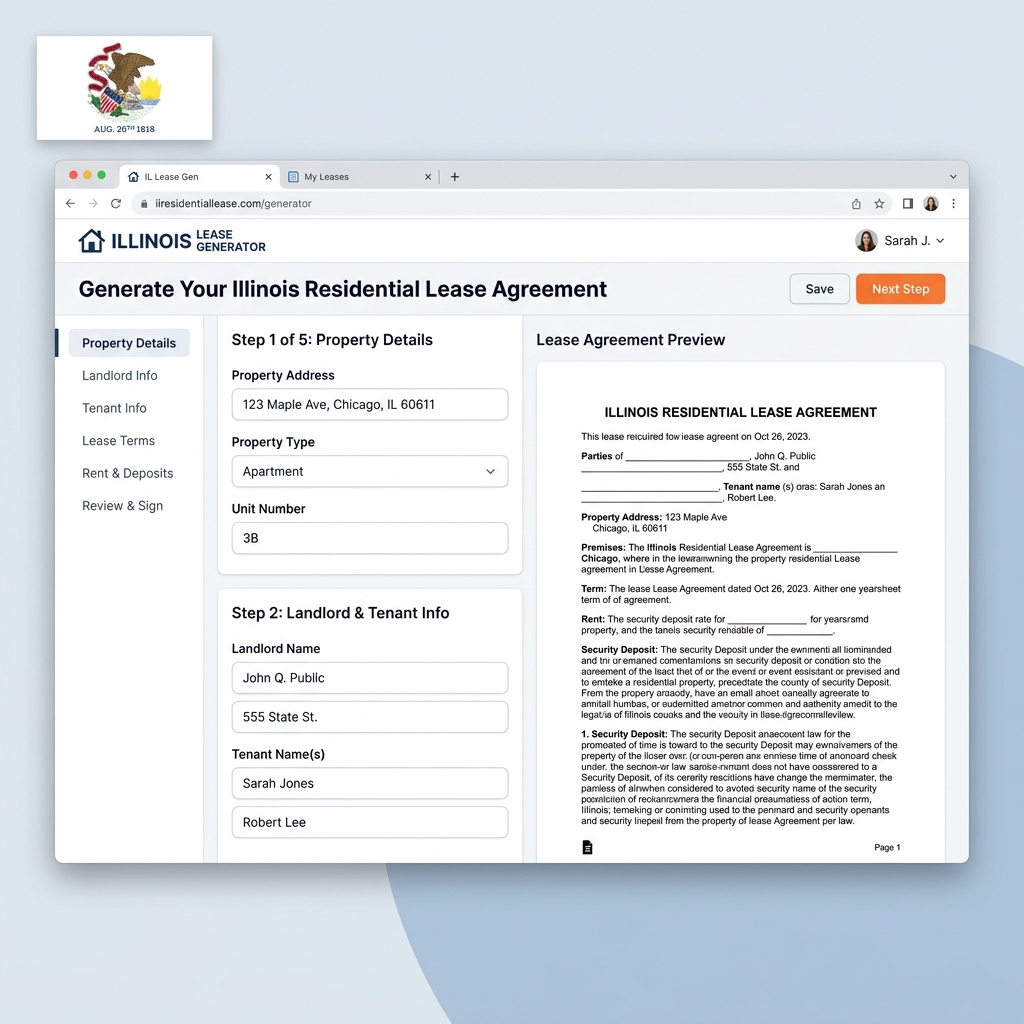
Our lease agreement generator produces a complete, state-aware Illinois residential lease in minutes, with the required disclosures and clauses built in.
Create Illinois Lease AgreementIllinois Security Deposit Rules
The Illinois Security Deposit Return Act sets a two-step timeline that landlords must follow carefully. The deadlines differ depending on whether the landlord is keeping any of the deposit.
If the landlord intends to make deductions, an itemized written statement of damages must be delivered within 30 days of the tenant moving out. The remaining deposit must then be returned within 45 days of lease termination.
If no deductions are taken, the full deposit is simply returned within the 45-day window. A clear security deposit return letter documents either the full refund or the itemized deductions and protects you from a later claim.
The penalty for getting this wrong is steep. A landlord who fails to provide the itemized list or return the deposit on time can be liable for twice the deposit amount, plus court costs and attorney's fees, so the 30 and 45-day deadlines deserve a place on your calendar.
Interest on Deposits
In larger buildings and in certain municipalities, Illinois landlords must pay interest on security deposits held beyond a set period. The exact threshold depends on the property size and the local ordinance.
If interest applies to your property, the lease should describe how and when it is paid. Tracking the applicable rate each year keeps you compliant and avoids small but avoidable penalties.
Mandatory Illinois Disclosures
Illinois requires specific disclosures that should be delivered before or at lease signing. Skipping them weakens your position and, in some cases, creates direct liability.
The radon disclosure is required under the Illinois Radon Awareness Act. Landlords must provide the prescribed radon hazard information before the tenant signs, alerting renters to a hazard common in parts of the state.
Properties built before 1978 require the federal lead-based paint disclosure, including the EPA pamphlet and any known hazard details. Many Illinois municipalities, including Chicago, also require a local summary of tenant rights to be attached to the lease.
Local Ordinances Matter
Chicago's Residential Landlord and Tenant Ordinance, and similar ordinances in other municipalities, often impose stricter rules than state law. These can affect deposit interest, disclosure summaries, and notice requirements.
Always confirm whether the property sits within a municipality that has its own ordinance. A clause that satisfies state law alone may still fall short of what a local ordinance demands.
Late Rent and Eviction Notices
When an Illinois tenant fails to pay, the landlord generally serves a 5-day notice to pay rent or the tenancy ends. This notice is a prerequisite to filing an eviction action in court.
For lease violations other than nonpayment, Illinois typically uses a 10-day notice to cure or vacate. The correct notice depends on the nature of the breach, so identify it before serving anything.
Serving a dated late rent notice as soon as rent is overdue starts the process properly and preserves your right to escalate. As with deposits, procedural missteps here are the most common reason Illinois evictions stall.
Maintenance, Entry, and Habitability
Illinois landlords must maintain the property in compliance with health and building codes and keep it fit for habitation. The lease should restate these duties and describe how tenants report repairs.
For entry, Illinois landlords should provide reasonable advance notice, and many local ordinances specify a minimum such as 48 hours, except in emergencies. Stating your notice practice in the lease reduces accusations of unlawful entry.
Documenting condition at the start and end of the tenancy is your best protection. A signed move-in checklist and a matching move-out checklist provide objective evidence whenever deposit deductions are challenged.
Screening Illinois Tenants
Illinois landlords may screen for income, credit, and rental history, but every decision must comply with the federal Fair Housing Act and the Illinois Human Rights Act, which adds protected classes beyond the federal baseline.
Applying the same written criteria to every applicant keeps your process consistent and defensible. A uniform rental application gathers identical information from each applicant and builds the record you would need if a denial were challenged.
Verifying income protects you in a market where you cannot easily adjust rent mid-lease. A documented rental income verification confirms the applicant can afford the unit before you sign.
Ending an Illinois Tenancy
A fixed-term Illinois lease ends on its stated date, though local ordinances may require move-out notices in some cases. Check both the lease and any applicable ordinance before assuming no notice is needed.
For month-to-month tenancies, the 30-day rule applies, and a written lease termination letter records exactly when notice was given. A clean record here prevents arguments about timing.
Why an Illinois-Specific Lease Is Worth It
A generic national template will not include Illinois's radon disclosure, its 30/45-day deposit timeline, or the local-ordinance summaries that cities like Chicago require. Those gaps are exactly where landlords lose deposit disputes.
An Illinois-specific agreement bakes the statutory deadlines and disclosures into the contract, so you are not relying on memory when a tenant challenges a deduction. It turns a complex web of state and local rules into one enforceable document.
Treat the lease as the foundation of the tenancy. Every notice and every deduction traces back to what the contract says, so it pays to get it right from the start.
Subletting and Assignment in Illinois
Many Illinois leases address whether a tenant may sublet or assign the unit to someone else. Without a clear clause, disputes arise when a tenant tries to hand the lease to a stranger the landlord never screened.
The lease should state whether subletting is permitted and, if so, that the landlord must approve any subtenant in writing. Requiring the same screening for a subtenant as for an original applicant keeps your standards consistent.
If you do allow subletting, run the proposed subtenant through your standard process, including a fresh rental application. That keeps you in control of who actually occupies the property even when the original tenant moves on.
Roommate Changes
When one roommate leaves and another wants to join, treat it as a new screening rather than an informal swap. The departing tenant's deposit interest and liability should be addressed in writing.
Document every roommate change with a signed amendment to the lease. This protects you from confusion about who is responsible for rent and damages if the arrangement later breaks down.
Fair Housing and Source-of-Income Protections
Illinois fair housing law reaches further than the federal baseline. The Illinois Human Rights Act protects additional classes, and many municipalities prohibit discrimination based on a tenant's lawful source of income, including housing assistance.
That means in covered areas you generally cannot refuse an applicant simply because they intend to pay part of the rent with a voucher. Applying income standards consistently, rather than rejecting a payment source outright, keeps you compliant.
Keep written records of your screening criteria and the reason for every approval or denial. A documented rental income verification that focuses on overall ability to pay, rather than the source, is both fair and defensible.
Keeping Records Throughout the Tenancy
Illinois disputes are won and lost on documentation. Because the state and many municipalities impose precise deadlines, the landlord who can prove exactly when notice was served or a deposit returned holds a decisive advantage.
Keep dated copies of every notice, signed checklist, payment record, and repair receipt in one organized file per tenancy. Photographs taken at move-in and move-out are especially valuable when a deduction is challenged under the Security Deposit Return Act.
When a renewal comes due, confirm the tenant still qualifies before extending the term. A current rental income verification and a quick review of payment history turn a renewal decision into a documented business choice rather than a guess.
Build Your Illinois Lease Agreement Today
You can produce a compliant Illinois lease without hiring an attorney for every tenancy. The right tool prompts you for the disclosures and deposit terms the state and your municipality require.
Our lease agreement generator walks through each clause and outputs a clean, signature-ready PDF tailored to Illinois. Pair it with a documented [move-in
This guide is part of our Rental Documents service — lease agreements, rent receipts and notices.
Explore Rental DocumentsRental Forms Knowledge Hub
Explore our suite of legally reviewed templates in the Rental category.

