
How to Write an Invoice That Gets Paid on Time
Marcus Vance / Payroll Operations Editor
Reviewed by: Reviewed by the Paystub Generator Editorial Team
Legal Reviewer
Last Updated: August 29, 2026
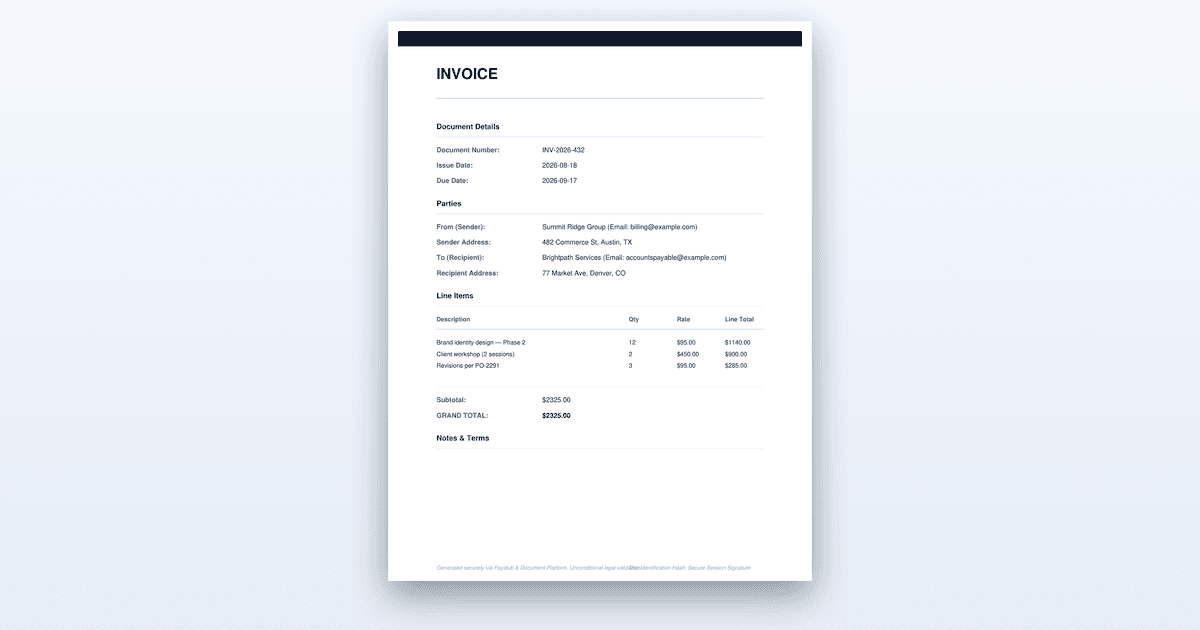
Seven steps to an invoice that clears fast: numbering, correct party details, billable line items, explicit terms and late fees, and a follow-up schedule.
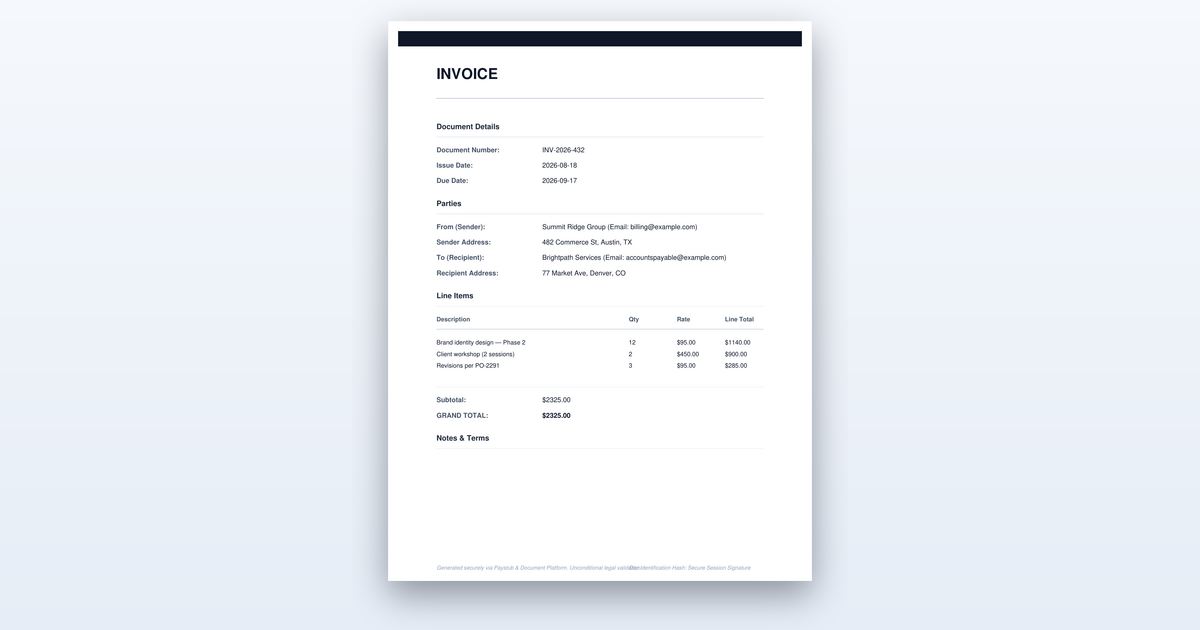
Short on time? You can also create the document you need in just a couple of minutes.
Key Takeaways
- •A unique sequential invoice number and an explicit calendar due date are what let a payables team process it without asking you anything.
- •The client's registered legal entity name must match their vendor record or the invoice can be rejected before review.
- •Line items naming deliverables, dates, quantities, and rates prevent the queries that delay payment.
- •Late fees and interest terms only bite if they are on the invoice as well as in the contract.
How to Write an Invoice That Gets Paid on Time
Writing an invoice properly is a seven-step process that takes about thirty minutes the first time you do it, and it is the single most effective way to stop late payments from becoming your normal routine. The document itself is only half the battle; the other half is the system you build around sending it, tracking it, and following up. Done right, an invoice answers every question a client's accounts payable team could have before they ask, which moves you from the bottom of the pile to the top.
Before You Start
Before you draft a single line, gather the paperwork that proves the work happened and the terms under which it was agreed. You need the signed contract, proposal, or purchase order that covers the work, because the details on those documents—rates, payment terms, late fees—are the legal backbone of your invoice. You also need the client's correct legal entity name, which is often different from the name on the email signature you have been using, plus the name and contact information of whoever handles their accounts payable. Finally, pull your own record of the work performed: dates, hours, deliverables, and the agreed rate for each. If you start writing the invoice without these, you will almost certainly produce a document that gets kicked back for a missing purchase order number or a mismatched legal name, and the delay will be entirely on you.
Step-by-Step: How to Write an Invoice That Gets Paid on Time
Step 1: Number and date it, and never reuse a number
Give every invoice a unique sequential number and put both an issue date and a due date on it. The issue date is the day you send it; the due date is the calendar day payment is expected, which you calculate by adding your payment terms to the issue date. Accounts payable teams run on reference numbers, not on names or memories. When your client's AP person opens their queue, they need to be able to say "invoice 2024-014 is approved" without having to describe what the work was. An invoice that cannot be cited unambiguously in an email or a system is an invoice that stalls while someone figures out what to call it.
Choose a numbering system and stick to it for the life of your business. A simple year-prefix sequence like 2024-001, 2024-002 works well for most freelancers, while a job-number system like 1042-01, 1042-02 works better if you invoice multiple times against one project. Never reuse a number, even if an invoice was voided or corrected; void the old one and issue a new number instead. You know this step worked when the invoice has a unique identifier that you could reference in an email subject line and a reader would know exactly which document you meant.
Step 2: Get both parties' details exactly right
Put your client's registered legal entity name on the invoice, not the trading name they use in everyday correspondence. If the contract says "Acme Holdings LLC" but your contact signs emails as "Acme," the invoice goes to the name on the contract. The reason matters: most mid-sized and larger companies maintain a vendor master file, and the name on your invoice must match the name on your vendor record or the invoice is rejected before a human ever reviews it. A mismatch means the invoice bounces back to you with a request to reissue, which adds days or weeks to the payment cycle through no fault of the work.
On your side of the header, include your full legal business name, your physical or registered address, and your tax identification number if your jurisdiction requires it on invoices. If you are a sole proprietor, your name and address are usually sufficient, but check what your client's vendor onboarding form demands, because some require a W-9 or equivalent before they can pay you at all. You know this step worked when every name and number on the invoice matches the paperwork the client already has on file for you.
Step 3: Describe the work the way the client will recognize it
Each line item must name what was delivered, when it was delivered, the quantity or hours, and the rate. A line reading "Consulting services — 12 hours at $85/hr" is acceptable, but "Website redesign consultation — 12 hours at $85/hr, 3 meetings in October" is better because it lets the approver match the work against their own records. If the work was done under a purchase order or contract, put that reference number on the invoice, usually in a dedicated field near the top or on each line item. The goal is to make the invoice self-evidently correct to someone who was not in the room when the work happened.
The single most common reason an invoice gets queried is a vague description. "Professional services" or "consulting" tells the approver nothing, so they have to email you for details, and that email exchange is where the payment cycle stalls. Break the work into as many lines as it takes to be unambiguous. If you delivered a report, name the report and the date. If you did ongoing support, list the weeks or dates covered. You know this step worked when you could hand the invoice to someone who never met you and they could reconstruct exactly what was done and why it cost what it did.
Step 4: State the payment terms explicitly on the invoice
Write your payment terms and the calendar due date on the invoice, not just "net 30" in a corner. A due date of "December 15, 2024" is unambiguous; "net 30" requires the reader to do arithmetic and decide whether the clock starts on the issue date or the delivery date. Put the terms in plain language near the total: "Payment due within 30 days of issue date. Due date: December 15, 2024." If your contract provides for a late fee or interest on overdue balances, state that on the invoice too, in a line like "A late fee of 1.5% per month applies to balances unpaid after the due date."
Late fees and interest terms only bite if they are on the invoice as well as in the contract. Accounts payable teams process the document in front of them, not the contract buried in a filing system. If the invoice does not mention the late fee, the client's AP system has no trigger to apply it, and you will have no leverage when you chase the payment. You know this step worked when a reader can look at the invoice and know exactly when the money is due and what happens if it is not there by then.
Step 5: Give them every practical way to pay
List the payment methods you accept and the details for each one, directly on the invoice. If you take bank transfer, give the full routing and account details, or the payment link if you use an invoicing platform. If you take credit cards, provide the link or the portal. If you take checks, give the mailing address. Every extra step between reading the invoice and completing payment adds days to the cycle, and bank details buried in an email thread add a week while someone searches their inbox.
Do not assume the client will ask for your payment details if they are missing; most will simply set the invoice aside and process the ones that are complete. Put everything on the invoice itself, in a clearly labeled section near the bottom, and repeat it in the email you send with the invoice. If you use a payment platform that generates a pay link, make that link prominent. You know this step worked when the only thing the client's AP person has to do is type a number and click send.
Step 6: Send it to the person who actually processes payment
Your day-to-day contact, the person who hired you and approved your work, is often not the person who pays you. In many companies, the person who manages the project has no authority to issue a check or authorize a transfer. Ask early in the engagement who handles accounts payable and what their intake process is. Some companies require invoices to go to a specific email address like ap@company.com; others have a vendor portal you must upload to. Send the invoice there, and copy your day-to-day contact so they know it is in the pipeline and can nudge it internally.
Sending the invoice to the wrong person is a silent killer of payment speed. The invoice arrives, your contact forwards it to AP, AP asks for a purchase order number, your contact asks you, you reply, and the cycle has added a week. You know this step worked when you have confirmation from the AP department or portal that the invoice was received, not just a read receipt from your project contact.
Step 7: Log it and follow up on a schedule you set in advance
Record the invoice number, issue date, due date, and amount in a simple spreadsheet or accounting tool the moment you send it. Then diarise two follow-up points: a polite reminder a few days before the due date, and a firmer one the day after if payment has not arrived. The pre-due reminder is a courtesy that often surfaces problems early—"we never received it" or "we need a W-9"—while the post-due follow-up is where you actually get paid. Invoices are paid in the order they are chased, not the order they arrive.
A follow-up schedule set in advance is more effective than any wording change on the document. It removes the emotional friction of deciding whether to chase; the calendar tells you when, so you send the email without agonizing. The pre-due note can be a one-liner: "Just checking that invoice 2024-014 arrived safely and is on track for the December 15 due date." The post-due note should be direct: "Invoice 2024-014 was due December 15 and I have not received payment. Can you confirm when it will be sent?" You know this step worked when you never have to wonder whether an invoice is outstanding; your log tells you instantly.
What to Do When an Invoice Goes Past Due
When the due date passes without payment, the first move is a polite but direct email to the AP contact and your project contact asking for a status update and a specific payment date. If that gets no response within a week, escalate to a phone call if you have a number, and then to a formal written notice referencing the invoice number, the due date, and any late fee provision on the invoice. At each stage, stay professional and factual; the goal is to get a commitment to a date, not to win an argument. If the client gives you a date, note it and follow up on that date. If they do not, you have a decision to make about whether the relationship is worth continuing to extend credit to.
Worked Example
Let us walk through a realistic case. Maria is a freelance graphic designer in Austin, Texas. She finished a logo and brand package for a client called Bluebird Coffee Roasters, whose registered legal entity is Bluebird Coffee Roasters, LLC. Her contract says payment is due net 30 from the invoice date, with a 1.5% monthly late fee. Her invoice number for this project is 2024-018, and she is issuing it on November 15, 2024, which makes the due date December 15, 2024.
Maria opens her invoice template and fills in the header: Bluebird Coffee Roasters, LLC, at the registered address from the contract, not the cafe address she visits. Her own line reads "Maria Alvarez Design, 1234 Congress Ave, Austin, TX 78701." She writes the issue date of November 15, 2024, the due date of December 15, 2024, and the terms line: "Payment due within 30 days of issue date. A late fee of 1.5% per month applies to balances unpaid after the due date." Her line items are three: "Logo design — 20 hours at $75/hr, $1,500"; "Brand style guide — 15 hours at $75/hr, $1,125"; "Two revision rounds — included, $0." The total is $2,625. She adds her bank details and a note that she also accepts payment by credit card via a link.
She emails the invoice to ap@bluebirdcoffee.com, the address her project contact gave her at the start of the engagement, and copies her contact. Her log records invoice 2024-018, issued November 15, due December 15, amount $2,625. On December 12, she sends a pre-due note asking if the invoice arrived safely; AP replies that it did and is scheduled. On December 16, with no payment in her account, she sends a post-due note asking for a status. AP replies that the check was cut but needs a signature and will go out December 20. She notes that date. The check arrives December 23. The whole cycle took five weeks from issue to payment, which is exactly what net 30 should look like when the process works. These figures are an example, not your numbers; your rates and dates will differ, but the structure is the point.
Where People Get This Wrong
The most common mistake is using the client's trading name instead of the registered legal entity. A freelancer invoices "Bluebird Coffee" because that is what is on the sign, and the invoice is rejected because the vendor file says "Bluebird Coffee Roasters, LLC." The fix is to copy the legal name from the contract or ask for the vendor onboarding form before you do any work. The second mistake is vague line items. "Consulting services" or "design work" forces the approver to email you for details, and that exchange adds a week to the cycle. The fix is to name the deliverable, the date, and the hours on every line. The third mistake is burying payment terms. If the invoice says "net 30" in tiny type but no calendar due date, the AP team has to calculate it themselves, and they will calculate it from the day they receive it, not the day you sent it. The fix is to write the actual due date. The fourth mistake is sending the invoice only to your project contact, who forwards it to AP, who asks for a purchase order number, which your contact asks you for, adding days. The fix is to ask for the AP contact and intake process at the start of the engagement, not after the invoice is late.
When to Get Professional Help
If a client is consistently paying late despite a correct invoice and a follow-up schedule, or if a payment is more than 60 days past due and your emails are going unanswered, it is time to talk to a lawyer or a collections agency. A demand letter from an attorney often resolves a dispute that emails cannot, and a collections agency can handle the messy end of chasing a client you no longer want to work with. Similarly, if you are dealing with a government contract or a large corporate client with a complex vendor portal, a bookkeeper or accountant who has dealt with that specific system can save you hours of frustration. This article is general information, not legal or tax advice; your situation may warrant professional input.
The Bottom Line
Writing an invoice that gets paid on time is about removing every reason for the client to ask a question. Number it, date it, name the legal entities correctly, describe the work specifically, state the terms and due date plainly, provide every payment method, and send it to the person who processes payment. Then log it and follow up on a schedule you set in advance. Do that, and late payment becomes the exception rather than the rule.
Need a Business Document?
Generate a polished, professional document in minutes.
Create a Business DocumentFrequently Asked Questions
What has to be on an invoice?
A unique invoice number, issue and due dates, both parties' details, itemized descriptions with quantities and rates, the total, the payment terms, and how to pay. Add tax identification numbers where your jurisdiction requires them.
What does net 30 mean?
Payment is due 30 days from the invoice date. Write the actual calendar due date beside it, because the phrase alone leaves room for a dispute about which date the count started from.
Can I charge a late fee?
Only if your contract or agreed terms provide for one, and some jurisdictions cap the rate. State the fee on the invoice as well as in the contract so it is enforceable in practice.
Authoritative References
The rules described here come from the agencies that set them. Check the current text before you rely on a deadline or a figure:
Related Guides
- How to Write a Business Proposal (With Free Template)
- Freelance Invoice Template: What to Include
- How to Dissolve an LLC: The Step-by-Step Wind-Down
Sources: Paystub-Generator.com editorial team. This guide is informational and not legal or tax advice.
This guide is part of our Business Forms service — invoices, quotes, estimates and receipts.
Explore Business FormsBusiness Forms Knowledge Hub
Explore our suite of professional templates in the Business category.
Citations & Legal Sources
- Paystub-Generator.com editorial team

