
How to Dissolve an LLC: The Step-by-Step Wind-Down
Marcus Vance / Payroll Operations Editor
Reviewed by: Reviewed by the Paystub Generator Editorial Team
Legal Reviewer
Last Updated: August 29, 2026
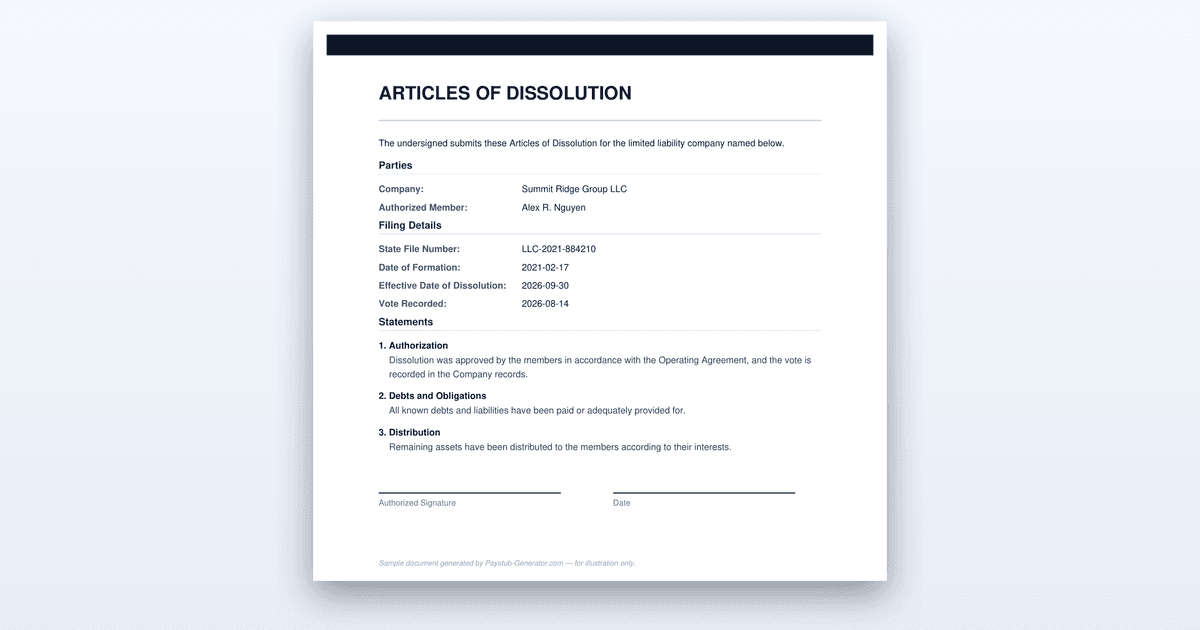
Closing an LLC properly: the member vote, creditor notice, final tax returns, cancelling registrations, articles of dissolution, and distributing what is left.
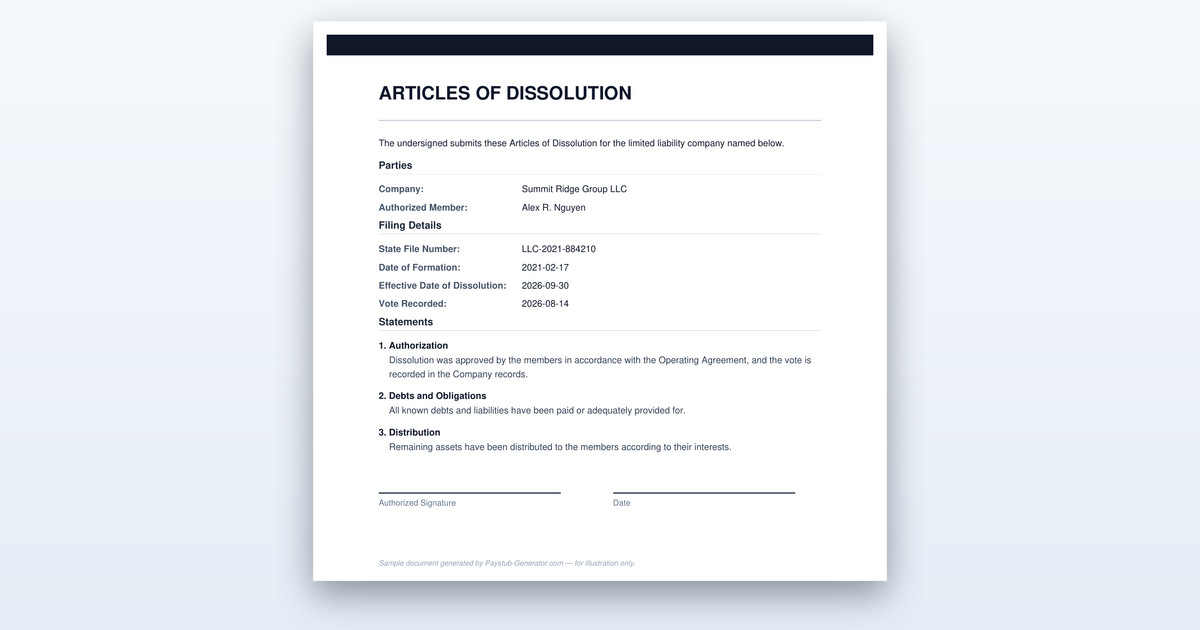
Short on time? You can also create the document you need in just a couple of minutes.
Key Takeaways
- •Dissolution is not complete until articles of dissolution are filed and accepted by the state.
- •An LLC left open, or foreign-qualified in a state and not withdrawn, keeps accruing annual report obligations and franchise tax.
- •Creditors are paid before members receive anything; distributing first can expose members personally.
- •Final federal and state returns must be marked as final, along with closing payroll and sales tax filings.
How to Dissolve an LLC: The 7-Step Wind-Down That Actually Protects You
Dissolving an LLC takes seven steps: vote to dissolve, notify and pay creditors, wind down operations, file final tax returns, cancel licences and registrations, file articles of dissolution, and distribute remaining assets. The whole process typically takes two to four months from the initial member vote to the state's official confirmation. How to dissolve an LLC is not a single filing — it is a sequence of financial, legal, and administrative tasks that must happen in the right order to protect you from personal liability and lingering fees.
Before You Start
Before you take the first formal step, gather the governing documents and a complete financial picture of the company. Your operating agreement is the single most important document because it specifies the voting threshold required to approve dissolution — some agreements require a unanimous vote while others allow a majority, and starting the process without checking this can invalidate everything that follows. You also need a current list of all debts, open contracts, leases, and outstanding customer obligations, because you cannot accurately vote on dissolution without knowing what the company still owes. Finally, confirm every state where the LLC is registered, including any foreign qualifications, and list every licence, permit, and registration held in the company's name. If you start without this information, you risk missing a creditor who can later sue you personally, or leaving a foreign registration open that keeps generating franchise tax bills for years.
Step-by-Step: The Wind-Down Process
Step 1: Vote to Dissolve and Record the Decision
The dissolution begins with a formal vote by the members, conducted exactly as your operating agreement specifies. Read the dissolution section of the agreement carefully — it will state whether you need a unanimous vote, a two-thirds majority, or some other threshold, and it may also specify how much notice members must receive before the vote is held. If your operating agreement is silent on dissolution, most state default rules require a majority of members to approve, but you should check your state's LLC act to confirm. Hold the vote at a properly noticed meeting or obtain written consent from every required member, then document the outcome in meeting minutes or a written consent form signed by all voting members.
This written record is your proof that the dissolution was authorized by the proper parties, and you will need it later if a member challenges the process or if a creditor questions whether the wind-down was legitimate. The record should include the date of the vote, the names of the members voting, and the specific resolution to dissolve the company. Once the vote is recorded and signed, you have the legal authority to begin winding down — but the LLC still exists for all legal and tax purposes until the state accepts your articles of dissolution. You know this step worked when you have a signed, dated document showing the required majority approved the dissolution resolution.
Step 2: Notify Creditors and Settle What Is Owed
With the vote recorded, your next obligation is to identify every creditor and give them formal notice that the LLC is dissolving. Many states provide a statutory procedure for this, typically requiring written notice to all known creditors, and some also allow or require published notice to reach unknown creditors. The requirements vary widely: publication is mandatory in some states, optional in others, and not part of the process at all in states such as Texas. Following this process matters because it creates a deadline after which creditors cannot bring claims against the company, and in many states, against the members personally. Check your state's LLC dissolution statutes to find the exact notice requirements, the publication period, and the deadline for creditors to respond.
While the notice period runs, work through the list of debts you compiled before starting and pay everything the company owes — loans, vendor invoices, unpaid rent, and any taxes that have accrued. Paying creditors before members receive any distribution is not just good practice; it is a legal requirement in most states, and distributing assets to members while debts remain unpaid can expose those members to personal liability for the unpaid amounts. If the company cannot pay all its debts, you may need to negotiate settlements with creditors or consider bankruptcy, which is a different process entirely. You know this step worked when every known creditor has been paid or has agreed in writing to a settlement, and the statutory notice period for unknown creditors has expired without new claims surfacing.
Step 3: Wind Down Operations and Close Out Contracts
Now you must systematically shut down the business's day-to-day operations, starting with cancelling every recurring obligation that would otherwise keep generating costs and liability. Terminate the commercial lease, cancel subscriptions for software, phone lines, utilities, insurance policies, and any other services that bill monthly or annually. For open contracts with customers or suppliers, either complete the work as agreed or assign the contracts to another party if that is permitted, and get written confirmation from the other party that the contract is closed. Collect any outstanding receivables — money customers still owe the company — because those funds are part of the assets that will eventually be distributed to members.
The judgement call here is deciding which contracts can be cancelled immediately and which need to be fulfilled or assigned, and this is where a careful review of each agreement is essential. Some contracts contain automatic renewal clauses that will keep the company on the hook for another term if you do not cancel in writing before a specific date, while others may require a notice period of 30 to 90 days. Make a checklist of every open obligation, note the cancellation deadline for each, and send written cancellation notices by certified mail so you have proof of delivery. You know this step worked when every recurring service is cancelled in writing, all customer contracts are either fulfilled or assigned, receivables are collected, and the company has no remaining operational obligations.
Step 4: File Final Tax Returns and Mark Them Final
Before you can dissolve the LLC with the state, you must settle its tax obligations, and this means filing final returns at both the federal and state level. File the final federal income tax return for the LLC — Form 1065 for a multi-member LLC or Schedule C attached to the appropriate individual return for a single-member LLC — and check the box that indicates this is a final return. If the LLC has employees, file the final federal payroll tax returns, including Form 941 for the last quarter, and issue final Forms W-2 to employees and Forms 1099-NEC to contractors. File the final state income tax return and the final state payroll and sales tax returns, marking each as final, and pay any balance due with the filing.
This step is where people get into trouble years later, because forgetting to mark a return as final or skipping a sales tax filing entirely means the state assumes the business is still operating and keeps sending notices and assessing penalties. Most states also require a final franchise tax payment or a statement that no tax is due before they will accept your dissolution filing, and some states require a formal tax clearance certificate from their revenue department. Check with your state's department of revenue for the specific final return requirements and any clearance process. You know this step worked when every federal and state return is filed with the final box checked, all payroll and sales tax filings are closed, and you have written confirmation of tax clearance if your state requires it.
Step 5: Cancel Licences, Permits, and Registrations
With taxes settled, turn your attention to the administrative registrations that the company holds in its own name. Cancel every business licence, seller's permit, professional licence, and health or safety permit that the LLC obtained to operate, and do this in writing with the issuing agency. If the LLC is foreign-qualified in any state other than its home state, file the appropriate withdrawal or cancellation of registration in each of those states — this is a separate filing from the home state dissolution, and it has its own fee and processing time. A foreign qualification left open is one of the most common reasons a dissolved company keeps receiving annual report notices and franchise tax bills from a state it no longer does business in.
The judgement call here is identifying every licence and registration the company actually holds, which is why your pre-start inventory is so valuable. Look through the company's records for any permit that was renewed annually, any licence that was issued by a city, county, or state agency, and any registration with a professional licensing board. Each agency has its own cancellation process — some accept a simple written notice, while others require a specific form or an online portal. You know this step worked when every licence and permit is officially cancelled in writing, and every foreign qualification has been withdrawn, confirmed by a written acknowledgement from each agency.
Step 6: File Articles of Dissolution with the Secretary of State
This is the filing that legally ends the LLC, and until it is filed and accepted by your secretary of state, the company still exists and still owes annual report fees and franchise taxes. Prepare the articles of dissolution — the form name varies by state, sometimes called a certificate of dissolution or a certificate of cancellation — and complete it according to your state's requirements. Most states ask for the LLC's name, the date of dissolution, and a statement that all debts have been paid or provided for, and several states require proof of tax clearance from their revenue department before they will accept the filing. The filing fee typically ranges from $50 to $200 depending on the state, and processing time can be anywhere from a few days to several weeks.
The judgement call here is timing the filing correctly — you must complete the tax returns and creditor notice period before filing, because the articles of dissolution often require you to certify that these steps are done. Filing too early means you are making a false statement, while filing too late means the company keeps accruing fees. Submit the articles online or by mail, pay the fee, and then wait for the state to return a stamped or certified copy confirming acceptance. You know this step worked when you receive the official confirmation from the secretary of state that the articles of dissolution have been filed and accepted, and the LLC no longer appears as active in the state's business registry.
Step 7: Distribute What Is Left and Keep the Records
After the state accepts your dissolution, you can finally distribute the remaining assets to the members according to the operating agreement's distribution provisions. The operating agreement typically specifies how profits and capital are allocated, and if it is silent, most states default to distributing according to each member's ownership percentage. Pay any final administrative expenses first — accounting fees, legal fees, and the costs of the dissolution itself — then distribute the remaining cash and assets to the members. Close the business bank accounts and credit cards once the final distribution is made, and obtain written confirmation from the bank that the accounts are closed.
The final task is record retention, and this is where most people make a quiet mistake. Keep the LLC's books, tax returns, meeting minutes, the dissolution vote record, and the articles of dissolution for at least the period your state and the IRS require — typically three to seven years for tax records, but some states require longer for business records. These records are your protection if a creditor surfaces later, if a member disputes the distribution, or if the IRS questions a final return. You know the entire process is complete when all assets are distributed, all accounts are closed, and your records are stored in a safe place where you can access them for years to come.
Worked Example
Consider a concrete example to show how this works in practice. Sarah owns a single-member LLC in Texas called Brightside Design LLC, a small graphic design studio. She decides to close the business in March 2024 because she is taking a full-time job. Her operating agreement requires only her own consent for dissolution, so she signs a written consent on March 15, 2024, recording her decision to dissolve. She has two outstanding debts: a $3,000 balance on the company credit card and $1,200 owed to a freelance illustrator. She also has a commercial lease that runs through August 2024, and she has three client projects in progress.
Sarah sends written notice to her credit card company and the illustrator on March 20. Texas does not require newspaper publication to terminate an LLC, so she skips that step. She completes the three client projects by April 15 and collects the final payments totaling $8,500. She negotiates an early termination of her lease with the landlord, paying a $2,000 penalty to break it in May instead of August. She cancels her Adobe subscription, website hosting, and business insurance in writing on April 1. She pays the credit card balance of $3,000 and the illustrator's invoice of $1,200 on April 20, and she pays the lease penalty of $2,000 on May 1.
Sarah files her final federal Form 1065 on April 15, marking it as a final return, and she files the final Texas franchise tax report on May 1, checking the final return box. She has no employees, so there are no payroll filings, and she files a final sales tax return showing zero sales for the quarter. She requests a Certificate of Account Status for Dissolution from the Texas Comptroller, which the Secretary of State requires with the filing and which a printout from the Comptroller's website will not satisfy. She cancels her Texas seller's permit on May 5. On May 10, she files the Texas Certificate of Termination with the Secretary of State, pays the $40 filing fee, and includes the statement that all debts have been paid. The state accepts the filing on May 20, and she receives the confirmation. She then distributes the remaining $2,300 in the business account to herself, closes the account, and stores her tax returns and dissolution records in a file she will keep for seven years. Brightside Design LLC is legally gone, and Sarah has no lingering franchise tax obligations or personal liability.
Where People Get This Wrong
The most common failure is simply stopping operations and never filing the articles of dissolution, often because the owner assumes that closing the bank account and stopping work is enough. The consequence is that the LLC remains active in the state's registry, accruing annual report fees and franchise taxes every year, and the penalties and interest on those unpaid fees can quickly exceed what the dissolution filing would have cost. The fix is to treat the articles of dissolution as a non-negotiable final step and file them even if the business lost money and you have no assets left.
Another frequent mistake is distributing assets to members before paying creditors, which happens when the owner wants to close quickly and assumes the remaining debts will just go away. The consequence is that the unpaid creditor can sue the members personally for the amount owed, and the members' personal assets are then at risk. The fix is to pay every known creditor in full before distributing anything, and if the company cannot pay its debts, to seek professional advice before making any distribution at all.
A third failure is forgetting about foreign qualifications, which occurs when an LLC registered in one state also qualified to do business in another state. The owner dissolves the home state LLC but never files the withdrawal in the foreign state, and the foreign state keeps sending annual report notices and franchise tax bills indefinitely. The fix is to check your pre-start inventory of registrations and file the withdrawal in every foreign state before or at the same time as the home state dissolution.
A fourth error is skipping the final tax filings, particularly sales tax returns for a quarter where the business had no sales. The owner assumes that no sales means no return is due, but the state expects a final return marked as final, and the failure to file generates penalty notices that continue for years. The fix is to file every final return, even zero-activity returns, and to mark each one clearly as the final filing for the LLC.
When to Get Professional Help
You should consult a business attorney or a CPA if the LLC has significant debts it cannot pay, if there are disputes among members about the dissolution or the distribution of assets, if the company has employees and complex payroll obligations, or if the business operates in multiple states with foreign qualifications. An attorney is also the right call if a creditor has already threatened legal action, and a CPA is essential if the LLC has substantial assets, real property, or complex tax situations. The fees for professional help typically range from a few hundred dollars for a straightforward dissolution to several thousand for a complicated one, and that cost is usually far less than the liability you risk by getting the process wrong.
The Bottom Line
Dissolving an LLC is a seven-step process that ends only when the state accepts your articles of dissolution, not when you stop doing business. Pay your creditors, file your final returns marked as final, cancel every licence and foreign registration, and keep your records for years afterward. Follow the order of the steps and you will walk away with no lingering franchise tax bills and no personal liability.
Need a Business Document?
Generate a polished, professional document in minutes.
Create a Business DocumentFrequently Asked Questions
What happens if I just stop filing and let the LLC lapse?
The state typically administratively dissolves it, but unpaid franchise taxes, penalties, and annual fees usually keep accruing first, and members can end up personally chased for some of them. Filing articles of dissolution is cheaper.
Do I need to notify creditors?
Most states provide a formal notice process for known and unknown creditors. Following it limits the period in which claims can be brought against the dissolved company.
How long does dissolving an LLC take?
The filing itself is often processed in days to a few weeks, but states requiring tax clearance can add months. Start the tax side early.
Authoritative References
The rules described here come from the agencies that set them. Check the current text before you rely on a deadline or a figure:
Related Guides
- How to Write a Business Proposal (With Free Template)
- Freelance Invoice Template: What to Include
- How to Write an Invoice That Gets Paid on Time
Sources: Paystub-Generator.com editorial team. This guide is informational and not legal or tax advice.
This guide is part of our Business Forms service — invoices, quotes, estimates and receipts.
Explore Business FormsBusiness Forms Knowledge Hub
Explore our suite of professional templates in the Business category.
Citations & Legal Sources
- Paystub-Generator.com editorial team

