
How to Write a Certificate of Appreciation That Means Something
Marcus Vance / Payroll Operations Editor
Reviewed by: Reviewed by the Paystub Generator Editorial Team
Legal Reviewer
Last Updated: August 29, 2026
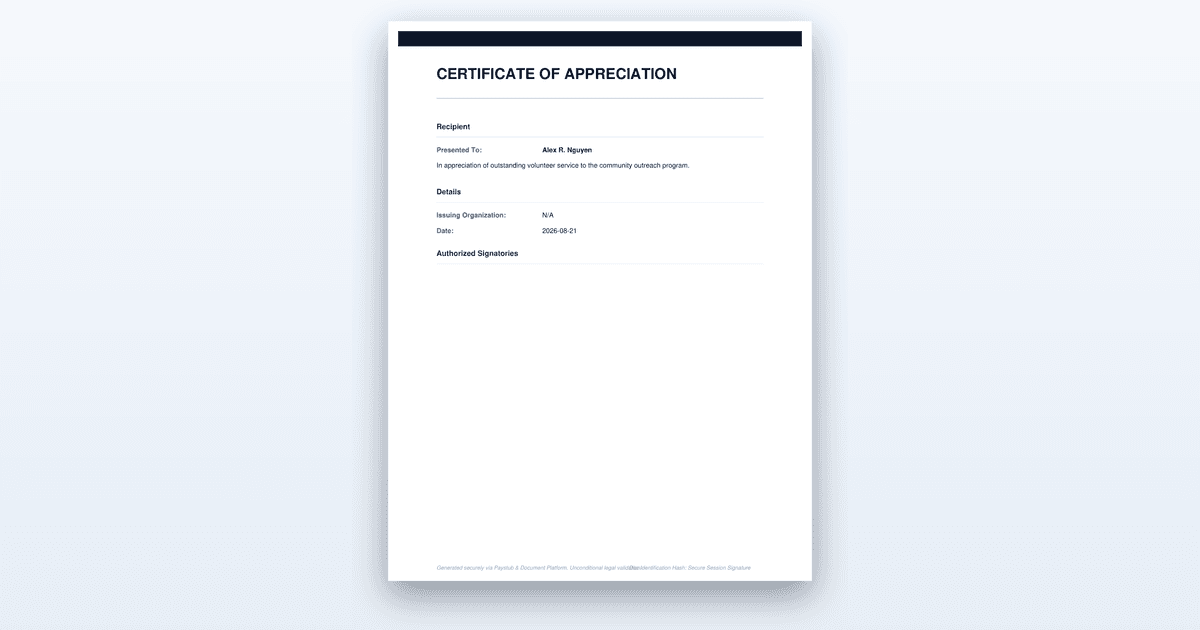
Wording, structure and signers for a certificate of appreciation: name the specific contribution, choose the right title line, and get the details right.
Short on time? You can also create the document you need in just a couple of minutes.
Key Takeaways
- •Naming the specific contribution is what separates a certificate that means something from filler.
- •Appreciation, recognition, and service are different title lines and should be chosen accurately.
- •The period covered and the presentation date make the certificate usable as a record later.
- •Two signatures from people with standing beat a long row of names.
How to Write a Certificate of Appreciation: 7 Steps That Make It Mean Something
You can write a certificate of appreciation that actually means something in seven steps and under an hour once you know the method: name the specific contribution, pick the accurate title line, and present it with the reason spoken aloud. The document itself is only half the gesture — the wording and the moment of handover are what make it land. Most certificates fail because they praise vaguely, so this guide walks you through writing one that the recipient will keep, not recycle.
Before You Start
Have four things settled before you open a template or a blank document. First, the recipient’s name exactly as they use it — not the legal name on file, but the form they actually go by, including titles like Dr. or Jr. and any suffixes. Second, a single sentence stating the specific contribution being recognized; if you cannot write this sentence yet, you are not ready to draft anything. Third, the period the recognition covers and the date of presentation, because those two facts are what make the certificate a usable record later. Fourth, who will sign it and whether that person’s standing means anything to the recipient. If you start without the specific contribution identified, you will produce a generic certificate that reads as filler, and the recipient will know it in the first five seconds.
Step-by-Step: Writing a Certificate of Appreciation
Step 1: Decide what specifically you are recognizing
Write the reason in one sentence before you touch the design, the font, or the border. The sentence must name an act, a project, a period of service, or a measurable outcome — not a character trait. “For her dedication” fails because it describes a mood. “For leading the fall food drive that collected 1,200 pounds for the county pantry” succeeds because it names what happened. Test your sentence by reading it aloud and asking whether it could be pasted onto anyone else’s certificate without changing a word. If it could, you have not identified the contribution yet.
This single sentence is the engine of the entire document. Every other line — the title, the recognition phrase, the signatures — hangs off it. The reason you do this before choosing a template is that the template will otherwise shape your words into generic praise. Start with the substance, then fit the form around it. When you can say the sentence out loud and it sounds like a specific person did a specific thing in a specific time frame, the step is done.
Step 2: Choose the title line that fits
The title is the big text at the top, and it should be accurate to what you are actually doing. Appreciation thanks someone for a contribution — effort given without a required outcome. Recognition marks an achievement — a goal met, a standard exceeded, a result delivered. Service marks time and commitment — years of tenure, sustained involvement, a completed term. These are not interchangeable, and choosing the wrong one reads as carelessness. A volunteer who organized a one-time event gets a Certificate of Appreciation. An employee who exceeded quota for four straight quarters gets a Certificate of Recognition. A board member finishing a six-year term gets a Certificate of Service.
The choice matters because it tells the recipient how you categorize their effort. Appreciation says “we are grateful you gave this.” Recognition says “you hit a mark that had to be hit.” Service says “your time and continuity mattered.” If you are unsure, ask yourself what the person would say if you asked them why they are getting this. Their answer will name the category. Once you have chosen, commit to it — do not hedge with “Certificate of Appreciation in Recognition of Service,” which reads as indecision.
Step 3: Write the recognition line naming the contribution
This is the body of the certificate, the two or three lines that carry the weight. Open with a presentation phrase — “is presented to,” “is hereby awarded to,” “is given in grateful acknowledgment to” — then the recipient’s name, then the reason. The reason must combine a connective phrase like “in appreciation of” or “in recognition of” with the specific act you wrote in Step 1. One concrete detail is worth three lines of adjectives. “In appreciation of her tireless dedication” is empty. “In appreciation of her leadership of the 2024 literacy program, which enrolled 47 children and distributed 300 books” is a document someone will keep.
Do not pad with praise words like “outstanding,” “exceptional,” or “remarkable” unless you can attach them to something specific. “For outstanding service” tells the recipient nothing; “for five years of outstanding service on the finance committee, including two years as treasurer” tells them exactly what you are honoring. The recognition line should be readable in one breath, because the recipient will read it aloud to family. If it takes two breaths, shorten it. When the line names the act and the outcome, the step is done.
Step 4: Add the period and the presentation date
State the period the contribution covers and the date the certificate is presented. The period goes in the body — “for service from January 2022 through December 2024” or “for the 2024 fiscal year” — and the presentation date goes near the signatures or at the bottom. These two facts are what make the certificate usable as a record later. Ten years on, the recipient will look at it and know exactly what it was for and when they received it. Without a period, the certificate floats in time and loses its documentary value.
The presentation date is also the date that should appear on any related records, social media posts, or internal announcements. Pick the date you will actually hand it over, not the date you drafted it. If you are presenting at an annual meeting, use that date. If you are mailing it, use the day you mail it. The period and the date together let the recipient file the certificate mentally and physically. When both are on the document and they match reality, the step is done.
Step 5: Choose signers whose signature carries weight
One or two signatures from people with real standing in the context beat a long row of names. The signer should be someone whose position means something to the recipient — the executive director of the nonprofit, the department head, the board chair, the principal. A signature from someone the recipient has never met adds nothing and can actually cheapen the gesture, because it signals that the certificate was mass-produced and passed through a routing list. If you are recognizing a volunteer, the signer should be the person who oversaw that volunteer’s work, not the CEO of a parent organization the volunteer has never interacted with.
The signature block should include the signer’s printed name and title beneath the signature line, so the recipient knows who is signing. If two signers, put the person with direct oversight first and the organizational leader second. Do not ask for more than three signatures; beyond that, the document becomes a roster, not a recognition. When every signer is someone the recipient would recognize and respect, the step is done. If you are signing it yourself, make sure your own title is on the document, because the authority of the signature depends on the authority of the office.
Step 6: Proof the names and titles before printing
A misspelled name undoes the entire gesture. Check the recipient’s name against a reliable source — their email signature, their personnel file, their volunteer application, their LinkedIn — not against your memory. Check the spelling of the organization’s own name, the signers’ names, and every job title. Then have a second person read the whole document aloud. The second reader will catch things you cannot see because you have been staring at the text. Check the date format, the period, and the title line one final time. Print one copy and read it in your hands before running the full batch.
The most common errors are silent: a transposed letter in a surname, a wrong middle initial, a title that was updated last month, the organization’s name missing a word. Each of these errors is immediately visible to the recipient and instantly reads as carelessness. If the certificate is for a volunteer and you are printing twenty of them for a ceremony, proof every single name against the list, not just the first one. When the names, titles, and dates all match the source documents, the step is done.
Step 7: Present it properly
Say the reason out loud when you hand it over. The certificate is the record; the moment of presentation is what the recipient actually remembers. Read the recognition line aloud, or better, say in your own words what the person did and why it mattered. “This is for the fall food drive — you collected twelve hundred pounds, and the pantry ran through February because of it” is worth more than the document itself. The spoken moment gives the certificate its emotional weight and tells the recipient that someone actually wrote those words with them in mind.
Present it in front of an audience if the recipient is comfortable with that, or privately if they are not. If you are presenting at a ceremony, hold the certificate so the recipient can read it while you speak, then hand it over and let them look at it. Do not hand it over and immediately move to the next item on the agenda; give the moment room to land. A photograph of the handover is a nice addition, but the spoken words are the essential part. When the recipient has heard the reason and holds the document, the step is done.
Where People Get This Wrong
The most common failure is the generic certificate. Someone writes “in appreciation of your dedication and hard work” and calls it done, and the recipient reads it, feels nothing, and files it in a drawer or throws it away. The consequence is a wasted gesture that actually communicates that you did not care enough to name what they did. The fix is Step 1 done honestly: write the specific contribution sentence before anything else, and refuse to proceed until it names an act, not a trait.
The second failure is the wrong title line. A certificate that says “Recognition” when the person volunteered their time, or “Service” when they completed a single project, reads as bureaucratic and disconnected. The consequence is that the recipient feels categorized incorrectly, which undercuts the praise. The fix is to ask what the person would call their own contribution and match the title to that.
The third failure is the misspelled name or wrong title, often discovered at the ceremony. The consequence is that the entire gesture collapses into embarrassment, and the recipient remembers the error, not the honor. The fix is the second reader and the source-check in Step 6, done a day before printing, not an hour before.
The fourth failure is the silent handover. Someone slides the certificate across a table with no explanation, or drops it in interoffice mail, and the recognition dies on arrival. The consequence is that the recipient never hears the reason, and the certificate becomes a piece of paper instead of a memory. The fix is Step 7: say the reason out loud, in your own words, at the moment of presentation.
Worked Example
Here is a full run-through with invented figures, so you can see the method in motion. Sarah Chen has volunteered with the Maplewood Community Garden for three years, and for the past two years she has coordinated the annual seedling sale that funds the garden’s operating costs. The board chair, Marcus Webb, wants to recognize her. This is an example, not your numbers.
Marcus starts with Step 1 and writes one sentence: “Sarah Chen coordinated the 2024 seedling sale, which raised $4,300 and funded the garden’s water system upgrade.” He reads it aloud and confirms it names a specific act with a specific outcome. Step 2: he considers the title. Sarah volunteered her time, so this is Appreciation, not Recognition or Service — although her three years of involvement could justify Service, the sale is the specific contribution, so he chooses “Certificate of Appreciation.”
Step 3: he writes the recognition line. “The Maplewood Community Garden presents this Certificate of Appreciation to Sarah Chen in appreciation of her coordination of the 2024 seedling sale, which raised $4,300 and funded the garden’s water system upgrade.” He reads it in one breath; it works. Step 4: he adds the period — “for the 2024 season, March through June” — and sets the presentation date as the garden’s annual volunteer dinner on November 15, 2024.
Step 5: he chooses two signers. Marcus himself, as board chair, and the garden’s executive director, Elena Rodriguez, who supervised Sarah’s work. He does not add the mayor or the city council member, because Sarah has never met them. Step 6: he proofs the document. He checks Sarah’s name against her email signature — it is “Sarah Chen,” no middle initial — and checks that “Maplewood Community Garden” is spelled correctly. Elena reads the draft aloud and catches that Marcus wrote “water system upgrade” when the project was actually the “irrigation system upgrade.” Marcus fixes it.
Step 7: at the dinner on November 15, Marcus hands Sarah the certificate and says, “Sarah, this is for the seedling sale — you raised $4,300, and the irrigation system we installed this fall is running because of you.” She reads the certificate, and it matches what he said. The certificate goes on her refrigerator, and the spoken moment is what she tells her family about. The whole process, from first sentence to handover, took Marcus about forty-five minutes spread over two days.
When to Get Professional Help
If the certificate is part of a formal employment action — a promotion, a retirement, a public award with legal or contractual implications — have your HR department or a lawyer review the wording before it is printed, because language that implies a contract, a promise, or a tenure commitment can create unintended obligations. If the certificate names a financial figure or a measurable outcome that could be disputed, have the numbers verified by whoever keeps the records. For the vast majority of volunteer, partner, and employee recognitions, no professional is needed — the steps above are sufficient — but when the document will be cited in a personnel file, a press release, or a legal context, one review is cheap insurance. This is general information, not legal advice.
The Bottom Line
Name the specific contribution, choose the accurate title line, and say the reason out loud when you hand it over. The certificate is the record, but the moment is the memory. Write the one-sentence reason first, proof the names against a source, and keep the signers to people the recipient actually respects — and the certificate will mean something for years, not minutes.
Frequently Asked Questions
What is standard wording for a certificate of appreciation?
A title line, a presentation phrase such as "presented to", the recipient's name, a line beginning "in appreciation of" that names the specific contribution, the date, and the signatures.
What is the difference between appreciation and recognition?
Appreciation thanks someone for a contribution, usually given freely. Recognition marks an achievement measured against a standard. Choose the one that describes what actually happened.
Should a certificate of appreciation be signed by more than one person?
One or two signers with genuine standing is usually stronger than a full row. Extra names dilute rather than add.
Authoritative References
The rules described here come from the agencies that set them. Check the current text before you rely on a deadline or a figure:
Related Guides
- Are Employee Awards Gift Certificates Taxable? IRS Rules
- Award Certificate: The Ultimate Guide to Recognizing Excellence
- OSHA bloodborne pathogens training documentation rules
- How to Create a Certificate of Completion People Actually Trust
Sources: Paystub-Generator.com editorial team. This guide is informational and not legal or tax advice.
This guide is part of our Certificates service — award, achievement and completion certificates.
Explore CertificatesCertificates & Awards Hub
Explore our suite of print-ready templates in the Certificates & Awards category.
Citations & Legal Sources
- Paystub-Generator.com editorial team
