
The Complete Guide to Using a General Bill of Sale
Paystub Generator Editorial Team
Last Updated: September 2, 2026
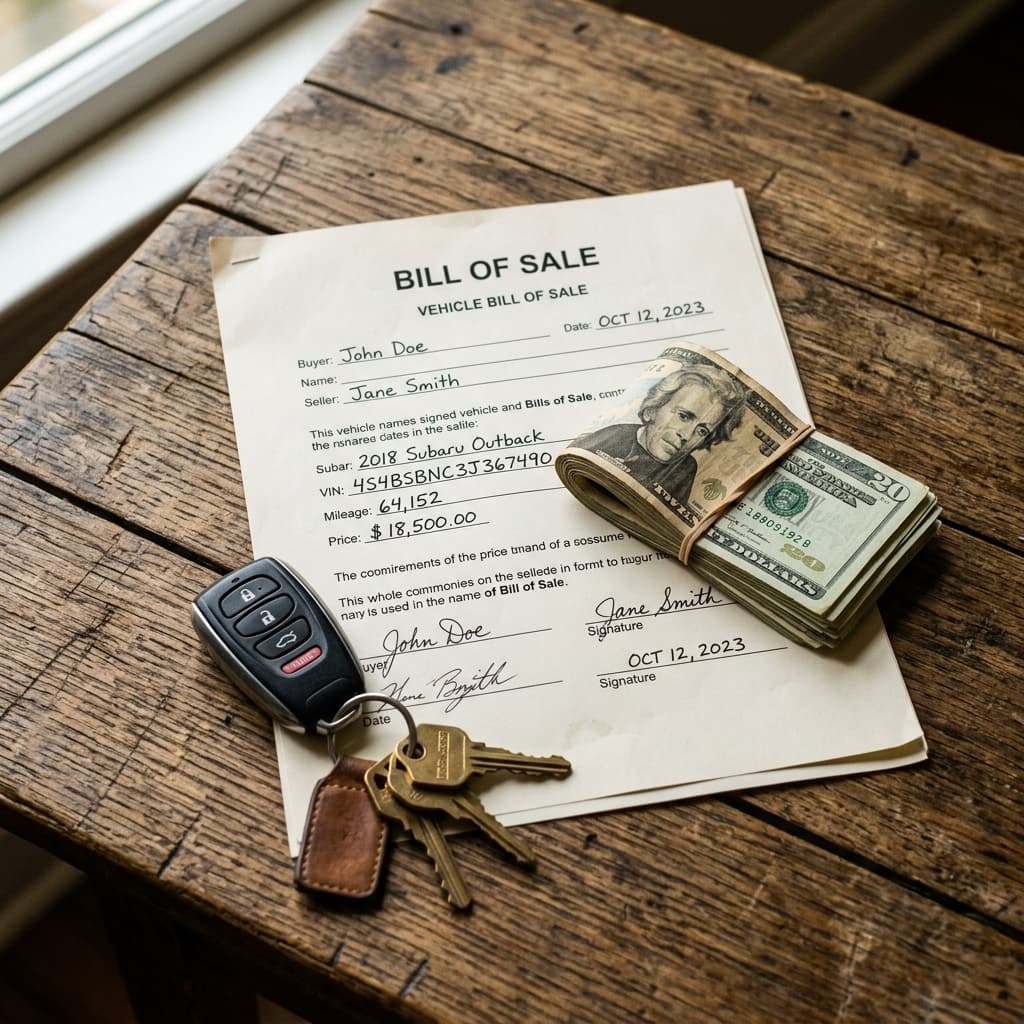
Everything you need to know about drafting, signing, and utilizing a General Bill of Sale for private transactions and personal property transfers.
A General Bill of Sale is a deceptively simple document that plays a monumental role in personal and business transactions. It acts as the official legal receipt proving that the ownership of a specific item has been transferred from one party to another. Whether you are selling a used laptop or buying a piece of heavy machinery, this document is your primary shield against future ownership disputes.
Many people rely on verbal agreements or casual handshakes for private sales, assuming a formal document is unnecessary. This is a dangerous misconception that frequently leads to bitter legal battles and significant financial losses. This comprehensive guide explores the critical importance of a General Bill of Sale, detailing exactly how to use it to protect your assets and your peace of mind.
What is a General Bill of Sale?
At its core, a General Bill of Sale is a legally binding written contract documenting the transfer of personal property. It records the essential details of a transaction, including who sold the item, who bought it, the purchase price, and the exact date of the transfer. Unlike specialized bills of sale (like those used specifically for motor vehicles or firearms), a general version can be used for virtually any item of personal property.
The person selling the item is formally referred to as the "Seller." The person purchasing the item is known as the "Buyer." Once both parties sign the document and the funds are exchanged, the Buyer becomes the sole, undisputed legal owner of the property described.
It is important to note that a General Bill of Sale is only used for "personal property" (also known as "chattel"). It cannot be used to transfer ownership of real estate or land; those transactions require complex deeds and title transfers. However, for everything from furniture and electronics to livestock and business equipment, it is the standard legal instrument.
Why Buyers Absolutely Need a Bill of Sale
For the Buyer, the Bill of Sale serves as irrefutable proof of legal ownership. If someone later claims that the item you purchased was stolen or belongs to them, you have written evidence proving you bought it legitimately. Without this document, the police or a judge may force you to surrender the item without any compensation.
Furthermore, a Bill of Sale is often required to obtain insurance on high-value items. If you buy an expensive piece of jewelry or a high-end bicycle, your insurance company will demand proof of purchase and the item's value before issuing a policy. The Bill of Sale provides exactly the documentation the underwriters require to establish the item's baseline worth.
In many jurisdictions, a Bill of Sale is also necessary to prove the basis for calculating sales tax or property tax on newly acquired assets. If you are audited by state tax authorities, a verbal claim of how much you paid will not suffice. The written document provides a clear, verifiable record of the transaction amount.
Why Sellers Must Insist on a Bill of Sale
Sellers often mistakenly believe that once they hand over the item and receive the cash, their liability ends. This is not necessarily true, especially if the item causes injury or property damage after the sale. A Bill of Sale explicitly documents the exact date and time the Seller relinquished ownership and responsibility.
Consider selling a used lawnmower to a neighbor. If that lawnmower malfunctions a week later and causes an injury, the injured party might try to sue you, claiming you sold a dangerous product. A properly drafted Bill of Sale, especially one including an "As-Is" clause, provides a robust legal defense against such claims.
Additionally, a Bill of Sale protects the Seller from disputes regarding the agreed-upon price or the condition of the item at the time of sale. If the Buyer later suffers buyer's remorse and demands a refund, the signed contract serves as proof that the sale was final. It completely shuts down attempts to renegotiate the deal after the fact.
State Law Disclaimers and Requirements
While a General Bill of Sale is a universal concept, the specific legal requirements for a valid document can vary by state. Disclaimer: This article provides general educational information and does not constitute legal advice. You should consult your state's specific laws or a qualified attorney to ensure compliance.
Some states require specific language to be used when selling items that require registration, like boats or ATVs, even if you are using a "general" form. Furthermore, requirements for witnesses and notarization differ wildly across jurisdictions. For instance, states like Louisiana and Nebraska often have strict notarization requirements for bills of sale involving specific types of high-value property.
If you fail to meet your state's execution requirements, the document may be deemed legally invalid in court. This means a judge could treat the transaction as if the Bill of Sale never existed. Always ensure the form you are using is explicitly tailored to the laws of the state where the transaction is taking place.
Generate a General Bill of Sale
Our General Bill of Sale generator produces a complete, printable document customized to protect your specific transaction and legal interests.
Create General Bill of SaleEssential Elements of the Document
A legally sound General Bill of Sale must contain several specific pieces of information to be enforceable. First and foremost, it must clearly identify both the Seller and the Buyer, including their full legal names, addresses, and contact information. Ambiguity regarding the parties involved is a common reason these contracts fail in court.
Second, the document must include a meticulous description of the property being sold. Do not simply write "one laptop"; instead, include the make, model, year, color, and, most importantly, the serial number. The more precise the description, the harder it is for either party to later claim a different item was part of the deal.
Third, the contract must explicitly state the total purchase price. If the item is being traded for another item or for services rather than cash, this "consideration" must be detailed thoroughly. The exact date of the transaction and the location (City and State) must also be clearly recorded.
The Power of the "As-Is" Clause
Perhaps the most crucial paragraph in a standard General Bill of Sale is the "As-Is" clause. This clause explicitly states that the Buyer is purchasing the property in its current condition, with all its existing faults and defects. It legally absolves the Seller of any responsibility for repairing the item if it breaks down after the sale is finalized.
Without an "As-Is" clause, a court might infer that the Seller provided an "implied warranty of merchantability." This means the Buyer could argue they expected the item to be in perfect working order, leading to lawsuits if the item fails. The "As-Is" designation forces the Buyer to accept the risk, emphasizing the importance of their own pre-purchase inspection.
However, an "As-Is" clause does not protect a Seller who commits outright fraud. If the Seller intentionally lies about a known defect—for example, covering up severe water damage inside an electronic device—they can still be sued. The clause only protects against normal wear and tear or defects the Seller was genuinely unaware of.
Payment Methods and Terms
The Bill of Sale should clearly document exactly how the Buyer is paying the Seller. Whether the payment is made via cash, certified check, bank wire transfer, or a digital payment platform, the method must be recorded. If a check is used, it is wise to include the check number directly on the document for easy tracking.
In some private transactions, the Buyer and Seller might agree to an installment payment plan. If this is the case, the Bill of Sale must detail the exact payment schedule, including due dates and specific installment amounts. However, for installment sales, a separate Promissory Note is highly recommended to provide stronger legal mechanisms for collecting the debt.
The document should also state whether the purchase price includes any applicable sales taxes. In many states, private sales between individuals are exempt from sales tax, but this varies significantly depending on the item and the jurisdiction. Clarifying tax responsibilities prevents unexpected liabilities from arising later.
Warranties and Guarantees
While the "As-Is" clause is standard, sometimes a Seller does offer a specific warranty. For example, a business selling refurbished equipment might offer a 30-day guarantee against mechanical failure. If any such warranty is offered, it must be explicitly written into the Bill of Sale to be legally binding.
The terms of the warranty must be incredibly specific to avoid ambiguity. It should state exactly what components are covered, how long the coverage lasts, and what the Buyer must do to file a claim. Verbal promises of "I'll fix it if it breaks" are entirely unenforceable and will be ignored by a judge.
Conversely, if the Seller is strictly selling the item "As-Is," the document should explicitly state that no warranties, express or implied, are being offered. This definitive language acts as a legal shield, shutting down any attempts by the Buyer to claim a warranty was implied during the negotiation phase. Clarity regarding warranties is essential for preventing post-sale conflicts.
The Role of Notarization
Many people wonder if a General Bill of Sale must be notarized to be legally valid. In most states, for standard personal property, notarization is not strictly required by law. The signatures of the Buyer and Seller are usually sufficient to create a binding contract.
However, having the document notarized is always highly recommended, especially for high-value transactions. A Notary Public acts as an impartial third-party witness who verifies the identities of the signers and ensures they are signing willingly. This completely eliminates the risk of one party later claiming their signature was forged.
If you ever need to use the Bill of Sale in court, a notarized document carries significantly more evidentiary weight. The judge will accept the notarized signatures as authentic without requiring further proof or testimony. For the small fee a notary charges, it provides an invaluable layer of legal security.
Witnesses to the Transaction
If you cannot find a notary, having independent witnesses sign the document is the next best option. A witness should be a neutral third party who is not involved in the transaction and does not stand to benefit from it. Family members of either the Buyer or Seller are generally poor choices for witnesses due to inherent bias.
The witness must watch both the Buyer and Seller sign the document and then immediately add their own signature and contact information. If a dispute later arises regarding the authenticity of the contract, the witness can be called to testify in court. Their testimony can verify that the transaction took place exactly as documented.
Some states may require at least one or two witnesses for bills of sale involving specific types of assets, even if notarization is not mandated. Always check your local regulations to ensure your execution method meets the required legal standard. When in doubt, utilizing both witnesses and a notary provides the ultimate level of protection.
Record Keeping and Storage
Once the transaction is complete and the General Bill of Sale is fully executed, proper storage is crucial. Both the Buyer and the Seller should receive a completed, signed copy of the document. The Buyer should keep their copy with the item's manuals, receipts, and warranty information.
The Seller should retain their copy in a secure filing system, alongside their tax records and major financial documents. It is highly recommended to scan the document and store a digital backup securely in the cloud. Physical paper can be easily lost, damaged by water, or destroyed in a fire, making digital redundancy essential.
You should keep the Bill of Sale for a minimum of several years after the transaction. The standard statute of limitations for breach of written contract claims in most states ranges from three to ten years. Retaining the document until this legal window closes ensures you are protected against any delayed lawsuits or tax audits.
Using a Bill of Sale for Business Assets
General Bills of Sale are not just for individuals selling personal items; they are vital for business operations. When a company sells off old office furniture, outdated computer servers, or surplus inventory, they must use a Bill of Sale. This documentation is essential for accurate corporate accounting and asset depreciation tracking.
For businesses, the document serves as proof of the asset's disposal for tax purposes. It demonstrates to the IRS exactly how much capital was recouped from the sale, which impacts the company's overall tax liability. Failing to properly document the sale of business assets can trigger severe penalties during a corporate tax audit.
When a business uses a Bill of Sale, the person signing must have the legal authority to bind the company. The document should clearly state the corporate title of the signer, such as "President" or "Managing Member." A signature from an unauthorized employee could render the entire transfer invalid.
Common Mistakes to Avoid
The most common mistake people make is using a generic, overly brief Bill of Sale that lacks crucial details. A document that simply says "I sold a TV for $100" offers almost zero legal protection if a dispute arises. The lack of serial numbers, dates, and "As-Is" clauses makes the contract practically worthless in court.
Another frequent error is failing to accurately identify the parties involved. Using nicknames or omitting complete addresses makes it incredibly difficult to track down the other party if a problem occurs. Always use full, legal names exactly as they appear on government-issued identification.
Finally, attempting to use a General Bill of Sale for items that require specialized forms is a critical error. Never use a general form to sell a car, a motorcycle, or a firearm, as these items have strict state and federal reporting requirements. Always use the specific legal instrument designed for the exact type of property you are transferring.
Conclusion
A General Bill of Sale is a fundamental tool for conducting safe, secure, and legally sound transactions. It protects Buyers from fraudulent ownership claims and shields Sellers from lingering liabilities after the item changes hands. By documenting the exact terms of the sale, you eliminate ambiguity and establish a clear, verifiable record of the event.
Do not let the informal nature of private sales lull you into a false sense of security. Whether you are selling a thousand-dollar piece of equipment or a hundred-dollar antique, take the time to draft a proper agreement. Insisting on a well-crafted General Bill of Sale is the hallmark of a responsible and legally protected individual.
Related Legal Resources
If you found this guide useful, our other legal tools can help you handle the next step. Explore our
This guide is part of our Legal Forms service — NDAs, bills of sale and demand letters.
Explore Legal FormsLegal Forms Knowledge Hub
Explore our suite of legally binding templates in the Legal Forms category.

