
The Ultimate Guide to Writing a Formal Demand Letter
Paystub Generator Editorial Team
Last Updated: September 2, 2026
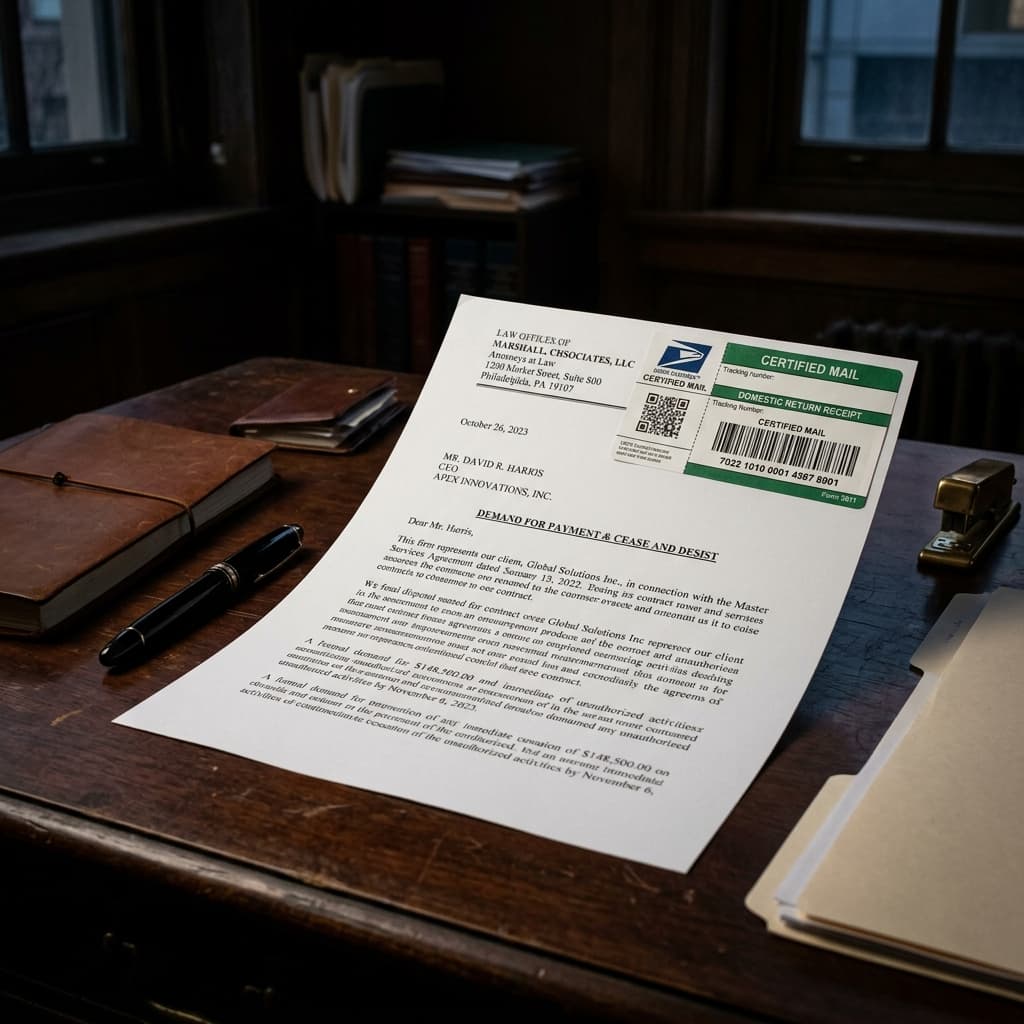
Learn how to draft an effective Formal Demand Letter to resolve disputes, demand payment, and avoid costly litigation.
When a business deal goes sour or a client refuses to pay an invoice, your first instinct might be to immediately file a lawsuit. However, jumping straight into litigation is often a massive mistake that will cost you thousands of dollars in legal fees and months of wasted time. A Formal Demand Letter is the crucial intermediate step that often resolves disputes quickly, effectively, and without setting foot inside a courtroom.
A well-crafted demand letter shows the opposing party that you are serious about enforcing your rights. It lays out the facts of the dispute clearly and provides a final opportunity for the other party to rectify the situation before legal action is taken. This comprehensive guide will teach you exactly how to structure, write, and send a Formal Demand Letter that actually gets results.
What is a Formal Demand Letter?
A Formal Demand Letter is a written communication that explicitly demands restitution or performance of a specific legal obligation. It is typically sent by an aggrieved party to a person or business that owes them money or has breached a contract. The letter serves as a formal declaration of your grievance and a stark warning that a lawsuit is imminent if the demands are not met.
Unlike a casual email or a phone call, a demand letter creates a permanent paper trail. It documents exactly what you are asking for, why you are entitled to it, and the deadline for compliance. If the dispute eventually goes to court, this letter serves as critical evidence that you attempted to resolve the matter in good faith before suing.
While lawyers frequently write demand letters on behalf of their clients, you do not technically need an attorney to draft one. Individuals and small business owners can successfully draft and send their own demand letters, provided they understand the essential legal components. A strong, professional letter is often enough to persuade a stubborn debtor to finally pay up.
Why You Should Always Send a Demand Letter First
Sending a Formal Demand Letter is almost always the most strategic first move in any civil dispute. The primary reason is cost efficiency; drafting and mailing a letter costs a fraction of what it costs to file a formal legal complaint. If the letter successfully resolves the issue, you have saved yourself an immense amount of time, money, and stress.
Furthermore, many courts, especially small claims courts, actively require you to prove that you demanded payment before filing a lawsuit. If you walk into court without having sent a demand letter, the judge may dismiss your case entirely. In many jurisdictions, a copy of the demand letter and proof of mailing must be attached to the initial small claims court filing.
Finally, a demand letter forces the opposing party to evaluate their own legal position seriously. Often, a debtor is simply ignoring your casual emails because they don't think you will actually escalate the matter. A formal letter, especially one citing specific contract clauses or statutes, changes the dynamic and forces them to respond.
State Law Disclaimers and Legal Threats
It is absolutely vital to understand that a demand letter must be factual and firm, but it cannot cross the line into extortion or harassment. Disclaimer: This article provides general educational information and does not constitute legal advice. You should consult your state's specific laws or a qualified attorney to ensure compliance.
For example, you can legally threaten to file a civil lawsuit if a debt is not paid. However, you cannot threaten to report the person to the police or claim they committed a crime (like theft) unless you are prepared to follow through, and even then, linking it to a demand for money can be considered extortion. The Fair Debt Collection Practices Act (FDCPA) heavily regulates how debt collectors can communicate, and while it primarily applies to third-party agencies, its principles are wise guidelines for anyone demanding payment.
Threatening to ruin someone's reputation, contacting their employer, or using abusive language can completely backfire. The opposing party could countersue you for harassment or intentional infliction of emotional distress. A demand letter must always remain strictly professional, objective, and focused solely on the legal and factual merits of the dispute.
Generate a Formal Demand Letter
Our Formal Demand Letter generator produces a complete, printable document customized to state your grievance firmly and professionally.
Create Formal Demand LetterStructuring Your Demand Letter
A successful demand letter follows a specific, highly logical structure. It begins with the sender's contact information and the date, followed by the recipient's full name and address. The subject line should be clear and unmistakable, such as "DEMAND FOR PAYMENT: INVOICE #12345."
The opening paragraph should immediately state the purpose of the letter and the exact amount of money being demanded. Do not bury the lead; the recipient should know exactly what the letter is about within the first sentence. The subsequent paragraphs will then dive into the factual history that justifies this demand.
The body of the letter should read like a chronological story of the dispute. It should detail when the contract was signed, what services were provided, when the invoice was sent, and how many times the recipient has ignored requests for payment. The final paragraphs will set a strict deadline and outline the consequences of non-compliance.
Stating the Facts Objectively
When writing the factual history of the dispute, emotion is your worst enemy. Do not use adjectives like "terrible," "dishonest," or "lazy" to describe the opposing party. Instead, rely entirely on objective, verifiable facts and specific dates.
For example, instead of writing "You did a horrible job fixing my roof and ruined my ceiling," write "On October 5th, your company repaired the roof. On October 10th, the roof leaked, causing $500 in water damage to the ceiling." This factual approach makes the letter read like a legal document rather than a personal vent. It shows the recipient that you are building a logical, evidence-based case that will hold up in court.
You should reference specific documents within this section, such as contracts, invoices, or prior email correspondence. By anchoring your narrative to written evidence, you make it extremely difficult for the recipient to dispute your version of events. Keep the narrative concise, focusing only on the facts directly relevant to the specific demand.
Calculating the Exact Demand Amount
Your demand must be for a specific, calculable amount of money. You cannot simply demand "a fair settlement" or "compensation for my trouble." You must explicitly break down exactly how you arrived at the total figure you are demanding.
If you are owed money for an unpaid invoice, the calculation is straightforward: list the invoice amount and any applicable late fees. If you are demanding compensation for property damage, you must include the exact cost of the repairs. You should always attach copies of the invoices, repair estimates, or receipts that prove your calculations are accurate.
In some states, you are legally entitled to demand prejudgment interest on unpaid debts. If your original contract included a clause regarding late payment interest, explicitly cite that clause and show the math for how the interest was calculated. Providing a clear, itemized breakdown removes any ambiguity and prevents the recipient from claiming the amount is arbitrary.
Establishing a Firm Deadline
A demand without a deadline is merely a suggestion. Your Formal Demand Letter must give the recipient a specific, reasonable timeframe to comply with your demands. If the deadline is too vague (e.g., "Please pay me soon"), the letter loses all its urgency and power.
Typically, a deadline of 10 to 14 days from the date of the letter is considered standard and reasonable. This gives the recipient enough time to receive the letter, consult with an attorney if necessary, and arrange for payment. State the deadline clearly, emphasizing the exact date: "If full payment is not received by 5:00 PM on November 15th..."
You must also explicitly state exactly how the payment should be made. Provide clear instructions: "Please send a cashier's check made payable to John Doe at the address listed above." Making it easy for them to pay increases the likelihood that they will actually do it.
Outlining the Consequences of Non-Compliance
The final section of the letter must clearly state what will happen if the deadline passes without resolution. This is the "threat" portion of the letter, and it must be delivered professionally but firmly. Usually, the consequence is the immediate filing of a civil lawsuit.
You should explicitly state that if the demand is not met, you will pursue all available legal remedies. You can mention that you will file a claim in small claims court or turn the matter over to your attorney for formal litigation. You should also state that if you are forced to sue, you will seek to recover court costs and attorney's fees, provided your contract or state law allows for it.
It is crucial that you only make threats you are fully prepared to execute. If you state that you will file a lawsuit on November 16th, and then November 16th comes and goes with no action, you lose all credibility. The opposing party will realize you are bluffing and will continue to ignore you.
Attaching Evidence and Documentation
A Formal Demand Letter should never be sent in isolation. It must be accompanied by the documentary evidence that supports your claims. Think of the letter as the summary argument, and the attachments as the undeniable proof.
Always attach copies (never originals) of the relevant contract or agreement that was breached. Include copies of all unpaid invoices, bounced checks, or relevant email correspondence where the recipient acknowledged the debt. If the dispute involves physical damage, include copies of repair estimates and photographs of the damage.
By providing the evidence upfront, you eliminate the recipient's ability to claim they don't know what you are talking about. It also demonstrates that you are highly organized and fully prepared to present your case to a judge. This level of preparation is often intimidating enough to force a quick settlement.
How to Send the Demand Letter
The method you use to send the demand letter is just as important as the content of the letter itself. You must have verifiable proof that the recipient actually received the document. Sending it via standard email or regular first-class mail is insufficient, as the recipient can simply claim it went to spam or was lost in the mail.
The gold standard for sending a Formal Demand Letter is United States Postal Service (USPS) Certified Mail with a Return Receipt Requested. This requires the recipient (or someone at their address) to physically sign for the letter upon delivery. The post office then mails the signature card back to you, providing ironclad proof of receipt.
You can also send a duplicate copy via standard first-class mail and email, explicitly noting in the letter that it is being sent via multiple methods. If the recipient refuses to sign for the Certified Mail, the fact that the first-class mail was not returned to you as undeliverable serves as presumed receipt in many courts. Always keep a copy of the final, signed letter and all tracking receipts for your own legal files.
Reviewing the Response (or Lack Thereof)
Once the letter is sent and the deadline is established, the ball is in the recipient's court. They may respond in several ways: they might pay the demand in full, ignore the letter entirely, or send a counter-offer. How you handle their response dictates the next phase of the dispute.
If they offer a partial payment or a settlement, you must carefully weigh the cost of litigation against the reduced payout. Accepting 80% of what you are owed today might be a better financial decision than spending months fighting in court to get 100%. If you agree to a settlement, ensure the new agreement is put in writing and signed by both parties.
If the deadline passes and you receive no response, or if they explicitly refuse to pay, you must follow through on your consequence. This is the moment to file your complaint in small claims court or formally retain a litigation attorney. Because you laid out your case clearly in the demand letter, your attorney or the judge will have an excellent starting point for the lawsuit.
Demand Letters for Personal Injury
While often used for debt collection, demand letters are also the standard starting point for personal injury claims. If you are injured in a car accident or a slip-and-fall, your attorney will send a demand letter to the at-fault party's insurance company. This letter differs significantly from a standard business demand letter.
A personal injury demand letter must exhaustively detail the medical treatment received, the specific injuries sustained, and the prognosis for future recovery. It must calculate "special damages" (quantifiable costs like medical bills and lost wages) and "general damages" (subjective costs like pain and suffering). Insurance adjusters use complex software formulas, like Colossus, to evaluate these demand letters, so they must be drafted with extreme precision.
Because personal injury law is highly complex and involves negotiating with massive insurance corporations, individuals rarely write these letters themselves. If you are dealing with a severe injury, it is strongly advised to hire a personal injury attorney to draft the demand letter and handle the negotiations. An amateur letter will almost certainly result in a lowball settlement offer from the insurance company.
The Role of an Attorney
You might wonder if you should pay an attorney to write your demand letter instead of doing it yourself. Having an attorney draft the letter on their official law firm letterhead undeniably adds significant psychological weight to the demand. When a debtor sees a letter from a law firm, they immediately realize the situation has escalated from a minor annoyance to a serious legal threat.
However, hiring an attorney to draft a simple letter can cost several hundred dollars. If the dispute is over a $500 unpaid invoice, spending $300 on an attorney makes little financial sense. In these smaller cases, drafting the letter yourself using a high-quality generator is the most logical approach.
Conversely, if the dispute involves tens of thousands of dollars, complex contract law, or allegations of fraud, an attorney is essential. An experienced lawyer will ensure the letter does not accidentally make damaging admissions or violate specific statutory requirements. Evaluate the dollar amount and the complexity of the case before deciding whether to draft it yourself or hire counsel.
Conclusion
A Formal Demand Letter is an incredibly potent tool in any professional's legal arsenal. It transforms a frustrating dispute into a formal, structured process with clear deadlines and consequences. By presenting a factual, objective, and well-documented case, you signal to the opposing party that you are fully prepared to defend your rights.
Remember that the goal of the letter is not to start a fight, but to end one before it reaches a courtroom. Keep your tone professional, your facts accurate, and your demands reasonable and calculable. When executed correctly, a demand letter is often the only legal action you will ever need to take to get what you are rightfully owed.
Related Legal Resources
If you found this guide useful, our other legal tools can help you handle the next step. Exp
This guide is part of our Legal Forms service — NDAs, bills of sale and demand letters.
Explore Legal FormsLegal Forms Knowledge Hub
Explore our suite of legally binding templates in the Legal Forms category.

