
The Definitive Guide to Employment Verification Letters
Paystub Generator Editorial Team
Last Updated: September 2, 2026
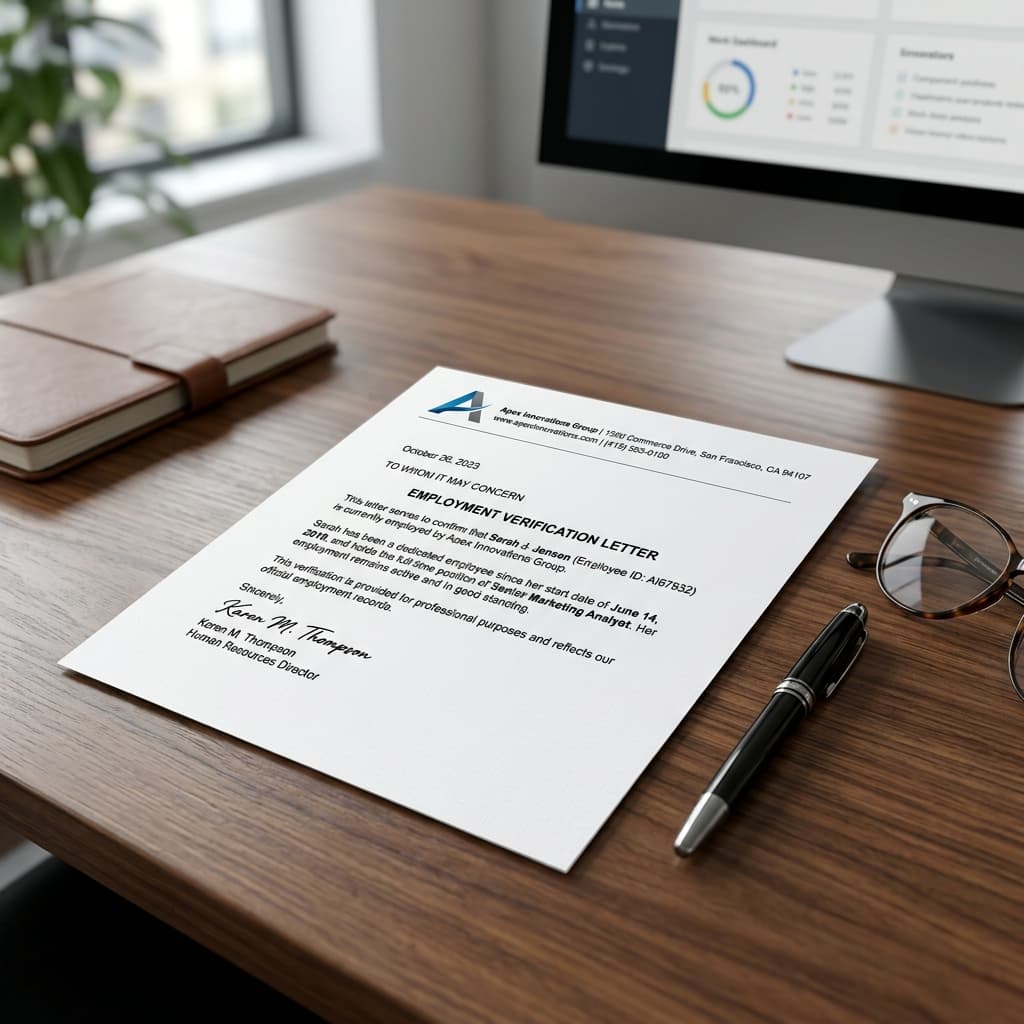
Everything you need to know about employment verification letters, including templates, legal requirements, and how to create them properly.
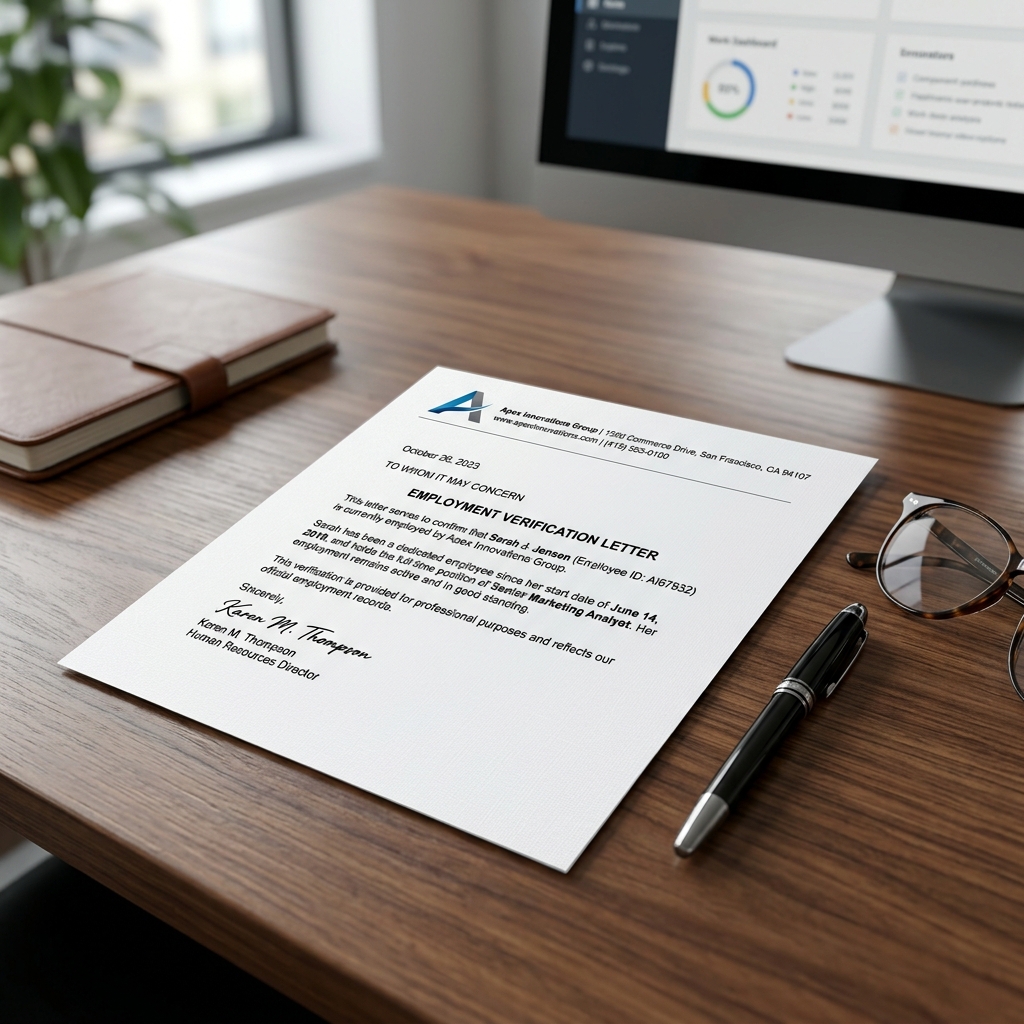
An employment verification letter is a formal document provided by an employer to confirm an individual's current or past employment status. Third parties such as banks, property managers, and government agencies rely on these letters to verify information. They act as an official record of a person's employment history and stability.
Creating an accurate employment verification letter is crucial for both employers and employees. Mistakes or missing details can lead to denied loans, rejected lease applications, or delayed visa processing. This extensive guide covers every aspect of employment verification, ensuring you have the knowledge to draft or request a perfect document.
What is an Employment Verification Letter?
An employment verification letter, sometimes called a proof of employment letter, is exactly what it sounds like. It is a signed statement from an authorized company representative confirming that a specific person works or worked for their organization. Human resources departments, direct managers, or business owners typically draft these letters.
The contents of the letter usually vary depending on who is requesting it and why. A standard letter might only include the dates of employment and job title. A more detailed letter could include salary information, typical hours worked, and the likelihood of continued employment.
It is important to remember that this document must be printed on official company letterhead. It must also include the physical signature of the person authorizing it. Electronic signatures are becoming more acceptable, but a wet signature remains the gold standard for many institutions.
Common Scenarios Requiring Employment Verification
There are countless reasons why someone might need proof of their employment. The most common scenario involves applying for a mortgage or personal loan. Banks need to ensure that the applicant has a stable income source to repay the borrowed funds.
Renting an apartment or house is another primary reason. Landlords want assurance that their prospective tenants have secure jobs and can afford the monthly rent. Without this verification, landlords might reject the application entirely.
Immigration processes frequently require employment verification letters. When applying for certain visas, such as an H-1B or a green card, the government must verify the applicant's job offer and employment terms. Additionally, prospective employers often verify past employment during the background check phase of the hiring process.
Essential Components of an Employment Verification Letter
Every employment verification letter must contain specific core elements to be considered valid. First and foremost, it must clearly identify the employer with the company name, address, and contact information. This is typically achieved by using official company letterhead.
The letter must also clearly identify the employee by their full legal name. Sometimes the last four digits of their Social Security Number are included, though privacy concerns often dictate omitting the SSN unless explicitly required. The document must state the employee's exact job title or position within the company.
Crucially, the dates of employment must be completely accurate. For current employees, the letter should state the start date and indicate that they are presently employed. For former employees, both the exact start and end dates must be provided.
If the requesting party requires income verification, the letter should state the employee's current salary or hourly wage. It should also clarify if the employment is full-time, part-time, or on a contract basis. Finally, the letter must be signed and dated by an authorized representative, including their printed name and job title.
Generate a Employment Verification
Our Employment Verification generator produces a complete, printable document...
Create Employment VerificationLegal Considerations and Compliance
When issuing employment verification letters, employers must navigate various privacy laws and regulations. You cannot simply disclose all of an employee's private information to anyone who asks. You must have a clear understanding of what is legally permissible to share.
In many jurisdictions, employers require written consent from the employee before releasing sensitive information like salary history or performance reviews. Check specific state laws regarding mandatory consent forms for salary disclosure during employment verification. Without consent, it is generally safer to only confirm the dates of employment and job title.
State laws vary significantly regarding what an employer can and cannot say about a former employee. Some states provide "qualified privilege," protecting employers from defamation lawsuits if they provide honest feedback about a former employee's job performance. Confirm which states offer qualified immunity for employment references.
However, to minimize legal risk, many companies adopt a strict policy of only verifying dates of employment and titles.
Employment Verification vs. Proof of Income
It is easy to confuse an employment verification letter with a proof of income letter, but they serve distinct purposes. An employment verification letter primarily confirms where and when someone worked. It establishes the employment relationship itself.
A proof of income letter, on the other hand, is laser-focused on financial compensation. While it confirms employment, its main goal is to document exactly how much money the individual earns. This is often required for rigorous financial evaluations.
Sometimes, a single letter can serve both functions if it includes detailed salary information. However, if a lender specifically asks for proof of income, they might require additional documents like pay stubs or W-2 forms alongside the letter. We offer dedicated generators for both document types to ensure you meet the exact requirements of the requesting party.
How to Request an Employment Verification Letter
If you are an employee who needs this letter, the process is usually straightforward. Start by contacting your human resources department or your direct supervisor. Explain who needs the letter and what specific information they require.
It is helpful to provide your employer with a template or a list of required bullet points. This saves them time and ensures the final document contains everything you need. Be sure to submit your request well in advance of any deadlines, as HR departments often have processing times of a few business days.
If you are applying for a mortgage, your lender might use a standardized form instead of a generic letter. In this case, you will need to sign the form authorizing the release of information. The lender will then send it directly to your employer to complete.
Writing the Perfect Letter: Best Practices for Employers
When drafting an employment verification letter on behalf of an employee, clarity and professionalism are paramount. Always use official company letterhead to establish authenticity immediately. Ensure all dates, titles, and salary figures are double-checked against official payroll or HR records.
Keep the tone objective and factual. This is not a letter of recommendation, so avoid subjective statements about the employee's work ethic or personality unless explicitly requested and permitted by company policy. Stick to the verifiable facts to protect both the company and the employee.
Ensure the letter is signed by an authorized individual, such as an HR manager, payroll administrator, or corporate officer. If the requesting party contacts the company to verify the letter's authenticity, the person who signed it should be prepared to confirm its contents.
Templates and Examples
Using a template ensures you do not forget any crucial details. Below are several templates tailored for different situations.
Template 1: Standard Employment Verification (No Salary)
[Company Letterhead]
Date: [Date]
To Whom It May Concern:
This letter is to verify the employment of [Employee Name] at [Company Name]. [Employee Name] has been employed with us since [Start Date]. Their current job title is [Job Title], and their employment status is [Full-Time/Part-Time].
If you have any further questions, please do not hesitate to contact our Human Resources department at [Phone Number] or [Email Address].
Sincerely,
[Signature]
[Printed Name] [Title] [Company Name]
Template 2: Detailed Employment Verification (With Salary)
[Company Letterhead]
Date: [Date]
To Whom It May Concern:
Please accept this letter as confirmation that [Employee Name] is currently employed with [Company Name]. [Employee Name] began their employment on [Start Date] and currently holds the position of [Job Title].
Their current employment status is [Full-Time/Part-Time], working approximately [Number] hours per week. [Employee Name]'s current base salary is [Salary Amount] per [Year/Month/Hour].
If you require any additional information, please contact me directly at [Phone Number] or [Email Address].
Sincerely,
[Signature]
[Printed Name] [Title] [Company Name]
Template 3: Past Employment Verification
[Company Letterhead]
Date: [Date]
To Whom It May Concern:
This letter confirms that [Former Employee Name] was employed by [Company Name] from [Start Date] to [End Date]. During their tenure with our company, their final job title was [Job Title].
Company policy restricts us from disclosing further details regarding previous employees. We can confirm that their employment was on a [Full-Time/Part-Time] basis.
For verification of this document, please contact our office at [Phone Number].
Sincerely,
[Signature]
[Printed Name] [Title] [Company Name]
Common Mistakes to Avoid
One of the most frequent errors is failing to use official company letterhead. A plain Word document without branding looks unprofessional and is often rejected by banks and landlords as fraudulent. Always ensure the company logo and contact details are prominently displayed.
Another major mistake is including inaccurate data. Guessing an employee's start date or estimating their salary can lead to severe consequences for the employee's loan application or background check. Always verify the numbers with official HR records before signing the document.
Finally, do not provide more information than requested or legally permitted. Over-sharing can violate the employee's privacy rights and expose the company to legal liabilities. Stick strictly to the facts requested by the third party, and always secure the employee's consent if disclosing financial information.
Advanced Scenarios: Verification for Contractors
Verifying employment for an independent contractor is slightly different than for a W-2 employee. Since contractors are not technically employees, you cannot use a standard employment verification letter. Instead, you provide a verification of contractor status or a history of services rendered.
In this letter, you must clearly state that the individual provides services as an independent contractor (1099). You should outline the dates they have provided services and the general nature of the work. You can also state the total amount paid to the contractor over a specific period, but avoid using terms like "salary" or "wages."
It is vital to maintain the distinction between an employee and a contractor in these documents to avoid misclassification issues. This ensures compliance with the IRS and Department of Labor. Check IRS guidelines on contractor vs.
employee classification regarding verification documents.
Responding to Verification Requests from Government Agencies
Sometimes, employment verification requests come from government entities, such as the Department of Social Services or immigration authorities. These requests must be handled with utmost care and promptness. Government agencies often have specific forms that must be completed accurately.
Failure to respond to government verification requests can result in fines for the employer or severe consequences for the employee. For example, an employee might lose essential benefits or face deportation issues. Always prioritize these requests and ensure the information provided matches official tax and payroll filings perfectly.
If you are unsure how to complete a specific government form, it is highly recommended to consult with your legal counsel or an experienced HR professional. Accuracy is non-negotiable in these scenarios.
International Employment Verification
Verifying employment for an individual moving to or from another country adds a layer of complexity. International banks and immigration departments may have stringent requirements for these letters. They might require the letter to be notarized or even translated and certified.
When writing an international verification letter, be exceptionally clear about the currency used for any salary figures. For instance, write "USD 75,000" rather than just "$75,000". Clearly state the country where the employee worked, as multi-national companies have offices globally.
It is also beneficial to provide international dialing codes with the contact phone numbers. Making it as easy as possible for the foreign entity to verify the document helps the employee tremendously in their international transition.
Digital Verification vs. Manual Letters
In recent years, many large corporations have moved away from manual employment verification letters. They now use automated third-party verification services, such as The Work Number. When an employee needs verification, they provide a specific code to the requesting party, who then accesses the database directly.
While this system is efficient for massive companies, it often frustrates employees and smaller lenders. Accessing these databases usually requires the requesting party to pay a fee. Furthermore, if there is an error in the automated system, correcting it can be a bureaucratic nightmare taking weeks to resolve.
For small to medium-sized businesses, providing a manual, well-drafted employment verification letter remains the most personalized and effective method. It costs the employer nothing but a few minutes of time, and it saves the employee the hassle of dealing with impersonal automated systems. It also allows for customized formatting if the requesting party has unique requirements.
Record Keeping and Documentation
Employers must maintain accurate records of all employment verification letters they issue. Keeping a copy of the finalized, signed letter in the employee's personnel file is a fundamental HR best practice. This ensures a historical record exists if a dispute arises later regarding what information was disclosed.
Furthermore, maintaining a log of all verification requests can protect the company. You should track who requested it, when it was requested, and what information was provided. If an employee claims that the company disclosed confidential information without authorization, this log serves as vital evidence.
It is recommended to retain these records for several years after the employee's departure. Check standard federal and state guidelines on retention periods for personnel records and related correspondence. Proper documentation is your best defense against potential litigation concerning privacy or defamation claims.
Summary of Employer Best Practices
When handling employment verification requests, employers should adopt a standardized policy. This ensures all requests are handled consistently, reducing the risk of discriminatory practices. It also streamlines the process for the HR department.
First, identify exactly who within the organization is authorized to sign these letters. Never allow direct managers to write their own custom letters without HR approval, as they might inadvertently share protected information. Second, create approved templates that restrict the information to the absolute bare minimum required.
Finally, always prioritize the employee's privacy. When in doubt about whether to disclose a piece of information, err on the side of caution. Securing written consent from the employee before sending any document is the safest course of action.
Employee Guide to Troubleshooting Verification Issues
If you are an employee struggling to get a verification letter, you have a few options. If your former employer has gone out of business, you cannot get a letter from them. In this scenario, you must rely on alternative documentation.
Gather your old W-2 forms, tax returns, and bank statements showing direct deposits from that employer. Often, lenders and landlords will accept these documents in lieu of a formal letter if you explain the situation. You can also try contacting the bankruptcy trustee if the company filed for bankruptcy, though this is a long shot.
If your current employer is simply unresponsive, escalate the request politely. Send a certified letter outlining your request and the deadline. Remind them that failure to verify your employment is causing you direct financial harm, such as losing a housing opportunity.
Frequently Asked Questions
Can I write an employment verification letter for myself?
If you own your own business or are a freelancer, you might have to verify your own employment. In this case, you can write the letter on your company letterhead, but it is often better to use a CPA or accountant to verify your income and business status to provide independent validation.
Do these letters need to be notarized?
Generally, standard employment verification letters do not require notarization. However, certain strict mortgage lenders or government agencies might specifically request a notarized document to prevent fraud.
How long is a verification letter valid?
Most organizations requesting the letter will want a recent document, typically dated within the last 30 to 60 days. A letter from six months ago does not prove you are currently employed today.
What happens if my employer refuses to provide a letter?
While frustrating, employers are generally not legally obligated to provide employment verification letters unless mandated by a specific state law or court order. If they refuse, you can offer alternative documentation like W-2s, pay stubs, or bank statements showing direct deposits.
Conclusion
Employment verification letters are critical documents that facilitate major life events like buying a house, renting an apartment, or securing a new job. Understanding what they are, what they must contain, and the legal implications surrounding them is essential for both employers and employees.
By utilizing templates, adhering to best practices, and remaining mindful of state laws, you can ensure these documents are accurate, professional, and compliant. Whether you are drafting a letter for a team member or requesting one for yourself, attention to detail is the key to a seamless verification process. Always remember to
This guide is part of our Employment Documents service — offer letters, agreements and verification letters.
Explore Employment DocumentsEmployment Forms Knowledge Hub
Explore our suite of easy-to-use templates in the Employment category.

