
Certificate of Achievement: Celebrating Success and Milestones
Paystub Generator Editorial Team
Last Updated: September 2, 2026
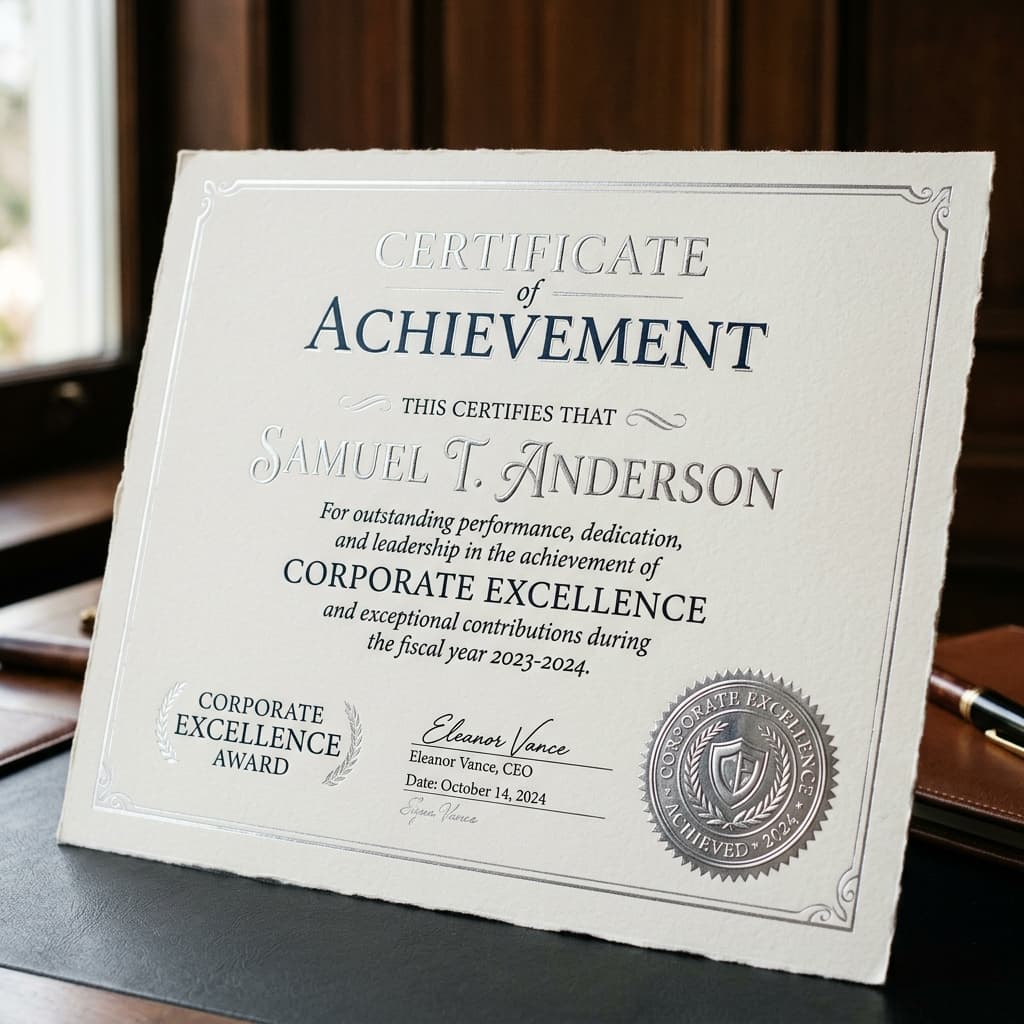
A complete guide to designing, wording, and presenting a Certificate of Achievement for corporate, academic, and personal milestones.
A Certificate of Achievement is a highly versatile and formal document used to acknowledge an individual's hard work, specific accomplishments, or completion of a significant goal. Unlike a generic award, an achievement certificate is usually tied to a measurable metric or a distinct milestone.
The psychological impact of receiving formalized recognition is well documented. According to organizational behavior studies, 82% of employees feel that receiving specific, formal recognition improves their daily job performance. A beautifully designed Certificate of Achievement serves as a tangible reminder of success that motivates future excellence.
This guide explores the many facets of the Certificate of Achievement. We will dissect its core components, provide tailored wording templates for various scenarios, and discuss the best practices for creating a document that recipients will be proud to display.
Key Components of a Certificate of Achievement
While the specific wording will vary depending on the occasion, every Certificate of Achievement must contain a standard set of elements. These elements ensure the document looks professional and conveys all necessary information clearly.
1. The Primary Headline
The headline should be the largest text on the document. While "Certificate of Achievement" is the most common and versatile choice, you can also use variations like "Award of Achievement" or "Certificate of Outstanding Achievement."
2. The Presentation Line
This small line of text bridges the headline to the recipient's name. Standard options include "is hereby presented to," "is proudly awarded to," or simply "awarded to."
3. The Recipient's Full Name
The recipient's name must be prominent, usually centered, and printed in a legible but elegant font. Double-checking the spelling is absolutely critical. A misspelled name transforms a moment of pride into an embarrassing administrative error.
4. The Specific Accomplishment
This is where the certificate becomes personalized. It must state exactly what the recipient achieved. Avoid vague language like "for doing a good job." Instead, use specific metrics, such as "for surpassing the Q4 sales quota by 125%" or "for successfully leading the software migration project."
5. Date of Recognition
The date anchors the achievement in time. It is usually placed near the bottom of the certificate. Depending on the design, you can use a formal date format (e.g., "This 15th day of November, 2024") or a simpler format (e.g., "November 15, 2024").
6. Issuing Organization Details
The name and logo of the company, school, or club issuing the certificate should be clearly visible. This authenticates the award and shows exactly who is recognizing the achievement.
7. Official Signatures
A Certificate of Achievement requires at least one official signature to be considered valid. This is usually the manager, principal, or CEO. Including the printed name and title below the signature line is standard practice.
The Importance of Celebrating Milestones
Why go through the effort of printing and presenting a formal certificate? The answer lies in the human need for validation and the positive culture it creates.
In a corporate environment, celebrating achievements creates a benchmark for success. When a team member receives a Certificate of Achievement for completing a grueling project, it signals to the rest of the team that hard work does not go unnoticed. It fosters healthy competition and drives overall productivity.
In educational settings, these certificates build self-esteem. For a student who has struggled but finally mastered a difficult subject, receiving a formal acknowledgment can be a transformative experience. It reinforces a growth mindset, teaching them that effort leads to tangible rewards.
Corporate Use Cases for Achievement Certificates
The corporate world offers endless opportunities to recognize employee milestones. Here are some of the most effective use cases.
Project Milestones and Completion
Modern business relies heavily on project-based work. When a team successfully launches a new product, completes a merger, or finishes a major client deliverable, issuing a Certificate of Achievement to the core team members is highly appropriate.
Sales and Revenue Targets
Sales departments are naturally metric-driven, making them perfect candidates for achievement certificates. Recognizing milestones like "First $1M in Revenue" or "Highest Client Retention Rate" motivates the sales force to continuously push their limits.
Safety and Compliance Goals
In industries like manufacturing or construction, safety is paramount. Issuing a Certificate of Achievement for reaching "365 Days Without a Workplace Injury" celebrates the collective effort required to maintain a safe environment.
Innovation and Process Improvement
Companies must innovate to survive. When an employee develops a new process that saves the company time or money, that achievement deserves formal recognition. A certificate validating their specific contribution encourages ongoing innovative thinking.
Generate a Certificate of Achievement
Our Certificate of Achievement generator produces a complete, printable document perfect for recognizing outstanding performance and specific milestones.
Create Certificate of AchievementAcademic and Extracurricular Use Cases
Schools, universities, and community organizations rely heavily on certificates to track progress and motivate participants.
Academic Excellence
Certificates are frequently used to recognize students who make the Dean’s List, achieve the highest grade in a specific class, or demonstrate exceptional improvement over a semester. These documents often become cherished additions to a student's academic portfolio.
Extracurricular Mastery
Achievements outside the classroom are equally important. Certificates recognizing a first-place finish in a debate tournament, achieving a new belt rank in martial arts, or completing a rigorous music grading exam provide valuable validation.
Community Service and Volunteering
Organizations that rely on volunteers often use achievement certificates to mark milestones. Recognizing a volunteer for completing "500 Hours of Community Service" is a powerful way to say thank you and encourage continued participation.
Best Practices for Certificate Design
A Certificate of Achievement should look like a formal credential, not a casual flyer. The design must reflect the weight of the accomplishment.
Paper Quality and Texture
The physical feel of the certificate is paramount. Always use a high-quality cardstock or specialty paper, ideally between 65 lb and 110 lb cover weight. Textured paper, such as linen or parchment finishes, adds an immediate sense of prestige.
Typography and Font Selection
Select fonts that convey authority and elegance. The primary headline is often set in a traditional serif font or a highly legible script font. The body text must be clean and easy to read; sans-serif fonts like Helvetica or Arial work well for the descriptive text. Never use more than three different fonts on a single certificate.
Borders and Visual Framing
A classic, ornate border instantly identifies the document as a certificate. While modern, minimalist designs are becoming popular, a traditional filigree or geometric border remains the standard for formal achievements. Ensure the border color complements your organization's logo.
Utilizing High-Resolution Assets
If you include a company logo, a school crest, or a digital seal, it must be completely crisp. Blurry, low-resolution images will instantly degrade the entire design. Vector images (SVG or EPS) are ideal for ensuring perfect clarity when printed.
Wording Templates for Various Achievements
Drafting the specific text can be the hardest part of creating a certificate. Here are several templates to serve as a starting point.
Template 1: Corporate Sales Target
Headline: Certificate of Achievement Presentation: This certificate is proudly awarded to Name: [Employee Name] Description: In recognition of your outstanding performance in surpassing the annual sales target by 120%. Your dedication, strategic thinking, and relentless work ethic have driven unprecedented growth for our division. Date: [Date] Signatures: [VP of Sales] | [CEO]
Template 2: Project Completion
Headline: Award of Achievement Presentation: Presented to Name: [Team Member Name] Description: For your invaluable contribution to the successful launch of [Project Name]. Your technical expertise and commitment to meeting strict deadlines were critical to the project's success. Date: [Date] Signatures: [Project Manager] | [Department Head]
Template 3: Academic Improvement
Headline: Certificate of Achievement Presentation: This certifies that Name: [Student Name] Description: Has demonstrated exceptional dedication and significant academic improvement in [Subject Name] during the 2024 academic year. Your hard work and perseverance are truly commendable. Date: [Date] Signatures: [Teacher Name] | [Principal Name]
Template 4: Safety Milestone
Headline: Certificate of Achievement in Safety Presentation: Awarded to Name: [Department or Team Name] Description: In recognition of achieving the remarkable milestone of 500 consecutive days without a recordable workplace incident. Thank you for prioritizing a safe working environment for everyone. Date: [Date] Signatures: [Safety Director] | [Plant Manager]
Template 5: Volunteer Milestone
Headline: Certificate of Outstanding Achievement Presentation: Presented with deep gratitude to Name: [Volunteer Name] Description: For reaching the incredible milestone of dedicating 1,000 volunteer hours to our organization. Your selfless service has made a profound impact on our community. Date: [Date] Signatures: [Volunteer Coordinator] | [Executive Director]
How to Present a Certificate of Achievement
The way a certificate is presented can be just as impactful as the document itself. A careless presentation diminishes the value of the award.
Make it a Public Event
Whenever possible, present the certificate in front of the recipient's peers. This amplifies the psychological benefits of recognition and provides a positive example for others to follow. A brief ceremony during a weekly team meeting or a school assembly is highly effective.
Provide Context
Don't just hand over the paper and walk away. The person presenting the award should take a moment to explain exactly why the recipient earned it. Detail the specific hurdles they overcame and the tangible impact of their achievement.
Use Protective Enclosures
Never hand a recipient a naked, easily bent piece of paper. Present the certificate in a specialized certificate folder, a padded cover, or a formal frame. This protects the document and signals that it is something worth preserving.
The Shift Towards Digital Achievement Certificates
As the world becomes more digitized, the demand for digital Certificates of Achievement is skyrocketing. Digital versions offer several distinct advantages.
Digital certificates are highly portable and verifiable. Many platforms allow you to issue certificates with unique cryptographic hashes or QR codes. This allows a third party (like a potential employer) to instantly verify the authenticity of the achievement online.
Furthermore, digital certificates are built for the modern professional ecosystem. They can be integrated directly into LinkedIn profiles with a single click. This public, verifiable display of achievements is invaluable for career networking and personal branding.
Frequently Asked Questions (FAQs)
What is the difference between a Certificate of Achievement and a Certificate of Completion?
A Certificate of Completion simply states that an individual finished a program or course (e.g., attending a 2-day seminar). A Certificate of Achievement usually implies a higher level of performance, indicating that the individual not only completed the task but excelled at it or met a specific, rigorous standard.
Should I frame the certificate before presenting it?
Framing is an excellent touch for highly significant milestones (e.g., a 20-year work anniversary). For more routine achievements, a high-quality, heavy-stock presentation folder is usually sufficient and more cost-effective.
Can I issue a Certificate of Achievement to a whole team?
Yes. You can issue a single certificate to "The Q3 Marketing Team." However, best practice suggests printing individual certificates for each team member, acknowledging their specific contribution to the collective achievement.
Do I need a physical signature, or is a digital signature okay?
A physical, wet-ink signature always looks more prestigious and authentic. However, for large organizations issuing hundreds of certificates, a high-quality scanned digital signature is widely accepted and far more practical.
What kind of printer should I use for certificates?
A high-quality laser printer is strongly recommended over an inkjet printer. Laser printers produce crisp, sharp text that won't smudge or bleed, especially if the certificate happens to get slightly damp. If you require metallic foils or raised lettering, you will need to use a professional printing service.
Conclusion
A Certificate of Achievement is a powerful instrument for motivation, validation, and team building. It transforms an abstract "good job" into a permanent, tangible credential.
By understanding the key components, investing in high-quality design, and executing a thoughtful presentation, you can ensure that your certificates truly honor the hard work of the recipients. Whether in a boardroom or a classroom, celebrating success with a formal Certificate of Achievement is an investment that always yields positive returns.
This guide is part of our Certificates service — award, achievement and completion certificates.
Explore CertificatesCertificates & Awards Hub
Explore our suite of print-ready templates in the Certificates & Awards category.
